

Outsourced law firm accounting helps legal practices maintain predictable financial stability. Law firms often face irregular payments and strict financial compliance requirements. Outsourced law firm accounting provides structured systems for managing financial responsibilities. This approach improves cash visibility, billing accuracy, and long-term financial planning.
By utilizing experienced financial professionals, firms can reduce administrative burdens while ensuring accuracy and compliance. It also allows attorneys to focus more on client service and case strategy instead of back-office tasks. Ultimately, outsourced accounting creates a more resilient financial foundation for growing law practices.
What You Will Learn From This Blog
- Learn what outsourced law firm accounting includes and how it extends beyond basic bookkeeping services.
- Understand common financial challenges law firms face that often disrupt predictable cash flow.
- See how outsourcing accounting supports stable finances through consistency, clarity, and structured processes.
- Discover how financial software improves accounting accuracy, reporting, and payment tracking efficiency.
- Learn how to evaluate and select a reliable accounting partner to avoid long-term financial issues.
What Is Outsourced Law Firm Accounting?
Outsourced law firm accounting involves hiring external financial professionals to manage a firm’s accounting tasks in accordance with legal industry requirements. The primary purpose of this approach is to ensure accuracy, compliance, and consistency while reducing the administrative burden on in-house staff and attorneys.
These services typically cover core accounting functions such as billing, trust accounting, payroll management, and financial reporting, all managed through dedicated accounting software for law firm compliance and accuracy.
Each function plays a critical role in maintaining organized financial records, improving cash flow visibility, and supporting informed decision-making within the firm.
Professionals who provide outsourced accounting services possess specialized knowledge of law firm regulations and compliance standards.
This industry-specific expertise helps minimize financial risk, ensures proper handling of client funds, and improves overall compliance accuracy.
Outsourced accounting also offers flexibility and technological advantages. Firms can scale services up or down based on their operational needs, helping control costs. Additionally, outsourced teams use law firm–specific accounting software to maintain accurate, timely, and transparent financial records.
Key Reasons Law Firms Are Transitioning To Outsourced Accounting Models
Limited Internal Resources
Lawyers and legal staff must prioritize client representation, case preparation, and court deadlines, leaving limited time for complex accounting responsibilities.
As a result, essential financial tasks are often delayed or handled inconsistently, increasing the risk of errors and missed deadlines.
Cost Management Needs
Hiring and maintaining full-time, in-house accounting staff significantly increases fixed operational expenses, including salaries, benefits, and training costs.
Outsourced law firm accounting provides predictable pricing models that help firms manage budgets more effectively while accessing specialized expertise.
Accuracy Expectations
Even minor errors in financial records can lead to serious compliance issues, billing disputes, and cash flow disruptions.
Accounting specialists use structured workflows and quality controls to reduce mistakes and ensure financial accuracy.
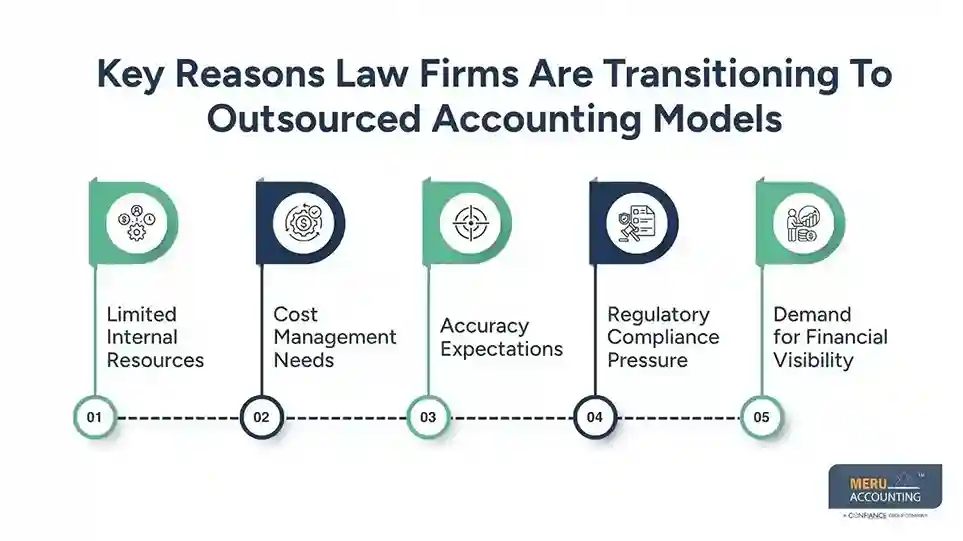
Regulatory Compliance Pressure
Trust accounting regulations require continuous oversight, detailed recordkeeping, and frequent updates to meet legal standards.
External accounting professionals stay current with changing compliance requirements, reducing regulatory risk for law firms.
Demand for Financial Visibility
Law firm partners rely on timely, accurate financial reports to make informed strategic and operational decisions.
Outsourced accounting ensures consistent reporting, clearer financial insights, and improved transparency across the firm.
Common Cash Flow Challenges Faced By Law Firms
Delayed Client Payments
Clients frequently delay payments beyond agreed billing terms due to disputes, oversight, or financial constraints.
These delays disrupt predictable cash inflows and make it difficult for law firms to maintain consistent working capital.
Inefficient Billing Processes
Late or inconsistent invoicing slows the entire payment collection cycle and extends accounts receivable timelines, often due to the lack of reliable accounting software for law firm billing workflows.
As a result, revenue recognition becomes unreliable, creating gaps between work performed and cash received.
Trust Account Mismanagement
Improper handling of trust funds can lead to temporary cash shortages and restricted access to operating capital.
In addition, trust account errors significantly increase compliance risks and expose firms to regulatory penalties.
High Fixed Operating Costs
Law firms incur recurring expenses such as salaries, rent, insurance, and technology costs regardless of income timing.
When revenue is irregular, these fixed obligations place added financial pressure on the firm.
Poor Financial Reporting
Inadequate or delayed financial reporting prevents firms from identifying emerging cash flow problems early.
Without timely insights, issues can escalate before corrective action is taken, impacting overall financial stability.
How Outsourced Law Firm Accounting Helps Maintain Steady Cash Flow
Consistent Billing Practices
Outsourced law firm accounting ensures invoices are generated accurately and issued promptly after services are delivered.
Timely and consistent billing improves client payment behavior, reduces delays, and accelerates cash inflows.
Accurate Cash Tracking
Accounting professionals closely monitor incoming and outgoing funds on a daily basis to maintain complete financial visibility.
This real-time tracking allows firms to always understand their current cash position and respond quickly to potential shortfalls.
Trust Account Oversight
Outsourced accounting teams ensure client trust funds are properly recorded and kept separate from operating accounts at all times.
This clear separation prevents cash misuse, protects client funds, and strengthens regulatory compliance.
Expense Control Measures
Outsourced teams regularly review operational expenses to identify inefficiencies and unnecessary spending.
Early cost detection helps firms control overhead, protect margins, and maintain healthier cash flow.
Cash Flow Forecasting
Future cash needs and expected revenue are projected using accurate financial data and historical trends generated by accounting software for law firm financial forecasting.
This forecasting enables more reliable planning, controlled spending, and informed financial decision-making.
Accounts Receivable Management
Outsourced teams actively track outstanding invoices and follow up on overdue payments.
This structured approach shortens collection cycles and improves overall cash availability.
Financial Reporting Consistency
Regular financial reports provide clear insights into revenue, expenses, and cash movement.
Consistent reporting helps firm leadership identify trends and address issues before they impact cash flow.
Scalable Financial Support
Outsourced accounting services scale with firm growth and workload changes.
This flexibility ensures financial processes remain efficient during expansion or periods of increased demand.
Key Benefits of Outsourcing Accounting for Law Firms
Predictable Financial Operations
Outsourced law firm accounting stabilizes monthly cash movement through consistent billing, tracking, and reconciliation processes. This stability gives firms greater financial confidence and reduces uncertainty in day-to-day operations.
Reduced Administrative Burden
By outsourcing accounting responsibilities, partners avoid time-consuming financial management tasks such as reconciliations, payroll, and compliance reporting.
This allows attorneys and leadership teams to remain focused on client service and case-related work.
Improved Strategic Decisions
Accurate and timely financial reports provide reliable insights into firm performance and profitability. Strategic decisions are made using verified financial data, supporting better business planning and growth initiatives.
Lower Compliance Risk
Professional accounting oversight ensures adherence to trust accounting rules and regulatory requirements. As a result, audit risks decrease significantly, and firms are better protected from compliance-related penalties.
Access to Skilled Professionals
Law firms gain access to experienced accounting specialists with in-depth knowledge of legal industry financial practices. This expertise improves overall financial accuracy, efficiency, and quality.
Cost Efficiency and Scalability
Outsourced accounting services reduce the need for full-time, in-house staff and associated overhead costs. Service levels can be scaled as firm’s needs change, providing financial flexibility.
The Role of Accounting Software for Law Firm Financial Management
Centralized Financial Records
Accounting software for law firm systems organizes all financial data efficiently. This centralization eliminates errors and ensures quick access to critical information.
Efficient Billing and Invoicing
Software automates invoice creation and tracking to speed up collections. Automation minimizes manual work and reduces the risk of missed payments.
Trust Accounting Accuracy
Accounting software for law firm use keeps client funds properly separated. This ensures compliance and builds client trust with transparent records.
Real-Time Expense Monitoring
Software records expenses as they occur, providing immediate insights. Firms gain control over spending and prevent unnecessary cash outflows.
Clear Financial Reporting
Reports generated by software provide detailed insights into profitability and cash flow. Data-driven reporting supports informed decision-making for growth and strategy.
Choosing the Right Outsourced Law Firm Accounting Partner
Legal Accounting Experience
Choose providers with direct law firm accounting expertise. Industry knowledge prevents errors and ensures smooth operations.
Transparent Service Scope
Understand all services included before signing agreements. Clear expectations prevent misunderstandings and future disputes.
Software Compatibility
Partners must be able to work with accounting software for law firm platforms. Technical capability ensures seamless integration with existing systems.
Communication Standards
Regular updates and clear communication are essential. Prompt responses help firms act quickly on financial matters.
Data Protection Practices
Client financial data requires robust security controls. Strong protection safeguards confidentiality and compliance adherence.
How Much Does Outsourced Law Firm Accounting Cost?
Service Complexity
Costs depend on the number and type of accounting tasks required. More comprehensive services typically provide greater long-term value.
Firm Size Considerations
Larger firms need more extensive accounting support. Pricing scales with firm size to match workload requirements.
Transaction Volume
High billing and payment volumes increase accounting workload. Fees reflect the effort required to manage complex transactions.
Software Environment
Existing accounting software for law firm systems may reduce implementation costs. New software setups may involve additional configuration expenses.
Overall Value
Outsourced law firm accounting delivers long-term financial efficiency. Improved cash flow, accuracy, and compliance often outweigh service costs.
Why Choose Meru Accounting For Outsourced Law Firm Accounting
Industry-Specific Expertise
Meru Accounting specializes in managing law firm finances with precision. Our deep understanding of legal regulations ensures accurate compliance and reduces risk.
Cash Flow Focus
Our outsourced law firm accounting services prioritize maintaining steady cash flow. We help firms achieve predictable financial stability and operational confidence.
Skilled Accounting Team
Our professionals handle complex legal accounting tasks efficiently and accurately. Every process is guided by clarity, accuracy, and attention to detail.
Software Proficiency
We are proficient in leading accounting software for law firm systems. Technology integration ensures reliable reporting and seamless financial management.
Scalable Service Model
Our services are flexible and can adapt as your firm grows. This scalability keeps costs controlled while supporting long-term business expansion.
Key Takeaways
- Stable cash flow is essential for maintaining daily operations and long-term continuity in law firms, making careful financial management a necessity.
- Outsourced law firm accounting improves financial control by increasing visibility into cash flow and performance, helping firms gain confidence in their numbers.
- Accounting software for law firm systems enhances accuracy in recordkeeping and reporting, supporting greater financial clarity and reliability.
- Selecting the right accounting partner is critical, as experience and reliability directly influence financial success and compliance.
- Consistent and well-managed accounting practices support long-term financial health, reduce financial stress, and enable sustainable firm growth.
FAQs
Outsourced law firm accounting involves hiring external financial professionals. These professionals manage billing, reporting, and compliance responsibilities.
Outsourced law firm accounting ensures timely invoicing and payment tracking. Better visibility helps firms maintain consistent incoming cash.
Outsourced law firm accounting follows strict trust accounting regulations. Client funds remain properly separated and fully compliant.
Accounting software for law firm systems supports accurate financial management. Outsourced professionals manage software efficiently and correctly.
Small firms gain support without hiring full-time accounting staff. Growing firms achieve better control over cash flow.