Friday is payday. The payroll file says one amount, the bank shows another, and QuickBooks has a balance that does not seem to match either. No one has been overpaid, yet something is clearly off. This is the kind of problem that makes payroll processing services for small business worth looking at beyond the basic task of sending pay.
Payroll sits between people, tax records, bank activity, and the books. One wrong pay rate can affect wages. One missed tax entry can leave an old liability on the balance sheet. One duplicate QuickBooks entry can make expenses look higher than they are. Effective payroll processing services for small business should keep these records tied together from payday through month-end.
What You Will Learn From This Blog
- What payroll processing services for small business actually cover.
- How payroll data moves into QuickBooks.
- Where bookkeeping fits into the payroll cycle.
- How reconciliation can expose errors that are easy to miss.
- What to compare when reviewing small business payroll services.
- Which questions can reveal gaps in a provider’s process.
- How Meru Accounting approaches payroll, bookkeeping, and reconciliation.
What are Payroll Processing Services for Small Businesses?
Payroll Calculation
Take a small firm with 15 employees. Some are salaried, some are paid by the hour, and two worked overtime this month. Add a bonus and a few deductions, and payroll is no longer one simple calculation. Payroll processing services for small businesses bring these pay items into a set process before the final amount reaches employees.
Tax Withholding
An employee’s gross wage is not the same as the amount that reaches their bank account. Federal, state, and other required deductions can change the final pay. Small business payroll services need the right worker data and current tax rules to work out these amounts.
Employee Records
Payroll depends on basic facts about each worker. Pay rate, filing details, benefits, deductions, and payment information all matter. If an employee’s pay rate changes from $25 to $28 an hour, that change needs to reach the payroll file before the next run.
Pay Statements
A pay statement gives employees a way to see how their pay was reached. It can show gross wages, tax withheld, deductions, and net pay. This also gives the employer a record to refer to when a worker asks why their take-home pay changed.
Tax Filing
Not every provider offers the same tax service. Some payroll processing services for small business calculate payroll but leave tax filing to the employer. Others include tax forms and payments. This difference should be settled before work begins.
What Do Payroll Processing Services for Small Business Include?
Employee Setup
Payroll problems often start before the first pay run. A new employee may have the wrong pay rate, an incorrect deduction, or missing tax details. A proper setup review can catch these issues before they turn into a payroll correction.
Time and Attendance
For hourly workers, approved time data is the starting point for small business payroll services. Imagine an employee worked 82 hours, but the payroll file shows 80. That two-hour gap can change gross pay, taxes, and the final bank payment.
Deductions and Benefits
Health plans, retirement contributions, wage deductions, and other items can change the final paycheck. The amounts also need to reach the correct accounts in the books.
Payroll Reports
A payroll report should answer more than “How much did we pay?” It can show wages, taxes, deductions, employer costs, and liabilities. These figures become useful when the bookkeeper checks the accounting file.
Payroll Tax Records
Payroll processing services for small businesses may also track amounts due to tax agencies. These records can then be compared with actual payments so an unpaid balance does not sit unnoticed.
How Payroll Processing Services Work With QuickBooks
Payroll Data
Consider a business that runs payroll for $50,000 but sees $53,000 of wage expense in QuickBooks. The payroll may be correct, yet the books are not. That difference needs to be traced rather than ignored.
Chart of Accounts
QuickBooks needs to know where payroll costs belong. Wages, employer taxes, benefits, and payroll liabilities may use different accounts. The setup should match the way the business wants to view its financial reports.
Journal Entries
A payroll run creates several accounting effects at once. Wages become an expense, deductions create liabilities, and the payment reduces cash. Payroll processing services for small businesses should account for these movements rather than treating payroll as only a payment.
Bank Matching
After payday, the bank transaction becomes another checkpoint. If the payroll report shows $46,800 and the bank shows $47,050, the difference needs an explanation before the books are closed.
QuickBooks Review
QuickBooks can record payroll data, but software does not replace review. Payroll processing services for small business should include checks on the entries so a correct payroll run does not turn into an incorrect accounting record.
Why Bookkeeping Matters for Small Business Payroll
Wage Expenses
Suppose payroll for March is processed on March 31, but the bank payment clears on April 1. The accounting treatment still needs to reflect the correct period. This is one reason payroll and bookkeeping cannot be treated as unrelated tasks.
Cash Flow
A business owner using small business payroll services should know not only the amount employees receive but also the tax, benefit, and other payroll amounts that may leave the bank.
Month-End Close
Month-end is where payroll figures meet the rest of the accounts. The bookkeeper can compare payroll reports with the general ledger and investigate differences before the monthly figures are final.
Tax Records
Payroll data can also flow into tax work. Records should show what was earned, withheld, paid, and still owed. Missing detail can make later review harder.
Account Review
This is where payroll processing services for small business can add value beyond the pay run. When payroll and bookkeeping are linked, a difference found in the books can be traced back to the related payroll report.
How Payroll Reconciliation Keeps Records Accurate
Compare Payroll Totals
Start with the payroll register from payroll processing services for small business and compare it with the ledger. Check gross wages, employee deductions, employer taxes, and net pay. If one figure differs, find the reason before moving on.
Check Bank Payments
The bank statement gives a separate view of what actually left the account. A payroll report and bank payment should connect, even when the dates differ because of processing time.
Review Tax Balances
Tax liabilities can remain open until payment is made. If a liability from two months ago is still sitting on the balance sheet, check whether the payment was missed, posted elsewhere, or already made but not cleared.
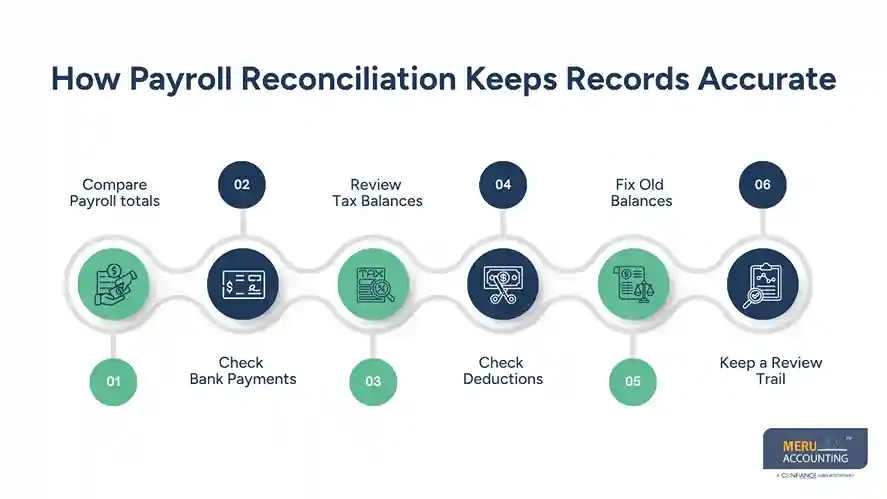
Check Deductions
Deductions deserve their own review. A retirement contribution that is correct on the payroll report but missing from the ledger can leave both payroll and accounting records out of line.
Fix Old Balances
Old balances are often clues. Rather than simply clearing a $600 payroll liability, find out why it remained there. The cause could be a duplicate entry, an unposted payment, or an incorrect payroll posting.
Keep a Review Trail
Payroll processing services for small businesses should make corrections traceable. If an entry changes, the business should be able to see what was changed and why.
optional anymore
on running the business
How to Choose the Right Small Business Payroll Services
Check the Full Scope
Two small business payroll services can have very different scopes even when their prices look similar. One may only process wages, while another may include tax work, payroll reports, bookkeeping entries, and reconciliation.
Check QuickBooks Skills
If your business uses QuickBooks, ask to see how payroll will connect with the existing books. You do not want payroll entries creating a second set of records that someone has to clean up later.
Check Tax Duties
Ask who owns each tax task. Who checks the tax amount? Who files the return? Who makes the payment? Who follows up if a filing is rejected? A written answer is better than an assumption.
Check Review Controls
Ask what happens between “payroll prepared” and “payroll approved.” Does someone review hours, rates, deductions, and totals? A simple approval step can catch an error while it is still easy to fix.
Check Communication
Small business payroll services should have a clear way to handle changes. If an employee submits a corrected timesheet one hour before payroll closes, you should know who receives it and what happens next.
Check Future Needs
A five-person firm may not stay a five-person firm. New workers, bonuses, benefits, different pay cycles, or another state can change payroll needs. Ask how the provider handles those changes before they happen.
Questions to Ask Before Hiring Payroll Processing Services for Small Business
What does the fee cover?
Do not stop at the quoted monthly price. Ask whether the fee includes payroll runs, tax work, reports, employee setup, bookkeeping entries, and reconciliation. Also ask what counts as an extra charge.
Who handles tax filing?
This is one of the most important questions. A provider may calculate the tax but expect the employer to submit the payment. Another provider may handle both. The agreement should state the exact role.
How does QuickBooks work?
Ask how payroll reaches QuickBooks. Will entries be posted automatically? Will a bookkeeper review them? How are duplicate entries avoided? These details matter when payroll is part of the monthly close.
How are mistakes fixed?
Ask for a real example. What happens if an employee is paid too much? What if the wrong tax amount is posted? What if payroll has already been closed? The answer tells you more about the service than a list of features.
How is reconciliation done?
Ask what gets compared and how often. Payroll processing services for small business should have a clear method for checking payroll reports against the ledger, bank activity, and outstanding liabilities.
Can the service scale?
Ask how the provider handles new employees, new pay types, benefits, or new locations. The aim is not to plan for every possible change but to know whether the payroll setup can handle normal business needs.
Why Choose Meru Accounting for Payroll Processing Services for Small Businesses
Meru Accounting provides payroll processing services for small businesses, such as pay math, payroll dues, time sheets, tax pay, and payroll tax forms.
Meru Accounting works with QuickBooks, Xero, NetSuite, Sage, MYOB, and Odoo, so payroll data can fit the accounting system used by the firm.
Its bookkeeping services cover bank and card checks, payroll book entries, and reconciliation of key books and data.
Using payroll, bookkeeping, and bank checks as one set can keep pay data, book entries, bank deals, and payroll dues in line.
Firms can judge the service based on staff count, pay cycle, book tool, report needs, and payroll needs.
Before they pick small business payroll services, firms should check what is in the plan, who files tax forms, how bank checks are done, what reports are sent, how errors are fixed, and the time set for each task.
Our Expert Perspective
One point is easy to miss when comparing payroll processing services for small businesses: payroll accuracy and accounting accuracy are not the same thing.
A company can pay every employee the right amount and still have incorrect books.
For example, assume a firm processes $40,000 in wages. The payroll report is correct. Employees receive the right amount. But the QuickBooks file contains a duplicate $40,000 payroll entry. The bank account may still reconcile because the duplicate entry was posted as an accounting transaction rather than another bank payment.
The payroll was right. The books were wrong.
This is why payroll needs a second view after the pay run. The payroll register, general ledger, bank activity, and liability accounts should be checked against one another. That extra step can reveal issues that are not visible from the payroll screen alone.
Key Takeaways
- Payroll processing services for small businesses should cover the full pay cycle, not just staff pay.
- Payroll data needs to link with QuickBooks and the main ledger.
- Bookkeeping puts payroll data in the full set of books.
- Reconciliation can find double entries, missed pay, and old tax dues.
- Small business payroll services can vary a lot in scope, even when fees look much the same.
- Ask who will file and pay tax forms before you sign a deal.
- Ask how QuickBooks entries are made and checked.
- Find out how payroll errors are fixed.
- Check payroll with bank and book data on a set basis.
- Pick a service based on the work it will do, not just the price shown.
FAQs
Compare payroll accuracy, QuickBooks integration, tax filing, bookkeeping, reconciliation, support, security, and pricing before choosing a provider.
Payroll processing services for small business should include payroll calculation, tax withholding, employee payments, payroll reports, tax filing, and payroll record management.
Yes, payroll processing services for small business can connect payroll data with QuickBooks to record wages, deductions, taxes, and payroll liabilities.
Payroll reconciliation checks payroll data against QuickBooks, bank transactions, and liability accounts to identify errors or unmatched amounts.
Ask about QuickBooks integration, tax filing, reconciliation, error correction, payroll reports, turnaround time, data security, and total service cost.
optional anymore
on running the business