
Real estate firms manage rent inflows, repair costs, staff payments, loan duties, and tax duties across many assets. Without proper planning, money gaps appear even when properties look profitable on paper. Real estate budgeting and forecasting services play a key role in stabilizing cash flow planning across these operations.
Modern property firms depend on structured financial planning to avoid missed payments, delayed vendor settlements, and sudden funding pressure. Clear visibility of expected income and planned spending across each property unit helps firms maintain steady cash flow throughout the year.
What You Will Learn From This Blog
- How property firms manage cash flow using structured planning methods
- Why real estate budgeting and forecasting services are important for stable financial control
- Common cash flow problems in property operations
- How financial forecasting reduces risk in property investment decisions
- How outsourcing partners and real estate outsourcing companies assist firms in financial planning
- How Meru Accounting supports property firms in financial control and reporting
Introduction to Real Estate Budgeting and Forecasting
Understanding Financial Planning In Property Firms
Real estate budgeting and forecasting services focus on planning income and expenses before they occur. This includes rent collection estimates, maintenance costs, loan payments, and tax obligations. Property firms use this structure to avoid sudden financial stress.
Role Of Income And Expense Planning
Each property earns income at different times, and expenses can be unpredictable. Aligning cash inflows with planned expenses prevents financial gaps.
Link Between Budgeting And Financial Stability
Overestimating income or underestimating costs can cause instability. Careful planning ensures firms maintain balanced finances.
Use Of Historical Financial Data
Past rent records, repair costs, and occupancy rates guide future planning. Historical insights improve accuracy in financial decisions.
Importance in Multi-Property Management
Large property firms manage several units at once. Real estate budgeting and forecasting services help combine all property data into one system for easier financial control.
Importance of Real Estate Budgeting and Forecasting In Property Firms
Better Control Over Cash Movement
Cash inflows and outflows become easier to track when property finances are planned properly. Clear visibility reduces confusion in daily financial decisions.
Improved Rent Collection Planning
Rent delays are common in property management and can affect liquidity. Firms can prepare backup strategies to handle delayed payments smoothly.
Structured Expense Management
Maintenance, repairs, and service contracts are planned in advance using real estate budgeting and forecasting services. Spending stays within defined limits, preventing unnecessary financial pressure.
Strong Financial Reporting Accuracy
Financial reports become more reliable when based on planned data rather than assumptions. Accurate reporting improves clarity in performance evaluation.
Support For Growth Planning
Firms planning expansion can assess financial readiness before investing in new properties. Careful planning reduces risk in long-term growth decisions.
How Real Estate Budgeting and Forecasting Enhance Cash Flow Management
Predictable Cash Flow Patterns and Better Control Over Cash Flow
Monthly inflows and outflows become easier to anticipate with proper financial planning. Stable and well-structured cash movement helps firms maintain full control over property finances and manage daily operations efficiently with fewer uncertainties.
Reduction in Payment Delays
Planning expenses ahead helps avoid last-minute funding issues that can delay payments. Firms can meet their obligations on time without financial stress.
Better Handling of Vacancy Periods
Vacant units reduce income, creating pressure on cash flow. Maintaining reserve funds ensures that operations continue smoothly during downtime.
Improved Debt and Loan Management
Loan repayments are managed efficiently using real estate budgeting and forecasting services. Proper allocation of funds ensures timely debt servicing while reducing the need for emergency borrowing and maintaining financial stability.
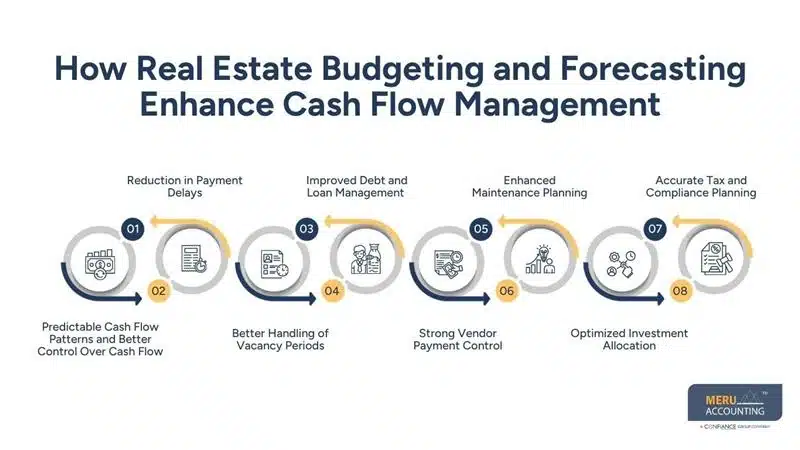
Strong Vendor Payment Control
Contractors and service providers receive payments promptly when financial plans are followed. Timely payments strengthen vendor relationships and operational reliability.
Enhanced Maintenance Planning
Scheduling repairs and upkeep in advance reduces unexpected costs. Maintenance budgets created through forecasting ensure smoother operations.
Optimized Investment Allocation
Funds can be directed toward high-performing properties or new acquisitions based on cash availability. Forecasting provides clarity on where investments are financially safe.
Accurate Tax and Compliance Planning
Anticipating tax obligations helps firms set aside sufficient funds. Proper planning reduces the risk of penalties and late fees while ensuring compliance.
Common Cash Flow Challenges Faced by Property Firms
Irregular Rent Payments
Many tenants delay rent payments, causing uneven cash flow across properties. Partnering with real estate outsourcing companies helps firms track and anticipate irregular rent payments efficiently.
High Maintenance Costs
Unexpected repairs increase financial pressure for property firms significantly. Real estate budgeting and forecasting services manage repair costs efficiently.
Vacancy Loss Pressure
Empty properties reduce rental income, straining overall cash flow. Maintaining reserve funds helps firms handle vacancies without financial issues.
Poor Expense Tracking
Untracked spending often creates gaps in the firm’s financial planning. Structured accounting processes improve transparency and prevent excessive expenditures.
Weak Financial Visibility
Firms cannot see future cash positions without proper financial systems. Accurate records provide clarity for operational and investment decision-making.
Role of Real Estate Budgeting and Forecasting in Reducing Financial Risks
Early Risk Detection
Financial shortfalls can be identified before they become serious problems. Real estate outsourcing companies help detect risks early, allowing firms to take timely action and minimize losses.
Protection Against Cash Shortages
Planning ahead helps firms avoid situations where payments cannot be met. Adequate cash management ensures obligations are covered without last-minute stress.
Stability During Market Changes
Property markets fluctuate due to shifts in demand and supply. Preparedness allows firms to maintain operations smoothly during market changes.
Better Investment Safety Checks
Before buying new property, firms evaluate potential financial impacts carefully. Thorough analysis reduces risk and ensures safer investment decisions overall.
Reduced Dependency On Emergency Loans
Proper financial planning lowers the need for urgent borrowing or loans. Real estate outsourcing companies help firms maintain operational stability without relying on emergency funding.
Benefits of Accurate Financial Forecasting For Property Investment Decisions
Smarter Investment Choices
Data-driven insights provided through real estate outsourcing companies allow firms to select properties with higher potential. Informed decisions reduce mistakes and improve overall investment planning efficiency.
Better ROI Planning
Return on investment becomes easier to project with careful financial analysis. Firms can plan spending to achieve higher returns on property investments.
Long-Term Financial Visibility
Real estate budgeting and forecasting services help firms see investment performance. Future financial trends become clearer, supporting more confident long-term decisions.
Reduced Investment Risk
Structured planning reduces the chances of making poor property investment choices. Firms avoid losses by analyzing all potential risks before committing funds.
Improved Portfolio Balance
Balancing high and low-income properties strengthens overall portfolio stability. Diversification ensures consistent cash flow across multiple property investments.
How Real Estate Outsourcing Companies Support Budgeting and Forecasting Services
Access To Skilled Financial Experts
Outsourcing firms provide experienced accountants to manage complex financial tasks efficiently. Professional expertise ensures accurate reporting and effective financial planning for firms.
Cost-Effective Financial Management
Outsourcing reduces the need for maintaining large in-house finance teams. Firms save costs while maintaining high-quality financial management support.
Better Use Of Accounting Tools
Many real estate outsourcing companies use real estate budgeting and forecasting services.
Advanced software improves accuracy and speeds up financial reporting processes.
Faster Report Generation
Reports are prepared quickly by outsourcing partners, allowing timely decisions. Speedy reporting enhances operational efficiency and improves strategic planning capabilities.
Scalable Financial Support
Services expand or contract according to firm growth and changing requirements. Flexible support ensures financial management keeps pace with business development.
Meru Accounting’s Role in Real Estate Financial Management
Meru Accounting provides structured financial support to property firms across global markets. Our team focuses on accurate planning and reporting for real estate clients managing multiple assets.
We offer real estate budgeting and forecasting services designed to improve cash clarity and reduce financial pressure. Our experts collaborate with real estate outsourcing company models to deliver cost-efficient financial solutions for property firms.
Our services include:
- Property income tracking and reporting
- Expense classification and analysis
- Cash flow forecasting for rental portfolios
- Budget creation for multi-property firms
- Financial review for investment planning
By working with Meru Accounting, property firms receive structured accounting and bookkeeping support that strengthens cash position tracking and improves clarity in future financial planning.
Key Takeaways
- Cash flow issues in property firms often come from weak planning
- Real estate budgeting and forecasting services create structured income and expense control
- Forecasting reduces risk in investment and daily operations
- Outsourcing partners bring efficiency and cost control
- Proper planning leads to more stable financial decisions
FAQs
Financial planning services used by property firms to estimate rent income, plan expenses, and manage future cash flow across properties.
Structured income and expense planning that reduces cash gaps and ensures steady fund availability for property operations.
Clear visibility of future income and expenses helps investors avoid shortages and plan property-related payments smoothly.
Issues like delayed rent, unexpected repair costs, vacancy losses, and weak expense control are reduced through planned financial tracking.
Professional accounting teams manage budgets, forecasts, and reports using structured tools for accurate financial control in property firms.