
Real estate financial analysis is a core method used by property developers to understand project costs, revenue potential, and final profit outcomes before and during construction. In today’s market, this process is not just a reporting tool but a planning base that guides better financial choices.
Property development projects involve land cost, approvals, labor, materials, and market risk. Without structured review, small errors can grow into major losses. This is where structured financial analysis and budgeting play a key role, helping developers track cost flow and plan funds with clarity.
When developers apply a structured financial review at each stage, they reduce uncertainty and gain clearer control over project direction.
What You Will Learn From This Blog
- How developers use real estate financial analysis to plan profitable projects
- Why is cost control tied to financial analysis and budgeting
- Key parts that shape the project’s financial structure
- How risk can be identified early using structured review
- Ways to improve profit margins with data-based decisions
- How Meru Accounting supports property developers in financial control
Understanding The Role Of Real Estate Financial Analysis In Development Projects
Real estate financial analysis plays an important role in development projects by helping developers break down total project costs into clear components such as land, materials, labor, permits, and financing.
This structured view reduces the chance of missing key expenses and keeps planning more organized. It also allows developers to estimate expected sales or rental income based on market data, helping them understand profit potential before construction begins.
Along with cost and revenue planning, financial analysis and budgeting support better investment decisions by helping investors compare multiple projects and choose those with more stable returns. t also allows developers to evaluate project performance against market benchmarks, which leads to more realistic pricing and better alignment with market conditions.
At the same time, cash flow planning ensures that the inflow and outflow of funds are monitored throughout the construction process. This reduces payment delays, improves fund control, and supports smoother execution from start to finish.
How Real Estate Financial Analysis Improves Property Development Decision-Making
Early Project Evaluation
Before land purchase or design approval, real estate financial analysis gives a clear picture of profit potential and risk level. Early insights allow developers to filter out weak opportunities and focus on viable projects with stronger returns.
Cost Decision Control
Developers can decide where to spend more and where to reduce costs using financial analysis and budgeting, avoiding unnecessary spending. Better allocation of resources keeps overall project spending aligned with planned limits.
Funding Strategy Selection
Loan mix, investor funds, and internal capital are planned in a structured way, ensuring financial stability. Balanced funding structures reduce pressure on cash reserves and support smoother project execution.
Project Timeline Planning
Time delays increase cost. Financial review links time with cost impact, helping developers plan realistic schedules. Clear time-cost mapping reduces the chance of budget overruns caused by delays.
Profit Target Setting
Clear profit goals are set based on a detailed financial review, making project targets measurable and realistic. Defined targets give developers a clear benchmark to measure financial success throughout the project cycle.
Why Financial Analysis and Budgeting are Critical In Real Estate Projects
Budget Accuracy
Financial analysis and budgeting ensure every cost is estimated before execution starts, reducing surprise expenses. Real estate financial analysis also validates assumptions using historical data and market benchmarks to improve accuracy.
Cost Control Discipline
Strong monitoring of expenses allows developers to detect overspending early and take corrective action before profit is affected. Comparing planned costs against actual spending at each stage strengthens this control and keeps the project financially on track.
Resource Allocation
Funds are distributed properly across construction stages using structured planning methods. Capital is assigned based on project priority and operational need, ensuring smoother execution without unnecessary financial pressure.
Financial Stability
Cash flow pressure during slow sales periods or construction delays is reduced through structured planning. Buffer strategies are also created to manage unexpected financial gaps and maintain steady operations.
Investor Confidence
Clear financial reporting increases trust among investors and funding partners. Transparent reporting makes project performance easier to review and verify, improving confidence in financial decisions.
Risk Management
Structured financial planning helps identify potential financial, market, and operational risks before they escalate. This allows developers to prepare mitigation strategies in advance and maintain better control over project outcomes.
What are the Key Components of Real Estate Financial Analysis?
Land Acquisition Cost
The base cost of land is analyzed using real estate financial analysis to determine project viability. Location strength, legal status, and future growth potential are also reviewed before final land selection.
Construction Cost Planning
Material and labor costs are reviewed to avoid overruns. Vendor pricing, supply chain variation, and site conditions are also considered during cost estimation.
Revenue Projection Models
Sales pricing and rental income are estimated using market trends and demand data. Income forecasts help developers understand expected returns before construction begins.
Loan And Interest Planning
Financing costs are calculated by considering loan structure, interest rates, and repayment timelines. Clear calculation ensures better understanding of total project cost and financial exposure.
Profit Margin Estimation
The final expected profit is calculated before project approval based on total cost and projected revenue. Clear margin review helps developers decide whether a project is financially viable before moving ahead.
How Financial Analysis And Budgeting Support Project Planning and Execution
Stage Wise Planning
Each phase of construction is linked with structured financial control to maintain cost discipline. Clear phase planning also reduces the chances of budget drift during execution.
Supplier Cost Management
Vendor contracts are reviewed carefully to avoid overpricing and hidden charges. Strong negotiation and review practices also help maintain fair procurement costs.
Cash Flow Scheduling
Payment schedules are aligned using financial analysis and budgeting to avoid cash gaps. Proper timing of inflows and outflows also ensures smooth construction progress without financial interruptions.
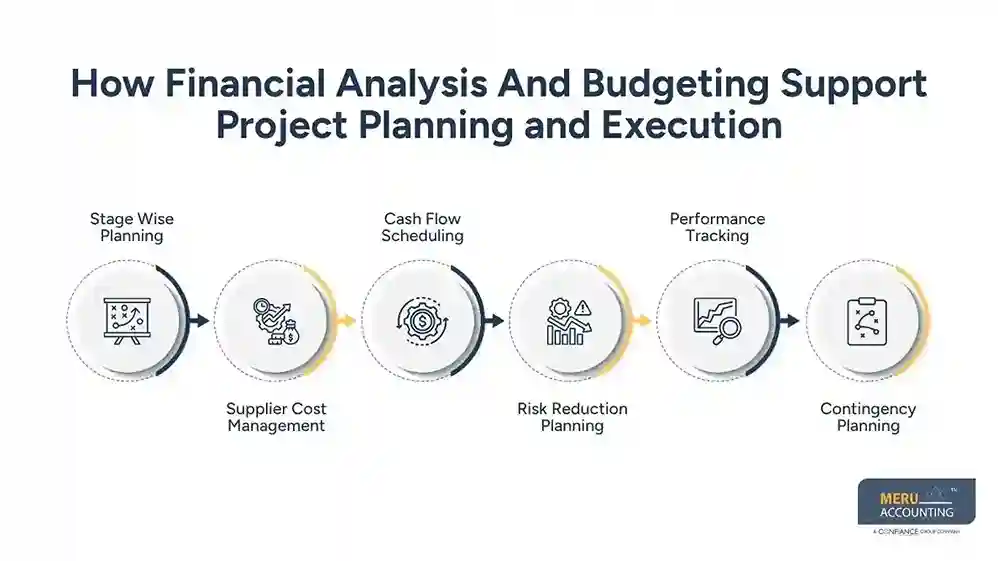
Risk Reduction Planning
Potential risks are identified early through a structured financial review. Early identification also allows developers to take corrective action before risks affect project cost or timeline.
Performance Tracking
Project progress is measured against approved budgets for better control. Regular tracking also highlights deviations early for timely correction.
Contingency Planning
Structured financial planning allows developers to set aside contingency funds for unexpected costs or delays. This ensures that unforeseen issues do not disrupt overall project execution or financial stability.
How to Evaluate Project Risk Using Real Estate Financial Analysis
Market Demand Risk
Real estate financial analysis checks if demand exists for the project location and type. Demand strength is also compared with similar nearby developments to assess sales potential.
Cost Overrun Risk
Construction cost risk is managed through structured planning and continuous monitoring. Regular comparison of planned vs actual expenses helps identify issues early and control overspending.
Sales Delay Risk
Slow property sales are predicted using market trends and demand patterns. Pricing strategy and buyer behavior are also reviewed to estimate absorption speed more accurately.
Interest Rate Risk
Loan cost changes are included in financial analysis and budgeting planning models. Future rate fluctuations are also considered to understand long-term financial exposure.
Regulatory Risk
Approval delays and policy changes are reviewed through structured financial evaluation. Compliance requirements and zoning updates are also monitored to reduce legal and planning disruptions.
Construction Delay Risk
Project timelines are assessed to identify possible delays caused by labor shortages, supply chain disruptions, or site-related issues. Early identification helps developers adjust schedules and reduce the impact on overall project cost and delivery.
How Real Estate Developers Can Improve Profit Margins Using Data-Driven Analysis
Cost Optimization Strategy
Using real estate financial analysis, developers can reduce unnecessary construction spending. Continuous cost monitoring also helps identify areas where savings can be achieved without affecting quality.
Better Pricing Strategy
Property pricing is set based on market comparison and demand patterns. Competitive analysis ensures alignment with buyer expectations and local market conditions.
Efficient Resource Use
Material and labor use is planned in a structured way to reduce delays and improve output. Better planning also reduces idle time and improves overall project efficiency.
Reduced Financial Waste
Strong controls prevent misuse of funds during project execution. Regular tracking systems also help detect unnecessary expenses at an early stage.
Faster Decision Making
Clear financial reports allow quick project decisions. Timely insights also support faster response to market changes and project adjustments.
Why Choose Meru Accounting?
At Meru Accounting, we work closely with developers to maintain structured financial records and improve project clarity. Our team provides detailed project reporting, cost tracking, and cash flow monitoring aligned with industry standards.
We assist clients in building accurate project budgets using structured financial planning methods, ensuring every stage of development is financially recorded and reviewed.
Our services include:
- Project cost tracking systems aligned with real estate financial analysis
- Budget planning using structured financial analysis and budgeting
- Monthly financial reporting for property developers
- Cash flow review for construction and sales cycles
- Support for multi-location real estate portfolios
With organized reporting and clear financial mapping, developers can reduce confusion and maintain better control over long-term project performance.
Our Expert Perspective
From our expert perspective, real estate developers often face profitability challenges not because of weak demand, but due to unclear cost visibility and fragmented financial tracking during project execution.
A structured real estate financial analysis combined with disciplined financial analysis and budgeting helps bring clarity to cost behavior, funding needs, and expected returns. This enables more confident decision-making and stronger control over project profitability throughout the development cycle.
Key Takeaways
- Real estate financial analysis is essential for project planning and profit control
- Strong financial analysis and budgeting reduce cost leakage
- Risk detection becomes easier with a structured financial review
- Developers can improve profit margins using data-based planning
- Clear financial systems increase investor trust and project stability
FAQs
Real estate financial analysis is the process of evaluating project costs, income, and profit potential before and during property development to guide better financial decisions.
Project profitability improves by controlling costs, improving pricing decisions, and reducing financial waste across the project cycle.
Financial analysis and budgeting are important because it ensures proper cost planning, cash flow control, and prevent overspending during construction and development.
Property developers estimate land cost, construction expenses, and expected returns before starting a real estate project.
Yes, real estate financial analysis reduces investment risk by identifying cost issues, funding gaps, and market risks early in the development process.