
- Our experts are always all ears to listen to your queries regarding bookkeeping and accounting or our services. You can contact us anytime by visiting: Contact Us page.
Bookkeeping for Restaurants Built for Growing Restaurant Businesses
Hire Remote Bookkeeper, Accountant, Tax Preparer, or Admin Staff
Monthly Bookkeeping, Payroll, Financial Reports, and Tax Help for Restaurant Owners
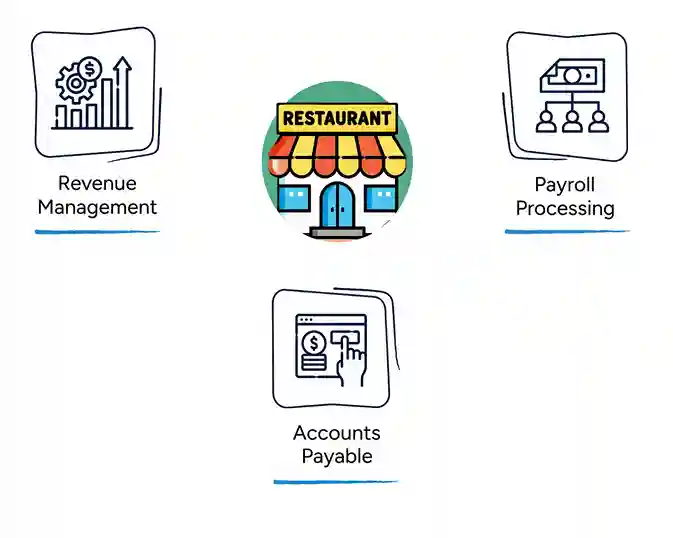
Bookkeeping for Restaurants
A restaurant handles hundreds of transactions each day, from food sales and orders to payroll, vendor bills, and card fees. Keeping these records in order helps owners know if the business makes a profit. Bookkeeping for restaurants puts sales, costs, payroll, inventory purchases, and bank data into one clear record. Restaurants also face tight margins, food price changes, tips, waste, refunds, deals, and delivery fees. Without clean books, it can be hard to see if higher sales lead to more profit.
Good bookkeeping services for restaurants help owners track sales, match POS data, check costs, and keep clear financial reports. Owners keep food and labor costs in check. Monthly reports can show gross margin, prime cost, sales trends, and cash flow. Owners can use these reports to set menu prices, plan staff hours, work with vendors, and plan new sites. With clean books, owners spend less time on data entry and more time on day-to-day work.
Trusted by restaurant owners, Meru Accounting makes bookkeeping for restaurants organized and easier to manage. We handle daily bookkeeping, reconciliations, expense tracking, payroll records, and financial reporting so you can focus on your customers and restaurant growth.
Key Aspects of Bookkeeping for Restaurants
Bookkeeping for restaurants goes beyond recording sales and expenses. It connects daily transactions with food costs, labor, inventory, vendor bills, and cash flow. Accurate bookkeeping for restaurants gives owners a clear view of how much the restaurant earns, where money is being spent, and which costs are affecting margins.
Daily Sales Reconciliation
Restaurants may receive payments through cash, credit cards, online ordering systems, POS terminals, and delivery platforms. These sales should be matched with deposits and accounting records. Daily reconciliation helps identify missing transactions, incorrect refunds, payment differences, and processing fees.
Food and Beverage Cost Tracking
Food and beverage costs can quickly reduce restaurant margins when prices rise or inventory is wasted. Record purchases by category and compare them with sales and usage. Regular cost tracking helps identify expensive ingredients, unusual changes, and areas where purchasing can be improved.
Inventory and Waste Monitoring
Inventory records should cover ingredients, beverages, packaging, and other stock used by the restaurant. Track purchases, usage, spoilage, and waste to understand what is actually being consumed. Clear records help owners reduce unnecessary purchases and protect margins.
Payroll and Labor Cost Accounting
Labor is one of the largest expenses for many restaurants. Track wages, overtime, payroll taxes, tips, benefits, and other employee costs accurately. Reviewing labor costs against sales helps owners understand staffing efficiency and manage schedules more effectively.
Vendor Invoice and Payment Management
Restaurants work with food distributors, beverage suppliers, cleaning companies, equipment vendors, and other service providers. Record invoices as they arrive and match them with payments. This helps identify duplicate payments, missed bills, and unexplained vendor balances.
Tax Preparation and Deduction Tracking
Bookkeeping services for restaurants organize income and expense records needed for tax preparation. Maintain supporting records for supplies, equipment, repairs, utilities, and other operating costs. Well-kept documentation helps support accurate financial reporting and makes tax preparation more organized.
Bank, Credit Card, and POS Reconciliation
Restaurant books should agree with bank statements, credit card activity, and POS reports. Reconcile these accounts regularly to identify errors and unexplained differences. Accurate reconciliation keeps financial statements dependable and helps catch problems early.
Cash Flow Management
A restaurant can have strong sales and still face cash pressure because of payroll, supplier payments, rent, taxes, and equipment costs. Monitor expected inflows and upcoming obligations to understand available cash. Cash flow reporting helps owners plan payroll, supplier payments, rent, and other operating expenses with more accurate financial information.
How Bookkeeping for Restaurants Help
Restaurant Owners
Bookkeeping services for restaurants give owners a reliable financial system for managing the many transactions that happen every day. Instead of relying only on sales totals, owners can review profitability, costs, cash flow, and financial trends.
Restaurant Transaction Tracking
Our bookkeeping for restaurants organizes sales, deposits, purchases, payroll, vendor invoices, fees, and operating expenses. Transactions are categorized consistently so financial reports reflect what is really happening in the business. Regular updates make it easier to find unusual activity and keep records current.
Profitability Reports
Our bookkeeping services for restaurants help prepare reports that show revenue, operating expenses, gross profit, labor costs, and cash flow. Owners can review revenue, gross profit, operating expenses, labor costs, and cash flow across reporting periods to evaluate financial performance and identify cost trends.
Food Cost and Margin Visibility
Restaurant profitability depends heavily on how well food and beverage costs are controlled. We organize expense data so owners can review purchasing trends and changes in margins. This gives management useful information when reviewing suppliers, menu prices, and operating costs.
Reduce Administrative Work
Daily bookkeeping can take restaurant owners away from customers, staff, and operations. Outsourcing routine accounting work reduces the time spent entering transactions, matching payments, and preparing reports. Owners get more time to manage the restaurant itself.
Better Cash Management
Bookkeeping for restaurants helps owners understand when money is coming in and when major payments are due. Tracking payroll, supplier invoices, rent, taxes, and other obligations gives a clearer view of available cash. This supports better spending and payment decisions.
Reports for Owners and Managers
Restaurant owners and managers need financial information they can understand quickly. Organized reports can show sales, expenses, labor costs, food costs, and cash flow without requiring them to sort through raw transactions. Clear reporting makes financial reviews more useful.
Types of Businesses in the Restaurant Industry
Restaurants operate in many formats, and each model has different sales channels, cost patterns, and bookkeeping needs. Good bookkeeping for restaurants should account for the way each business earns revenue and manages expenses. At Meru Accounting, our bookkeeping services for restaurants can support different restaurant models. We serve:
Standard Restaurants
Standard restaurants manage dining room sales, servers, kitchen staff, tips, food purchases, and customer payments. Bookkeeping should separate sales, tips, payroll, food costs, and operating expenses. Clear financial records help owners understand margins and manage labor and purchasing costs.
Quick-Service Restaurants
Quick-service restaurants often process a high volume of smaller transactions through POS systems and digital payment channels. Track sales, discounts, refunds, delivery fees, food purchases, and labor costs carefully. Regular reconciliation helps keep high transaction volumes under control.
Cafes and Coffee Shops
Cafes may sell coffee, beverages, baked goods, meals, and packaged products through several payment channels. Bookkeeping should organize sales and ingredient costs by category. Tracking purchasing and sales trends helps owners manage margins and identify popular revenue streams.
Specialty Restaurants and Food Businesses
Food trucks, bakeries, catering businesses, bars, and specialty food operations can have different revenue and expense patterns. Their books may need separate tracking for events, catering orders, beverages, delivery income, or product sales. Organized records make it easier to measure each revenue stream.
Software We Use in our Bookkeeping for Restaurants
The right accounting and restaurant software can reduce manual work and improve financial accuracy. Bookkeeping services for restaurants can connect financial records with the tools used for sales, payments, payroll, and daily restaurant operations.

Track restaurant income, expenses, vendor bills, bank transactions, and financial reports.

Manage bank feeds, expenses, bills, payments, and financial reports for restaurant businesses.

Connect restaurant POS sales, payments, tips, discounts, and other sales data with accounting records.
These tools support different parts of the restaurant finance process and can help reduce manual data entry.
They also give owners and managers better access to sales, costs, payroll, and financial data.
They also give owners and managers better access to sales, costs, payroll, and financial data.

Track POS sales, payments, refunds, and other transaction data from restaurant locations.
.

Manage payroll, employee wages, taxes, benefits, and other labor-related records.

Track budgets, reports, property costs, and income per property.
Role of Bookkeeping for Restaurants
Here’s a list of all the roles of bookkeeping for restaurant businesses:
Daily Bookkeeping
Bookkeeping for restaurants records sales, purchases, deposits, fees, payroll, and other transactions. Keeping these records current prevents large backlogs and makes financial reports more reliable. Daily bookkeeping also makes it easier to investigate unusual transactions.
POS and Payment Reconciliation
Bookkeeping for restaurants compares POS sales with payment processor deposits and accounting records. Differences can occur because of refunds, tips, processing fees, discounts, or timing. Regular reconciliation helps confirm whether recorded revenue matches payment activity.
Monitor Food Costs
Bookkeeping for restaurants track ingredient purchases and other food-related expenses over time. Owners can compare spending with revenue and identify changes in food costs. This information can support purchasing decisions and help protect restaurant margins.
Generate Financial Reports
Bookkeeping services for restaurants create reports covering revenue, expenses, profit, cash flow, and other key financial measures. These reports help owners understand current performance and compare results across months or locations.
Review Restaurant Profitability
Sales alone do not show whether a restaurant is profitable. Reviewing revenue alongside food costs, labor, rent, utilities, and other expenses provides a more complete picture. Owners can identify periods or locations where margins need attention.
Support Restaurant Management
Accurate financial records give restaurant owners and managers information for purchasing, staffing, pricing, and expansion decisions. Reports can also help management compare actual results with budgets. Better information supports more informed operational choices.
Multi-Location Accounting
Restaurant groups need financial information for each location as well as the business as a whole. Bookkeeping for restaurants can organize sales, expenses, payroll, and other transactions by location. This makes it easier to compare performance and identify stronger or weaker locations.
Payroll and Tip Records
Restaurant payroll can involve hourly wages, overtime, tips, payroll taxes, and other employee costs. Organized bookkeeping keeps these transactions properly recorded. Accurate payroll records also make labor cost reporting easier.
Reduce Errors and Improve Financial Control
Outsourcing bookkeeping can reduce manual entry, missed transactions, duplicate payments, and reconciliation errors. Regular reviews keep financial records more organized. Better control gives owners greater confidence in the numbers they use to run the restaurant.
Why Choose Meru Accounting for
Bookkeeping Services for Restaurants?
With years of experience and expertise in the food and restaurant industry, we have updated our services as per industry standards. Serving restaurants of all types and sizes, our team has become proficient in offering bookkeeping services for restaurants. Here’s why restaurant owners rely on us:
Hands-On Bookkeeping for Restaurants
Our team manages sales records, expenses, vendor transactions, payroll costs, reconciliations, and other bookkeeping needs. We keep financial information organized so owners can understand how money moves through the restaurant.
Solutions Built Around Your Restaurant
A cafe does not have the same bookkeeping needs as a multi-location restaurant. We can organize records around the restaurant’s sales channels, expense categories, locations, and reporting needs. This gives owners financial information that fits their operation.
Quick Access to Financial Information
We prepare clear financial reports that help owners review sales, expenses, cash flow, and profitability. Having updated information available makes it easier to review performance and act when costs begin to change.
Save Time on Routine Bookkeeping
We handle transaction entry, reconciliations, expense records, and reporting so restaurant owners do not have to manage these tasks themselves. Less administrative work gives owners more time for customers, staff, purchasing, and daily operations.
Support Restaurant Growth
As sales increase or new locations are added, bookkeeping becomes more complex. Our bookkeeping services for restaurants can support growing transaction volumes and additional locations while keeping records organized. This helps owners scale without letting bookkeeping become a bottleneck.
Reduce Financial Risks
Accurate records and regular reconciliations help reduce errors and missing transactions. We organize supporting records and financial data so owners have better control over their books. This also makes it easier to prepare information for tax and financial reviews.
Tips for Efficient Bookkeeping for Restaurants
- Use Restaurant Accounting and POS Software
Choose software that works with your POS and accounting workflow. Connected systems can reduce manual entry and make sales reconciliation easier. They also give owners faster access to financial information.
- Reconcile Daily Sales
Compare POS totals with cash, card, online ordering, and delivery transactions. Review refunds, discounts, tips, and processing fees as part of the reconciliation. Regular checks help catch differences before they build up.
- Track Food Costs Separately
Create clear categories for ingredients, beverages, packaging, and other food-related purchases. Reviewing these costs against sales helps identify changes in margins. It also makes supplier and purchasing reviews more useful.
- Keep Business and Personal Funds Separate
Use separate bank accounts and cards for restaurant transactions. Mixing personal and business spending makes bookkeeping harder and can create confusion during tax preparation. Separate accounts keep financial records cleaner.
- Reconcile Bank and Credit Card Accounts
Match bank and credit card activity with your bookkeeping records regularly. Review outstanding transactions and investigate differences. Frequent reconciliation keeps financial statements more accurate.
- Monitor Labor Costs
Track wages, overtime, payroll taxes, tips, and other labor expenses. Compare labor costs with sales to understand staffing trends. This can help owners identify periods when labor spending is higher than expected.
- Review Prime Cost
Monitor major controllable costs such as food, beverage, and labor expenses. Reviewing these costs together gives owners a useful view of restaurant operating performance. Changes can signal a need to review purchasing, staffing, or pricing.
- Keep Vendor Records Organized
Store invoices and payment records by vendor. Review bills before payment and check for duplicate or unexpected charges. Organized vendor records make it easier to resolve billing issues.
- Track Delivery and Payment Fees
Online ordering platforms and payment processors may charge different fees. Record these expenses separately so owners can understand their impact on revenue. Clear tracking helps compare sales channels more accurately.
- Monitor Inventory and Waste
Record inventory purchases and review spoilage, waste, and unusual usage. High waste can reduce margins even when sales are strong. Regular inventory reviews help identify where costs can be controlled.
- Keep Payroll Records Current
Record wages, employee costs, overtime, and tips correctly and on time. Keep payroll reports and supporting records organized. Current records make monthly financial reviews more accurate.
- Plan for Taxes
Set aside funds for expected tax payments rather than waiting until deadlines approach. Keep expense records and supporting documents organized throughout the year. Good planning reduces last-minute pressure.
- Use a Restaurant-Specific Chart of Accounts
Organize accounts for food sales, beverage sales, food costs, payroll, rent, utilities, delivery fees, merchant fees, repairs, and other restaurant expenses. A clear chart of accounts makes financial reports easier to understand.
- Review Financial Reports Regularly
Check entries and reports for mistakes. Audits catch errors early and keep finances correct. Spot missing or duplicate entries fast. Regular audits keep your books trusted and ready for review.
Meru Accounting’s Bookkeeping Services for Restaurants
Restaurant finances involve more than recording sales. Food purchases, payroll, vendor bills, payment fees, inventory, taxes, and operating expenses all need to be recorded correctly. Without organized books, it can be difficult to understand actual restaurant profitability. Meru Accounting provides complete bookkeeping services for restaurants to keep financial records accurate, organized, and useful. We handle daily bookkeeping, reconciliations, reporting, and other accounting tasks so restaurant owners can focus on operations and growth.
01. Daily Sales and Transaction Bookkeeping
We organize daily restaurant sales from POS systems and other payment channels. Cash, card, online orders, refunds, discounts, tips, and related transactions are recorded and reviewed. This keeps revenue records consistent and makes reconciliation easier.
02. Food Cost and Expense Tracking
We categorize food purchases, beverages, packaging, utilities, repairs, and other restaurant expenses. Owners can see where operating money is going and monitor changes in major cost areas. Organized expense records also support better budgeting and financial reporting.
03. Restaurant Financial Reports
We prepare income statements, expense reports, cash flow reports, and other financial reports for restaurant owners. Reports make it easier to review revenue, costs, and profitability. For businesses with multiple locations, financial information can also be organized for location-level comparison.
04. Cash Flow and Budget Planning
We track expected income and upcoming expenses such as payroll, supplier payments, rent, taxes, and equipment costs. Cash flow information helps owners review upcoming payroll, supplier payments, rent, taxes, and equipment costs and plan cash needs. Budget data can also support future purchasing and growth plans.
05. Payroll and Labor Cost Tracking
We organize payroll-related transactions, including wages, overtime, tips, payroll taxes, and other employee costs. Labor expenses can be reviewed alongside restaurant revenue to give owners a clearer picture of staffing costs. Accurate records support better financial reporting.
06. Tax-Ready Records
Income and expenses are organized throughout the year so financial records are ready for tax preparation. Supporting documents are kept with the appropriate expense records. This reduces the need to reconstruct transactions when tax deadlines approach.
07. Reconciliation and Financial Review
We reconcile bank accounts, credit cards, POS activity, payment processor transactions, and other financial records. Differences are reviewed and corrected when identified. Regular reconciliation helps ensure that financial reports are based on accurate information.
08. Scalable Bookkeeping Services
Our services can support restaurants as their transaction volume increases or new locations are added. Financial records can be organized consistently across the business. This gives growing restaurant groups a bookkeeping process that can keep pace with expansion.
Don’t let bookkeeping hold back your restaurant growth.
Running a restaurant takes constant attention. Let Meru Accounting handle your bookkeeping for restaurants with organized records, accurate reconciliations, timely reports, and clear financial information. Spend less time on bookkeeping and more time serving customers, managing your team, and growing your restaurant business.
FAQ's
Daily sales and payment data should be checked often, while bank and card accounts should be reconciled on a set schedule. Monthly close work helps keep reports current and useful.
A restaurant may need a bookkeeper when sales grow, records fall behind, or the owner spends too much time on financial tasks. Getting help early can keep books clean as the business grows.
Cost depends on the restaurant’s size, sales volume, number of transactions, locations, payroll needs, and level of support. A small restaurant may need less support than a large restaurant group.
Owners can handle basic books when the business is small and transactions are simple. Outsourcing can be a better fit when sales grow, payment channels increase, or the owner needs more time to run the restaurant.
It brings sales and key costs into clear reports. Owners can compare revenue with food, labor, rent, fees, and other costs to see if the restaurant is making a profit.
Hiring Virtual Accountant With Meru Accounting
- Meru Accounting provides world-class services that cater to all the needs of cloud accounting and bookkeeping of your business.
- We work on the best accounting software like Xero and Quickbooks, as well as add-ons that will make sure all your work is up-to-date.
- Help you with switching from your traditional software to Xero and Quickbooks.
- We also manage VAT, BAS, Sales Tax and Indirect taxes for you so you are always ready at the end of the financial year.
When you choose to outsource your accounting work with us, it benefits you in the following ways:
- Cost-saving
- Access to skilled and experienced professionals
- Better management of books of accounts
- Decreased chances of errors
- Improve business efficiency
- De-burdens in-office employee’s dependency
- Better turnaround time
- We work on virtual technologies like Team Viewer, Virtual Private Network (VPN) to share and access data from your system.
- You have to share your accounting software login details.
- Through that, we complete all of your work and update it on the cloud, so you can have access to your data from anywhere and at any time.
- Software is not a barrier for us. Due to our strong and professional accounting knowledge, we can prepare your books in almost any of the accounting software.
We provide our bookkeeping services at the rate of US $10 per hour. So, you only need to pay for the amount of time actual work is done.
We take certain preventive measures to secure your data, like:
- Cyberoam Firewall to prevent any kind of foreign threat.
- Dual-step authentication
- Implement anti-virus
- Limit user access so that login details are with a few people.
- Meru Accounting work on some of the best accounting software’s like:
- Xero
- Quickbooks
- Netsuite
- Saasu
- Wave
- Odoo
- Along with that, we also work with many add-ons like Workflow Max, Receipt Bank, Slack, TradeGecko etc., to extend your software’s capacity and improved work experience.
To book for trial, call us on our numbers or Please fill out the form here.
Our Work Information
- We have combined team of Professionals. Seniors are generally Certified Chartered Accountants. Junior Bookkeepers are having Qualifications like Bachelors of Commerce, Masters of Commerce, Masters in Business Administration in the subject of Accounts and Finance, Intermediate level Qualification of Chartered Accountancy, etc.
- For information visit our work methodology page.
We prepare a checklist of information required for bookkeeping and send you at timely intervals so as to ensure that we can do bookkeeping faster.
- We can provide to you once we move ahead in our interview.
- We serve clients on MYOB and have expertise working in Essentials, Account Rights Plus, etc.
Yes, We are presently processing Payroll for Number of clients in US , UK and Australia and take care of complete payroll activities.
Goods and Service tax (GST) is levied on sales of all the goods and services in Australia. GST is generally chargeable at 10% of value of sales.
- Business Activity Statement is a predefined form to be submitted to the Australian Tax office by all the business persons in order to report on their all the tax obligations during the period covered.
- BAS is generally required to be filed quarterly by various businesses.
Individual Business Owners
- Yes, Owner of the business can prepare sign and lodge the tax return on his own. Its not mandatory that the Tax return needs to be signed by an EA or CPA.
- No , its not mandatory that it should be prepared by only CPA or EA. It can be prepared by anyone who has PTIN.
We have Enrolled Agent who has the Authority to sign the documents for our clients after completing the through professional check.
Meru Accounting has its operational centre in India and hence the prices are quite less as compared to US based CPA’s and Enrolled Agents.
Meru Accounting has a team of Tax experts. Each Tax expert prepares around 300-400 Tax returns every year for various CPA’s in United States and Individual Businesses like yours. Due to this vast Experience and Robust Quality Check processes in place we can ensure you about correct Tax planning for your firm.
