Running a small business often starts with simple financial tracking. Most owners begin with recording sales, noting expenses, and preparing taxes at the end of the year. At that stage, accounting looks like a basic support task. But in real business practice, financial management is much wider than that. It is not limited to data entry or yearly filing work. It is a continuous system that helps owners understand performance, control risk, and plan growth. This is where small business accounting services become important. They do far more than bookkeeping and tax filing. They support day-to-day decisions, long-term planning, and financial stability.
Many business owners only see accounting as a compliance task. In reality, it works like a guide for business direction. With the right support—often from a skilled small company accountant—financial data turns into useful business insight. This blog explains what small business accounting services actually include, what most people misunderstand, and how they help build stronger and safer businesses.
What You Will Learn From This Blog
In this blog, you will learn:
- What small business accounting services include beyond basic bookkeeping
- Core financial tasks handled in daily operations
- Strategic roles accounting plays in business growth
- Common myths about accounting services
- How accounting supports decision-making and stability
- How professional support improves financial control
What Are Small Business Accounting Services?
Small business accounting services refer to structured financial management for small firms. This includes recording, checking, analyzing, and reporting business finance flow. Many people think accounting is only about books and taxes. That is only a small part of the full system.
In reality, accounting services also help businesses:
- Understand profit and loss clearly
- Manage cash flow better
- Plan budgets for future growth
- Follow tax rules properly
- Reduce financial risk
- Make better business choices
A small company accountant does not only handle records. They help business owners understand what the numbers mean and how to act on them.
Core Functions Covered by Small Business Accounting Services
These are the basic functions that form the base of accounting work. Small business accounting services ensure these core functions are handled in a structured and compliant way.
Bookkeeping and Record Maintenance
This includes daily tracking of financial movement like sales, purchases, bills, and payments. It builds the base for all financial reports. Every transaction is entered in a clear way so that nothing is missed or copied twice.
Bookkeeping also helps keep financial clarity by keeping records updated in real time or at fixed intervals. This lowers confusion during audits, tax filing, and financial checks. Clean records also make it easier to track business results over time and spot spending trends.
Financial Statement Preparation
Key reports are prepared, such as:
- Profit and Loss Report
- Balance Sheet
- Cash Flow Report
These reports show how the business is doing. They also help business owners see if the company is making profit, holding steady assets, or facing cash flow problems.
Financial statements are also used by banks, investors, and other parties to judge business trust level. A small company accountant ensures these reports are correct, well set, and in line with accounting rules, making them useful for both inside and outside decisions.
Tax Filing and Compliance
Accounting services help with:
- Income tax filing
- GST work
- Tax planning
- Deduction checks
A small company accountant helps ensure rules are followed and penalties are avoided. They also make sure all filings are done on time, lowering the risk of fines or legal issues.
Beyond filing, tax compliance also means tracking changes in tax laws and using them correctly in business records. Proper planning helps lower extra tax load while staying fully within legal rules.
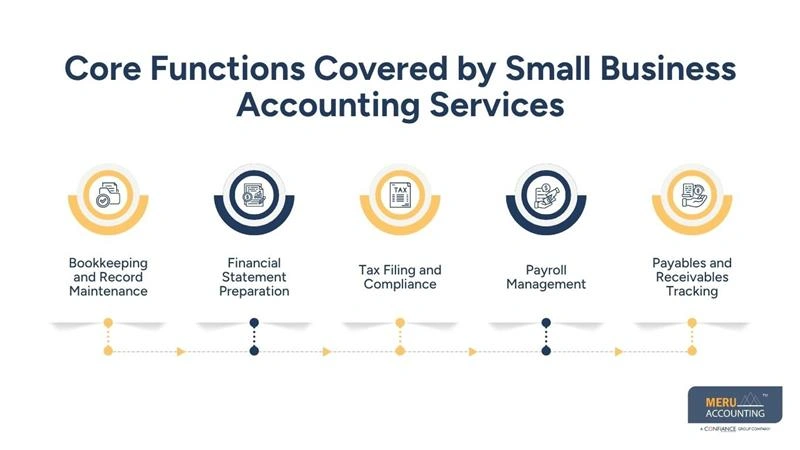
Payroll Management
This includes salary calculation, deductions, bonus tracking, and compliance for employees. It ensures that employees are paid right and on time without mistakes.
Payroll management also covers legal needs such as provident fund payments, professional tax, and other required deductions based on rules. Correct payroll work helps build employee trust and keeps the business in legal line.
It also reduces admin work for business owners by setting up and managing salary tasks in a structured way.
Payables and Receivables Tracking
This helps track money owed to suppliers and money due from customers. It keeps cash flow steady and ensures that the business always knows its financial position in real time.
Proper tracking of payables helps avoid late payment charges and keeps strong supplier ties. On the other hand, tracking receivables ensures on-time collection from clients, which improves cash flow.
A well-managed system in this area helps reduce cash gaps and supports smooth daily work.
Beyond Bookkeeping: What Small Business Accounting Services Really Include
Modern small business accounting services go much further than record keeping. They support planning, control, and growth.
Financial Analysis and Meaningful Insights
Instead of only showing numbers, accounting helps explain them.
It answers questions like:
- Is the business making real profit?
- Which service or product earns more?
- Where is money being wasted?
This helps owners make better decisions based on facts.
Cash Flow Control
Cash flow is one of the most important parts of any business.
Accounting services help:
- Track incoming and outgoing money
- Predict future cash gaps
- Improve payment timing
- Keep enough working funds
A small company accountant helps avoid cash shortages that can harm daily operations.
Budget Planning and Forecasting
Instead of reacting to problems, businesses can plan ahead.
This includes:
- Monthly and yearly budgets
- Revenue planning
- Expense limits
- Growth estimates
This gives a clear financial direction.
Business Performance Tracking
Accounting helps measure success using data.
It includes:
- Profit margin tracking
- Cost control review
- Growth trend analysis
- KPI monitoring
This shows whether business plans are working.
Strategic Financial Advice
One major value of accounting is guidance.
It supports decisions like:
- Pricing changes
- Cost reduction plans
- Expansion timing
- Investment choices
A small company accountant often acts as a financial guide, not just a record keeper.
Risk Control and Compliance Safety
Accounting helps reduce financial risk by:
- Finding compliance issues early
- Preventing tax mistakes
- Reducing fraud risk
- Keeping records clean
This protects the business from legal and financial trouble.
Digital Accounting and Automation
Modern accounting uses tools to improve speed and accuracy.
It includes:
- Cloud-based systems
- Automated billing
- Real-time reports
- Software integration
This saves time and reduces human error.
These are key things that make small business accounting services essential for long-term business stability.
Common Misconceptions About Small Business Accounting Services
Many business owners misunderstand accounting. Some common myths include:
Myth 1: Accounting is only for tax season
Accounting is a year-round process, not just a yearly task. It helps track financial health on a continuous basis instead of only during filing time. Regular accounting also reduces last-minute stress and errors during tax deadlines. Businesses that follow ongoing accounting practices usually have better financial control throughout the year.
Myth 2: Bookkeeping and accounting are the same
Bookkeeping records data. Accounting explains and analyzes it. Bookkeeping is mainly about entering transactions correctly in the system. Accounting goes further by turning those records into meaningful financial insights for decision-making. Without accounting, bookkeeping data has limited use for business planning and growth.
Myth 3: Small businesses do not need accountants
Even small firms benefit from planning, control, and risk reduction. A structured accounting system helps small businesses avoid financial mistakes that can grow into bigger problems. It also supports better budgeting and cash flow control from the start. A small company accountant can guide early-stage decisions that improve long-term stability.
Myth 4: Hiring a small company accountant is too costly
In most cases, good accounting saves more money than it costs by avoiding errors and improving planning. Poor financial tracking often leads to missed deductions, penalties, and cash flow issues. Professional support also helps identify savings opportunities that owners may overlook. Over time, the financial benefits usually outweigh the service cost.
Myth 5: Software replaces accountants
Software helps, but it cannot replace expert judgment and advice. It can automate calculations and reporting, but it cannot interpret complex financial situations. Businesses still need human insight to make strategic decisions based on data. A skilled accountant adds context, experience, and direction that software alone cannot provide.
Meru Accounting’s Small Business Accounting Services
At Meru Accounting, we provide structured and reliable small business accounting services designed for real business needs.
We focus on more than data entry. Our goal is to help business owners understand their financial position clearly and make better decisions.
Our services include:
- Full bookkeeping and accounting support
- Clear financial reports and insights
- Tax planning and compliance handling
- Cash flow monitoring and planning
- Budget and forecast preparation
- Dedicated small company accountant support for direct guidance
We work with small businesses to reduce confusion, improve financial control, and support steady growth.
Our approach is simple—clear numbers, better decisions, and long-term stability.
Our Expert Perspective
From our experience working with small businesses, most financial issues do not start with tax filing or bookkeeping errors. They usually begin with limited visibility in daily financial decisions. This is why small business accounting services are most effective when used as a continuous support system, not just a year-end activity.
A skilled small company accountant helps connect numbers with real business actions, such as pricing, spending control, and cash flow timing. At Meru Accounting, we have seen that businesses make stronger and more stable decisions when they receive regular financial insights instead of waiting for annual reports.
Key Takeaways
- Small business accounting services go beyond bookkeeping and tax filing
- They include planning, analysis, forecasting, and advisory support
- A small company accountant helps turn data into decisions
- Cash flow and budgeting are key parts of financial control
- Accounting is a year-round business function
- Technology improves accuracy but does not replace expertise
- Good accounting reduces risk and supports growth
FAQs
They include bookkeeping, reporting, tax filing, payroll, budgeting, forecasting, and financial analysis.
A bookkeeper records transactions. A small company accountant analyzes data and supports business decisions.
They help improve cash flow, reduce risk, support planning, and ensure compliance.
Yes. They provide insights that help improve pricing, reduce costs, and plan expansion.
Yes. Accounting is a continuous process, not just a tax-time activity.