In the logistics industry, financial accuracy decides how smoothly operations run and how fast a company can grow. Many logistics firms now rely on transportation and logistics accounting to manage cost tracking, route expenses, fuel usage, and shipment profitability. Without structured financial systems, even high-revenue companies may face cash flow pressure and weak planning.
Outsourcing has changed how companies manage transportation and logistics accounting, especially when dealing with cross-border shipments, fleet costs, and warehouse coordination. At the same time, transportation accounting services are becoming a key part of daily financial control for logistics firms that want better clarity and stable growth.
What You Will Learn From This Blog
- How logistics companies manage financial records for transport operations
- Why outsourced accounting is important for scaling logistics businesses
- Role of cost tracking in fleet and freight operations
- How financial clarity improves decision-making in logistics
- Ways outsourcing reduces internal workload and errors
What Is Transportation And Logistics Accounting?
Transportation and logistics accounting is the process of tracking and managing all financial activities linked to the movement of goods. It covers key cost areas such as fuel, tolls, driver wages, vehicle repairs, and storage charges.
The main goal is to ensure that every shipment is recorded with clear and accurate financial details so that companies can understand their true operating costs.
It also includes revenue allocation for each shipment or route, which helps businesses identify which deliveries are profitable and which are creating losses.
Along with this, it manages fleet and asset accounting by tracking vehicle value, depreciation, and maintenance cycles, giving a clear view of long-term asset performance.
In addition, transportation and logistics accounting ensures compliance with tax rules, GST/VAT systems, and international reporting standards such as IFRS. With structured financial reporting, management gains real-time visibility into costs and income, helping them make more informed operational decisions.
Understanding the Role of Transportation and Logistics Accounting in Modern Supply Chain Operations
Real-Time Cost Monitoring
Modern logistics depends on transportation and logistics accounting to track fuel, labor, and freight costs in real time. Financial gaps reduce when every expense is recorded as it occurs, helping companies avoid unexpected cost overruns during daily operations.
Profitability Analysis Per Route
Companies use detailed financial data to understand which delivery routes generate higher margins and which routes need adjustments. Better planning of distance, fuel usage, and delivery timing becomes possible, leading to improved cost control and stronger financial outcomes.
Inventory Movement Tracking
Accurate financial recording links inventory flow with shipment movement. Stock values, dispatch records, and billing data stay aligned across warehouses and distribution centers, reducing mismatches in reporting and audit issues.
Better Cash Flow Planning
Structured accounting systems allow businesses to predict incoming payments and outgoing expenses more clearly. Stable working capital is maintained as payment delays are identified early and managed through proper planning.
Data-Driven Supply Chain Decisions
Management teams use financial and operational data to adjust pricing, route selection, and delivery schedules. Decision-making becomes more balanced and based on actual performance instead of assumptions.
Role of Transportation Accounting Services in Streamlining Financial Operations
Structured Financial Recording
Transportation accounting services organize invoices, freight bills, and payment records in a systematic way. Financial documents stay properly categorized, which reduces confusion during audits and monthly reporting cycles.
Error Reduction In Billing
Freight billing and customer invoicing become more accurate when structured accounting processes are applied. Manual mistakes reduce significantly as records are checked and matched against shipment data.
Faster Month End Closing
Clean and updated records allow finance teams to complete month-end closing in less time. Reporting becomes more consistent, which helps management access financial results without delays.
Vendor Payment Management
Logistics firms manage payments to drivers, fuel suppliers, and warehouse partners through structured tracking systems. Timely payments improve vendor relationships and keep operations stable.
Improved Cost Transparency
Clear reporting from transportation accounting services ensures management understands where money is spent. Cost visibility improves decision-making, especially in fuel usage, routing, and vendor selection.
How Transportation and Logistics Accounting Supports Business Expansion
Scalable Financial Systems
Transportation and logistics accounting creates systems that grow with increasing shipment volume and fleet size. Financial records stay structured even when operations expand, which helps companies avoid confusion during rapid growth phases.
Expansion Into New Regions
Companies using structured financial systems can enter new markets with controlled financial risk. Cost tracking for new routes, warehouses, and delivery networks becomes more accurate, reducing early-stage financial uncertainty.
Investor Confidence
Clean financial records make it easier for investors and lenders to trust business performance data. Clear reporting on revenue, cost, and profit trends increases the chances of securing expansion funding.
Pricing Strategy Improvement
Accurate cost breakdowns allow firms to adjust pricing based on real operational expenses. Better pricing decisions improve competitiveness while maintaining healthy margins across different routes and services.
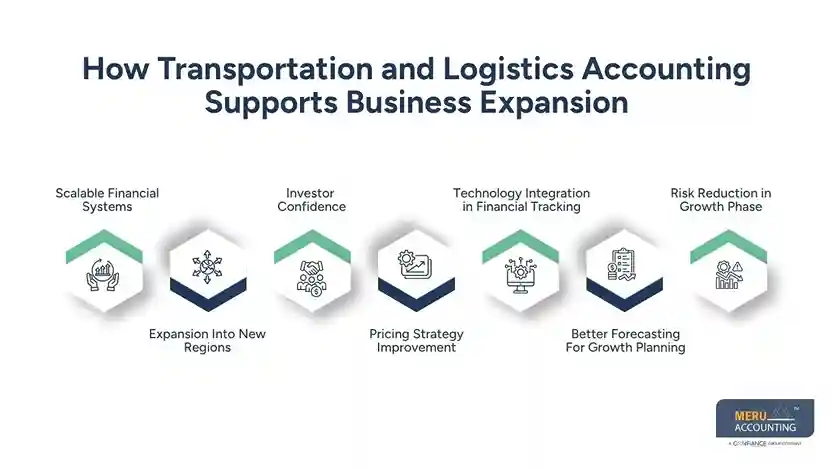
Technology Integration in Financial Tracking
Modern logistics firms use digital systems to connect shipment data with accounting records. Automation reduces manual work and improves the speed of financial reporting during expansion.
Better Forecasting For Growth Planning
Historical financial data helps businesses predict future demand, fleet requirements, and cash flow needs. Planning becomes more stable when decisions are based on consistent financial patterns.
Risk Reduction in Growth Phase
Strong transportation and logistics accounting reduces financial mistakes during rapid expansion. Better visibility into costs, revenue flow, and operational spending helps companies avoid losses while scaling operations.
How Outsourcing Helps Reduce Operational Costs in Logistics Companies
Lower In-house Staffing Costs
Outsourcing transportation and logistics accounting reduces the need for large internal finance teams. Salary burden and hiring pressure decrease, helping companies control overall operational costs.
Reduced Software And Training Expense
Companies save money on accounting tools and training when transportation accounting services are outsourced.
Additional savings also come from avoiding frequent software upgrades and system maintenance costs.
Fewer Financial Errors
Professional accounting processes reduce mistakes in billing, expense recording, and reporting. Fewer errors lead to lower correction costs and better accuracy in financial statements, especially during high shipment volumes.
Flexible Service Usage
Outsourced services can be increased or reduced based on business demand. Seasonal peaks in logistics operations become easier to manage without hiring temporary internal staff.
Better Use Of Internal Resources
Internal teams can focus more on core logistics activities such as delivery coordination, route planning, and customer service. Financial tasks are handled externally, improving overall operational focus.
Common Challenges in Logistics Accounting and How Outsourcing Solves Them
Complex Multi-Location Data
Managing financial records across multiple warehouses and transport routes often creates confusion in reporting. Outsourced teams bring structured reporting systems that reduce errors and improve coordination between locations.
Fuel Cost Fluctuations
Frequent changes in fuel prices make cost tracking difficult for logistics companies. Better monitoring methods help adjust expenses quickly and reduce unexpected cost gaps.
Delayed Invoice Processing
Invoice delays often create cash flow pressure in logistics operations. Faster invoice handling improves payment cycles and keeps working capital stable.
Compliance Difficulties
Tax and regulatory requirements in logistics accounting are often complex and time-sensitive. Regular updates in rules are tracked to avoid penalties and filing errors.
Lack Of Financial Visibility
Limited visibility into expenses and revenue makes decision-making difficult for management. Clear reporting systems give better insight into cost patterns and operational spending.
Why Logistics Companies Choose Meru Accounting For Scalable Financial Management
Meru Accounting provides focused support for logistics firms dealing with high shipment volumes, fleet cost tracking, and multi-location operations. Our approach to transportation and logistics accounting is built on practical industry needs, ensuring financial records remain clear and usable for daily decision-making.
Our transportation accounting services cover freight billing, fuel expenses, driver payments, and route-wise cost tracking. This structured system reduces errors in records and gives better visibility into shipment profitability and cash flow.
As logistics companies grow, Meru Accounting scales its transportation and logistics accounting processes without disruption. With consistent reporting, compliance handling, and cost clarity, our transportation accounting services help businesses manage expansion with more control and fewer financial gaps.
Our Expert Perspective
In our experience working closely with logistics firms, a clear pattern emerges: financial clarity directly influences how smoothly a company scales. When transportation and logistics accounting is managed with proper structure, businesses are able to reduce cost leakages and improve long-term planning.
We have observed that companies adopting transportation accounting services early tend to maintain more stable growth and face fewer unexpected financial pressures during expansion.
Key Takeaways
- Logistics growth depends on accurate financial tracking
- Outsourced accounting reduces operational pressure
- Route-based cost analysis improves pricing decisions
- Clean financial records attract investors and lenders
- Expert support reduces errors and improves compliance
FAQs
Transportation and logistics accounting is the process of tracking financial records related to freight, fuel, transport, and logistics operations in a structured way.
Logistics companies outsource accounting to reduce costs, improve accuracy, and manage complex financial tasks more efficiently without increasing internal workload.
Common reports include shipment cost reports, profit per route reports, fuel usage reports, and monthly expense summaries for better planning.
Yes, structured records reduce mistakes in billing, vendor payments, and expense tracking, which often occur in manual systems.
Most companies notice clearer records and better cost tracking within the first billing cycle, especially when data is organized properly from the start.