
Businesses today are shifting how they manage money records, reporting, and financial planning. One major reason behind this shift is the rise of virtual accounting and bookkeeping services, which allow firms to handle accounts without needing in-office teams.
Many companies now rely on remote financial management to reduce manual work, ensure accurate records, and maintain consistent financial control across multiple locations.
At the same time, many firms are opting for structured reporting systems that do not require large internal teams or high operational costs.
In this blog, you will learn why this shift is happening, which industries benefit the most, what challenges arise during adoption, and how to select the right service provider. You will also discover how modern tools and remote teams are transforming financial tracking for growing businesses.
What You Will Learn From This Blog
- Why businesses prefer virtual accounting and bookkeeping services over traditional setups
- Key benefits of using virtual accounting services for growing firms
- Industries that gain the most from remote financial systems
- Common transition challenges and simple ways to manage them
- How to select a reliable financial service provider
- Ways financial visibility and reporting quality improve with remote systems
- Performance areas that show measurable improvement
- How Meru Accounting supports businesses with structured financial services
Introduction To Virtual Accounting And Bookkeeping Services
Virtual accounting and bookkeeping services involve managing financial records through online systems and remote professionals. These services allow businesses to maintain accurate, up-to-date records without the need for a full in-house accounting team.
By using digital tools, organizations can streamline processes such as invoicing, payroll, reconciliation, and tax preparation, reducing dependency on physical office space while ensuring timely and precise financial management.
Remote experts handle key accounting tasks from anywhere, allowing businesses to focus on strategic growth instead of routine bookkeeping.
Cloud-based platforms further enhance this setup by providing secure data storage, real-time updates, and controlled access, ensuring that financial information remains both accurate and accessible.
The shift from traditional manual systems and desktop-based software to digital solutions has also accelerated reporting cycles and improved efficiency.
Organizations operating across multiple regions particularly benefit from the global accessibility these services offer, as financial data can be retrieved and analyzed anytime, regardless of location. This combination of flexibility, security, and efficiency makes remote financial management an increasingly attractive option for modern businesses.
Key Reasons Businesses Are Switching To Virtual Accounting And Bookkeeping Services
Cost Control And Resource Savings
Companies save on hiring costs by using virtual accounting and bookkeeping services instead of maintaining full-time staff. This also lowers training and infrastructure expenses. Savings can be redirected toward growth initiatives and strategic investments.
Faster Financial Reporting
With virtual accounting services, reports are generated quickly using automated tools, reducing delays in decision-making. Leadership teams gain timely insights to respond effectively to financial changes.
Better Accuracy In Records
Human errors in manual entries are reduced through structured systems. Consistent validation checks ensure data remains clean and reliable across all reports.
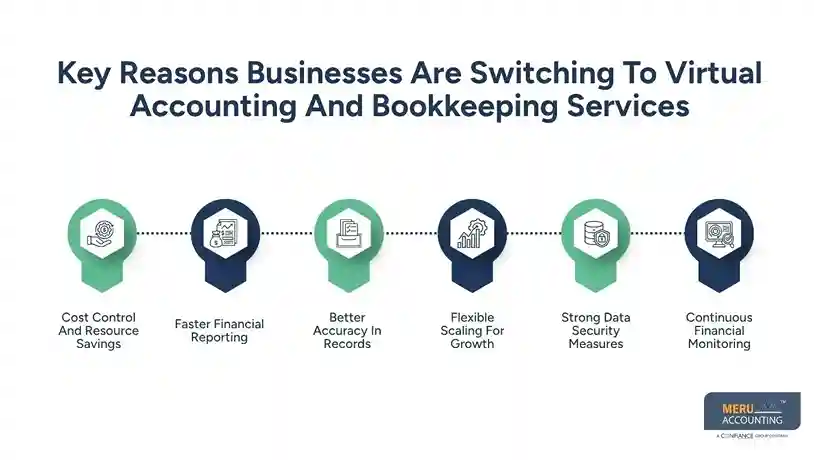
Flexible Scaling For Growth
Growing firms often expand quickly, and remote financial solutions allow scaling without hiring large teams. Business operations can adjust smoothly during peak and low activity periods without disruption.
Strong Data Security Measures
Modern systems include encryption and access control for safer financial data handling. Sensitive financial information remains protected against unauthorized access and misuse.
Continuous Financial Monitoring
Real-time updates from remote financial systems allow businesses to track cash flow instantly, without waiting for monthly reports. Ongoing monitoring allows early identification of financial gaps and irregularities.
Industries Benefiting Most From Virtual Accounting Services
E-Commerce And Online Retail
Online sellers manage high volumes of orders, payments, and refunds efficiently. Efficient financial tracking ensures smoother operations and reduces the risk of errors in daily transactions.
Real Estate Sector
Property firms require clear records for rental payments, commissions, and project expenses. Organized financial data also helps in planning property acquisitions and managing investor reporting.
Healthcare Providers
Clinics and hospitals must maintain precise billing records and insurance claim documentation. Accurate bookkeeping ensures compliance with regulatory requirements and simplifies audits.
Hospitality And Travel Industry
Hotels and travel firms rely on virtual accounting and bookkeeping services to track seasonal revenue and manage vendor payments. This also helps them optimize costs during peak and off-peak periods efficiently.
Startups And Small Businesses
Startups often choose virtual accounting services to maintain financial clarity while operating on tight budgets. Remote accounting enables them to focus more on growth strategies without worrying about routine bookkeeping.
Professional Service Firms
Consultants, agencies, and freelancers require simple yet organized systems for billing and client invoicing. Proper financial records also assist in evaluating profitability and planning for tax obligations.
Challenges Businesses Face During Transition And How To Overcome Them
Data Migration Issues
Moving old records into virtual accounting and bookkeeping services systems can be complex if data is unorganized. Proper categorization and cleanup of existing data before migration can reduce errors and save time.
Staff Adaptation To New Systems
Teams may take time to adjust to new platforms and processes. Providing clear guides and small training sessions helps employees gain confidence with new workflows.
Internet And System Dependence
Since online tools are central to these systems, downtime can temporarily halt access to financial data. Maintaining backup systems and offline records can minimize disruptions during outages.
Security Concerns During Initial Setup
Businesses may worry about data safety, especially during onboarding. Using strong passwords, multi-factor authentication, and controlled access ensures sensitive financial information remains secure.
Cost Of Initial Setup Tools
Although long-term savings exist, initial investments in software, integration, and training can be high. Careful budgeting and phased implementation help manage upfront expenses efficiently.
Solution Approach
Proper planning, training sessions, and phased migration help businesses adopt virtual accounting and bookkeeping services smoothly. Regular reviews and feedback loops ensure the transition is effective and sustainable.
How to Choose the Right Virtual Accounting and Bookkeeping Service Provider
Experience And Industry Knowledge
Select providers with proven experience across your industry. Experienced providers can anticipate common challenges and offer solutions tailored to your business needs.
Technology And Tool Usage
Ensure the provider uses updated platforms for virtual accounting services that support automation and reporting. Modern tools can integrate with existing systems, reducing manual effort and improving accuracy.
Data Security Standards
Check encryption methods and access controls used by the provider. Strong security standards ensure sensitive financial data remains protected from unauthorized access.
Communication And Reporting Style
Clear reporting schedules are important when using virtual accounting and bookkeeping services for consistent updates. Providers should offer customizable reporting formats to suit different stakeholder needs.
Pricing Structure Transparency
A reliable provider offers clear pricing without hidden charges. Understanding all costs upfront helps businesses budget effectively and avoid unexpected fees.
Support And Responsiveness
Quick response time is crucial for critical financial tasks. Providers that offer 24/7 support or dedicated account managers can resolve issues promptly and maintain smooth operations.
How Virtual Accounting Enhances Financial Transparency for Stakeholders
Real-Time Financial Access
Stakeholders can review updates anytime through virtual accounting and bookkeeping services dashboards. This allows management and investors to respond quickly to financial changes and opportunities.
Clear Audit Trails
Every transaction is recorded systematically, making audits easier and more reliable. Detailed audit trails also help in maintaining compliance with regulatory requirements.
Improved Decision Support
Accurate financial data helps investors and management understand business performance. Decisions about investments, cost-cutting, or expansion are more informed with clear insights.
Better Budget Control
Companies track spending patterns more clearly using structured financial reports. This ensures departments stay within budget and helps plan future allocations effectively.
Reduced Financial Miscommunication
Centralized records reduce confusion between departments and ensure everyone has the same information. Misunderstandings about expenses, payroll, or revenue are minimized.
Stronger Investor Confidence
Transparent reporting builds trust with investors and partners. Reliable financial data reassures stakeholders that the business is well-managed and accountable.
Key Performance Metrics Improved By Virtual Bookkeeping Solutions
Cash Flow Monitoring
Virtual accounting and bookkeeping services provide real-time cash flow updates. This allows businesses to anticipate shortfalls and plan for upcoming expenses more effectively.
Expense Tracking Accuracy
Businesses using virtual accounting services record expenses more precisely. Accurate expense tracking helps identify unnecessary costs and optimize spending.
Revenue Reporting Speed
Financial reports are generated faster, enabling timely review of business performance. This supports quicker decision-making and helps management respond to changing market conditions.
Tax Filing Efficiency
Organized records reduce delays during tax submission. Proper documentation also minimizes errors and simplifies compliance with tax regulations.
Profit Margin Analysis
Clear data helps identify profit patterns. Insights from these analyses allow companies to refine pricing and cost strategies.
Operational Cost Control
Companies monitor spending more effectively. This visibility allows managers to adjust budgets and improve overall operational efficiency.
Why Choose Meru Accounting?
Meru Accounting has worked with global clients across industries, offering structured financial systems built on accuracy and clarity. As a provider of virtual accounting and bookkeeping services, Meru Accounting focuses on helping businesses manage financial records with strong reporting discipline and consistent review cycles.
Our team provides virtual accounting services that include bookkeeping, payroll support, financial reporting, and tax coordination. We work with tools like cloud accounting systems to ensure businesses can access updated financial data without delay.
From startups to established firms, Meru Accounting designs virtual accounting and bookkeeping services based on business size, transaction volume, and reporting needs. Our approach reduces manual effort and gives leadership teams better financial visibility for planning and control.
Our Expert Perspective
From our experience, businesses using virtual accounting and bookkeeping services often achieve better financial visibility, improved reporting accuracy, and smoother operational control. Structured remote financial systems help management teams access timely insights, reduce manual errors, and support business growth without increasing administrative complexity.
We have also observed that consistent financial monitoring improves decision-making and strengthens confidence among stakeholders and investors.
Key Takeaways
- Businesses are shifting to remote financial systems for better control and flexibility
- Virtual accounting and bookkeeping services reduce cost and improve reporting speed
- Industries like e-commerce, healthcare, and real estate benefit strongly
- Transition challenges can be managed with proper planning
- Choosing the right provider is key for long-term financial stability
- Transparent reporting increases trust among stakeholders
- Performance tracking becomes easier with structured systems
FAQs
They are remote financial systems where professionals manage records, reporting, and reconciliation using online tools instead of working in the office.
Yes, most providers use encrypted systems and secure access controls to protect financial information.
Startups, small businesses, e-commerce firms, healthcare providers, and service-based companies can use these services.
Yes, they reduce hiring, training, and infrastructure costs while maintaining accurate financial records.
Look for experience, strong technology use, clear reporting systems, and reliable communication support.