
Virtual accounting services are changing how businesses handle financial tasks such as bookkeeping, tax filing, and reporting. Instead of managing everything in-house, companies now prefer remote experts who work through secure cloud systems. This approach helps improve accuracy and reduce operational pressure.
Many businesses are choosing virtual accounting services because they offer better flexibility, cost control, and access to skilled professionals. From startups to established firms, this model supports smooth financial operations without the need for a full-time internal team.
What You Will Learn From This Blog
- Understand the meaning and purpose of virtual accounting services in business operations
- Learn how virtual accountant services work in daily financial tasks and processes
- Explore the key features that make these services effective and reliable
- Compare traditional accounting methods with virtual accounting services
- Identify the main benefits that support business growth and efficiency
- Know the reasons why many businesses are switching to virtual accounting services
- Recognize common challenges and learn practical ways to handle them
Introduction To Virtual Accounting Services
Virtual accounting services involve managing financial records remotely using cloud-based software, allowing accountants to perform tasks without being physically present. This approach helps businesses handle bookkeeping, payroll, tax preparation, and financial reporting through online systems. Many service providers also offer advisory support to guide better financial decisions.
These services rely on cloud platforms that store and manage data securely while providing instant updates and easy access to records. Businesses can view their financial information anytime, which improves control and transparency.
Small businesses, startups, and large companies all use this model because it offers a cost-effective way to manage finances without maintaining a full in-house team.
The demand for virtual accounting services continues to grow as more companies adopt digital tools in their daily operations. With the need for faster reporting and better financial management, businesses are increasingly choosing remote accounting solutions to improve efficiency and reduce costs.
How Virtual Accountant Services Work For Modern Businesses
Remote Access To Financial Data
Financial data is stored on cloud systems. Virtual accountant services access and update this data from any location. This ensures business owners can review records anytime without waiting for manual updates.
Task Management And Communication
Tasks are managed through shared platforms. Communication happens through email, calls, and online tools. This helps maintain clear coordination between the business and the accounting team.
Real-Time Reporting
Reports are created instantly, giving business owners clear insights into income and expenses. Quick access to reports supports better planning and timely decision-making.
Data Security Measures
Secure login systems and encryption help protect sensitive financial data from risks. Regular backups also ensure that important data is not lost.
Integration With Business Tools
Virtual accountant services connect with payroll, invoicing, and inventory systems for better coordination. This integration reduces manual work and improves overall efficiency.
Key Features Of Virtual Accounting Services
Cloud-Based Accounting Systems
All financial data is stored online, making it easy to access anytime. This ensures business owners can review financial records from any device when needed.
Automation Of Routine Tasks
Processes like invoicing and bank reconciliation are automated to reduce errors. Automation also saves time and improves consistency in daily accounting tasks.
Scalability Of Services
Businesses can adjust services based on their needs without difficulty. This flexibility supports growth without the need for major changes in the system.
Cost Control And Transparency
Clear pricing structures help businesses manage expenses better. It also allows better budget planning with no unexpected costs.
Expert Support And Advice
Virtual accounting services provide access to experienced professionals for better financial decisions. This helps businesses plan ahead and avoid financial mistakes.
Real-Time Data Access
Financial information is updated instantly and can be viewed at any time. This helps business owners stay informed and respond quickly to changes.
Difference Between Traditional Accounting And Virtual Accounting Services
Aspect | Traditional Accounting | Virtual Accounting Services |
Work Location | Requires physical presence in an office environment | Operates remotely using cloud-based systems |
Cost Structure | Involves higher costs such as salaries, office space, and training | More cost-effective with flexible pricing and no infrastructure cost |
Access To Data | Limited access, often restricted to office systems | Real-time access to financial data from anywhere |
Speed Of Reporting | Slower due to manual processes and delays | Faster reporting with automated and digital tools |
Flexibility And Scalability | Difficult to adjust quickly to business changes | Easily scalable based on business needs and growth |
Top Benefits Of Virtual Accounting Services For Businesses
Cost Savings
Businesses reduce costs related to hiring and infrastructure by using virtual accounting services. This helps companies allocate funds to other important areas of growth.
Better Accuracy
Automation and expert handling reduce the chances of errors in financial records. Accurate data improves trust and supports better financial planning.
Time Efficiency
Routine tasks are completed quickly, saving valuable time. This allows business owners to focus more on core activities.
Access To Skilled Professionals
Virtual accountant services provide expert knowledge without full-time hiring. Businesses benefit from specialized skills without long-term commitments.
Improved Compliance
Businesses stay updated with tax rules and avoid penalties. Proper compliance also reduces the risk of legal issues.
Real-Time Financial Insights
Instant reports help in making better financial decisions. Up-to-date data allows quick responses to financial changes.
Why Businesses Are Switching To Virtual Accounting Services
Need For Flexibility
Businesses prefer solutions that allow remote access and easy management. This helps teams work smoothly without being tied to a fixed location.
Rising Operational Costs
Companies aim to reduce expenses, and virtual accounting services help achieve this goal. Lower overhead costs make it easier to manage budgets effectively.
Shift Toward Digital Systems
Cloud-based solutions are becoming more common in business operations. Digital tools improve efficiency and simplify financial management.
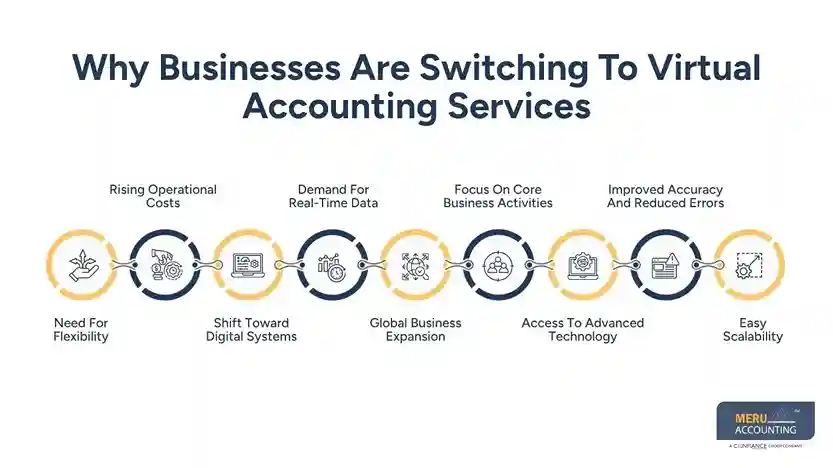
Demand For Real-Time Data
Instant access to financial data improves planning and control. This allows quicker decisions based on updated financial information.
Global Business Expansion
Virtual accountant services support businesses operating across different locations. This makes it easier to manage finances across different regions.
Focus On Core Business Activities
Businesses want to spend more time on growth and operations. Outsourcing accounting tasks helps reduce internal workload.
Access To Advanced Technology
Virtual accounting services use modern tools and systems. This helps businesses stay updated without investing in new software.
Improved Accuracy And Reduced Errors
Automation and expert handling improve the quality of financial data. This reduces the chances of costly mistakes.
Easy Scalability
Businesses can scale services up or down based on their needs. This flexibility supports both small startups and growing companies.
Common Challenges In Virtual Accounting Services And How To Overcome Them
Data Security Concerns
Choosing reliable providers and secure systems reduces risk. Using strong passwords and access controls also improves data protection.
Communication Gaps
Regular updates and clear communication methods help avoid confusion. Setting fixed meeting schedules ensures better coordination.
Software Learning Curve
Training sessions help teams adapt to new tools easily. Ongoing support from service providers makes the transition smoother.
Dependence On Internet
Using stable internet connections ensures smooth operations. Backup connections help avoid disruptions during important tasks.
Choosing The Right Provider
Checking experience and service quality helps in selecting the right firm. Reading client feedback also helps in making a better decision.
Why Choose Meru Accounting For Virtual Accounting Services
- Meru Accounting has strong experience in handling clients across different industries
- Our team provides expert support in bookkeeping, tax, and reporting
- Modern software ensures secure and accurate financial management
- We design our services to match the needs of each business
- Meru Accounting serves clients from different countries with consistent quality
Our Expert Perspective
Based on practical experience, businesses that adopt virtual accounting services often achieve improved financial clarity within a short period. Real-time access to financial data, combined with expert support, helps reduce confusion and improves financial planning.
Many business owners initially hesitate to move away from traditional systems. However, once virtual accountant services are implemented, improved accuracy, smoother workflows, and better control over financial records become clearly visible.
Key Takeaways
- Virtual accounting services help businesses manage financial tasks remotely in a simple and efficient way
- Businesses can reduce costs and improve overall efficiency by using virtual accounting services
- Real-time financial data helps in making better and faster business decisions
- Virtual accountant services provide expert support without the need for full-time hiring
- Strong security systems and proper setup are important for smooth operations
- Many businesses choose this model because it offers flexibility and ease of use
FAQs
Virtual accounting services manage business finances online with the help of remote experts. Cloud software is used to handle bookkeeping, tax, and financial reporting tasks.
Businesses switch to virtual accounting solutions to reduce costs and improve efficiency. Real-time financial data and expert support are available without full-time hiring.
Virtual accounting solutions operate online, while traditional accounting requires office presence. Faster reporting and easy data access make virtual services more efficient.
Virtual accountant services are suitable for small businesses with limited budgets. Professional financial support is available without the expense of in-house staff.
Virtual accounting services include bookkeeping, payroll, tax filing, and reporting. Compliance support and financial planning are also part of these services.