FICA tax is a federal payroll tax that both employees and employers must pay. It helps fund two major government programs: Social Security and Medicare. If you earn a paycheck, chances are, FICA tax is already being taken out. Many people ask, “What is FICA tax?” This guide breaks it down in the simplest way possible. Let’s explore what FICA taxation is, how it works, and what it means for both employees and employers.
What Is FICA Tax?
FICA stands for the Federal Insurance Contributions Act. It is not a single tax but a combination of two:
- Social Security Tax
- Medicare Tax
These taxes come out of your pay to help run public aid programs. The Social Security tax gives money to people who are retired, disabled, or to the families of workers who have died. The Medicare tax helps pay for health care for those who are 65 or older, or who have long-term health needs.
Both workers and bosses pay FICA tax. Each pays half. If you work for yourself, you pay the full amount. This is called the self-employment tax.
FICA is a big part of how the U.S. helps people who can’t work due to age or health. It helps them get basic money and health care.
Why You Should Pay FICA Tax
Social Security
FICA tax helps fund your future Social Security income. When you retire or can’t work due to health problems, this program gives you monthly support. It also helps your spouse or kids if you pass away. Paying FICA protects both you and your family.
Medicare
Part of the FICA tax goes to Medicare. This program helps people who are 65 or older and those with health issues get care. It covers doctor visits, hospital stays, and other medical needs. Your payment helps keep this care ready for use.
Legal Duty
FICA tax is required by law. If you earn wages or are self-employed, you must pay it. Employers also pay their share. Paying FICA helps support key programs for all workers.
Risk of Penalties
If you skip or underpay FICA tax, the IRS may charge fines or interest. You could also face audits or other issues. Paying on time helps you stay safe and follow tax rules.
Who Pays FICA Tax?
1. Employees
- They pay 50% of the total FICA tax.
- The tax is automatically deducted from their paycheck.
2. Employers
- They pay the other 50% of the tax.
- They match the amount paid by the employee.
3. Self-Employed Individuals
- They pay both parts (employee + employer share).
- This is called the SECA tax instead of FICA.
How Much Is the FICA Tax Rate?
Here is a breakdown:
Tax Type | Rate | Who Pays |
Social Security | 6.2% | Employee and Employer each |
Medicare | 1.45% | Employee and Employer each |
Total FICA Tax | 15.3% | Shared between both |
- If you’re self-employed, you pay the full 15.3%.
- High-income earners may pay an extra 0.9% Medicare levy.
FICA Tax Limits (2025 Update)
Social Security Wage Limit
In 2025, the wage cap for Social Security tax is $168,600. You pay 6.2% Social Security tax on income up to this amount. Earnings above this are not taxed for Social Security. Your boss also pays 6.2%, making the total 12.4%, split between you and your boss.
Medicare Tax Limit
The Medicare levy has no income cap. You pay 1.45% on all your earnings. Your boss also pays 1.45%, for a total of 2.9% toward Medicare.
Extra Medicare Tax
If your pay goes over a set amount, you pay 0.9% more in Medicare tax.
This applies to:
- $200,000 for Single filers
- $250,000 for Married filing jointly
This extra tax is paid by you only, not your boss.
If You Are Self-Employed
If you work for yourself, you pay on both sides. That means:
- 12.4% Social Security (up to $168,600)
- 2.9% Medicare (on all earnings)
- +0.9% if your pay is above the high-income line
You may deduct half of your self-employment tax when you file taxes.
Why These Limits Change
The Social Security wage cap goes up most years. It is based on average U.S. wage growth. This helps the system stay on track for future needs.
What Does FICA Tax Cover?
FICA taxation helps fund key U.S. benefit plans. Here’s what it pays for:
1. Social Security Benefits
FICA tax supports the Social Security program. It gives money to people who need help due to age, health, or loss of a loved one. This includes:
- Retirement Payments
Monthly income for people aged 62 and up, based on past work. - Disability Benefits
Help for people who can’t work due to long-term health issues. - Survivor Benefits
Money for spouses or kids if a working family member dies. - Family Benefits
Extra income for family members of people who get Social Security.
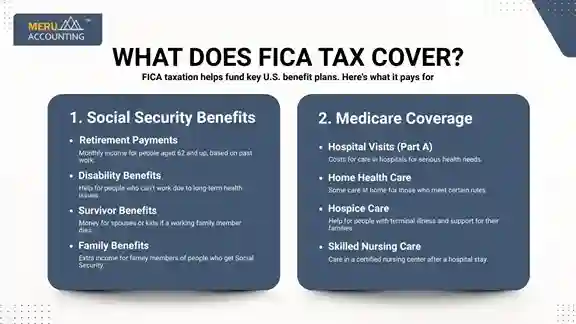
2. Medicare Coverage
FICA tax also funds Medicare, which helps cover health costs. This includes:
- Hospital Visits (Part A)
Costs for care in hospitals for serious health needs. - Home Health Care
Some care at home for those who meet certain rules. - Hospice Care
Help for people with terminal illness and support for their families. - Skilled Nursing Care
Care in a certified nursing center after a hospital stay.
How Is FICA Tax Collected?
1. For Employees
- Under FICA taxation, the tax is taken out of your pay by your employer.
- Your employer withholds your part and sends it to the IRS.
- You do not have to do anything—this is built into payroll.
2. For Self-Employed Workers
- If you are self-employed, you must pay both the employee and employer share.
- You must calculate the tax using Schedule SE when you file your return.
- You can pay this tax through quarterly estimated payments.
Sample FICA Tax Calculation
- Annual Income Example
Let’s say you earn $60,000 in a year under current FICA taxation rules.
This income will be subject to both Social Security and Medicare taxes. - Social Security Tax (6.2%)
You will pay $3,720 toward Social Security.
This helps fund retirement and disability benefits for workers and families. - Medicare Tax (1.45%)
You will also pay $870 toward Medicare.
This supports health care for people aged 65 and older or with certain conditions. - Total FICA Tax You Pay
Your total FICA tax will be $4,590.
This amount is taken out of your pay throughout the year. - Employer Match
Your employer must also pay $4,590.
This matches what you paid and is part of their payroll duty. - Combined Total FICA Tax
The full FICA tax paid (by both you and your employer) is $9,180.
This joint effort funds Social Security and Medicare for all workers.
What Is the Employer’s Role in FICA Tax?
- Withholding from Paycheck
Employers must withhold the right amount under FICA taxation from each paycheck.
This ensures employees don’t have to pay a large amount at year-end. - Matching the Employee’s Share
Employers must match the same amount of FICA tax that the employee pays.
This doubles the contribution and helps build the Social Security fund. - Filing Payroll Tax Forms
They must file payroll tax forms every quarter.
These forms report wages, tips, and withheld taxes to the IRS. - Sending Payments to the IRS
Employers must send the withheld and matched tax to the IRS on time.
Failing to do so may lead to interest charges or penalties.
What If I’m Self-Employed?
- Use Schedule SE
If you’re self-employed, you must file Schedule SE with your tax return.
This form helps calculate your Social Security and Medicare tax. - Deduct the Employer Portion
You can deduct 7.65% (the part usually paid by the employer) from your income.
This deduction reduces your taxable income, lowering your tax bill. - Make Estimated Tax Payments
You must pay estimated taxes during the year to avoid interest and late fees.
These are usually paid four times a year using IRS Form 1040-ES.
What If I Overpay FICA Tax?
How Overpayment Can Happen
You may overpay FICA tax if:
- You work two or more jobs, or
- Your income goes over the wage cap for Social Security.
Each employer may withhold as if you didn’t have other jobs.
Getting a Refund
To get back the extra tax:
- File your tax return like normal.
- The IRS will return the overpaid FICA tax to you.
You may see the refund added to your overall tax return balance.
FICA Tax vs Income Tax
FICA Tax | Income Tax |
Flat rate (6.2% + 1.45%) | Varies by income level |
For Social Security & Medicare | For government programs and operations |
Split between employer/employee | Paid by an individual only |
Exemptions from FICA Tax
- Certain Non-Resident Aliens May Be Exempt
Some foreign students and scholars do not have to pay FICA tax.
Their visa type and work status decide if they qualify. - Religious Workers May Be Exempt
Workers in some religious groups can apply for an exemption.
They must file Form 4029 and get IRS approval first. - Some Government Workers May Be Exempt
Certain state or local employees with strong pension plans may be exempt.
Their wages may not be subject to Social Security tax if they’re in qualifying systems.
How FICA Tax Affects Your Paycheck?
- Always Check Your Pay Stub
Your pay stub shows the amount of FICA tax withheld.
This helps you make sure the right amount is taken out. - Look for the Social Security and Medicare Tax
These are listed as separate lines on your pay slip.
Add both to find your total FICA contribution for that pay period.
How FICA Tax Helps Your Future
- Social Security Credits Build Over Time
You earn credits as you work and pay FICA taxes.
These credits help you qualify for Social Security benefits later. - You Need 40 Credits to Qualify for Retirement
Most people earn 4 credits per year of full-time work.
So, about 10 years of work is needed to qualify. - Medicare Kicks In at Age 65
Once you turn 65, Medicare helps with health care costs.
Your FICA tax today funds your care in the future. - FICA Is a Long-Term Investment
It’s not just a payroll cut—it helps secure retirement and health care.
It protects you and your family in the long run.
Common FICA Tax Mistakes to Avoid
- Not Checking Pay Stubs Regularly
Small errors can lead to big problems later.
Always review the FICA amounts taken from your pay. - Freelancers Forget to File Schedule SE
If you’re self-employed, this form calculates your FICA tax.
Missing it may lead to fines or tax trouble. - Missing Estimated Tax Payments
Self-employed workers must pay tax throughout the year.
Skipping payments can result in interest and penalties. - Mixing Up Income Tax and FICA Tax
These are different types of taxes.
FICA funds benefits; income tax supports general government work. - Assuming You’re Exempt Without Proof
You must meet strict rules to avoid FICA tax.
Always confirm before skipping any payroll deduction.
Tips for Employers
- Use Payroll Software
Good software can calculate and withhold FICA tax on time.
This lowers the risk of mistakes or late filings. - Stay Updated on Wage Limits
Social Security has an annual wage base cap.
Make sure your systems adjust as limits change. - File Forms 941 and W-2 Properly
These IRS forms show wages paid and taxes withheld.
Mistakes here can lead to audits or penalties. - Educate Your Staff About FICA Tax
Help workers understand what FICA taxation is and how it helps.
Clear info builds trust and improves payroll checks.
Tips for Employees
- Check Your Paycheck Often
Look at the amounts for Social Security and Medicare.
Make sure the right percentage is being withheld. - Know How Much Is Withheld
For most workers, it’s 7.65% of gross wages.
Track your total yearly contribution for FICA taxation planning. - Watch the Social Security Wage Limit
After a certain income, the Social Security tax stops.
In 2025, that limit is $168,600. - Keep Records of Contributions
Use online tools to check your Social Security credits.
This helps with retirement planning and tax checks.
FICA Tax Planning for the Future
- Know Your Tax Bracket and Deductions
Understanding your full tax picture helps you plan better.
This includes how much you owe in FICA and income tax. - Use Tax Tools to Check Take-Home Pay
Online tax calculators give a quick view of your pay after tax.
This helps plan budgets and savings. - Freelancers Pay the Full 15.3%
If you work for yourself, you cover both parts of FICA.
Budget ahead so you’re not surprised during tax season. - Track Your Social Security Statements Online
Visit the SSA website to review your work and tax record.
Errors caught early are easier to fix. - Stay On Time With Estimated Taxes
If you’re self-employed, pay taxes each quarter.
This avoids late fees and keeps your finances smooth.
Understanding what is FICA tax? is important for every worker and business owner. It may seem like just another deduction, but it plays a key role in your financial future. FICA taxation funds programs that may one day help you or your loved ones.
Whether you’re an employee, employer, or freelancer, knowing the basics of FICA tax helps you stay informed and in control.
Partner with Meru Accounting to manage your payroll and FICA tax with accuracy and confidence. Our team handles everything—from tax calculations to filings, so you can focus on growing your business.