




Law firms deal with money in ways that are very different from most other businesses. Client trust funds, billable hours, retainers, and payroll for skilled professionals all require careful handling. This is why accountants for lawyers play such an important role in law firm operations.
From managing trust accounts to tracking work in progress and running accurate payroll, legal accounting demands a deep understanding and constant attention.
In this blog, we explain why accountants for lawyers are essential, how they manage trust accounts, WIP, and payroll, and how the right accounting support helps law firms stay compliant and financially healthy.
What You Will Learn From This Blog
In this blog, you will learn:
- Why law firms need specialized accountants for lawyers
- How trust accounts should be managed correctly
- Best practices for handling work in progress (WIP)
- How payroll can be managed without errors
- How accounting software for lawyers improves accuracy
- Common mistakes law firms make without expert legal accountants
Why Accountants for Lawyers Are Essential for Law Firm Financial Management
Law firm accounting is not the same as regular business accounting. Legal regulations, bar association rules, and ethical requirements make financial management more complex. Accountants for lawyers understand these rules and help firms follow them correctly.
Without proper legal accounting support, law firms may face:
- Trust account violations
- Incorrect billing and WIP tracking
- Payroll errors
- Tax compliance issues
Dedicated legal accounting specialists help law firms stay organized, accurate, and compliant while allowing attorneys to focus on clients and cases.
Understanding the Unique Accounting Challenges Faced by Law Firms
Law firms face accounting challenges that are specific to the legal profession. These include:
Trust Accounting Rules
Client funds must be kept separate from business funds. Even small mistakes can lead to serious penalties.
Work in Progress (WIP) Tracking
Legal work is billed based on time, not products. Tracking billable and non-billable hours accurately is critical.
Complex Billing Structures
Hourly billing, retainers, contingency fees, and fixed fees all require different accounting treatment.
Payroll for Legal Staff
Law firms employ lawyers, paralegals, and administrative staff with different compensation structures.
Tax and Regulatory Compliance
Law firms must follow strict tax and professional compliance rules. Errors in filings or reporting can trigger penalties or audits.
Expense Allocation Across Matters
Shared firm expenses must be allocated accurately across legal matters. Incorrect allocation affects pricing decisions and case profitability.
This is where experienced accountants for lawyers become valuable partners.
Why Trust Accounting Requires Specialized Law Firm Accounting Support
Trust accounts are one of the most sensitive areas of law firm accounting. Accountants for lawyers ensure that trust funds are handled correctly at all times.
Strict Separation of Funds
Client funds must never mix with operating funds. Accountants monitor this separation daily.
Accurate Recordkeeping
Every deposit and withdrawal is recorded with proper client references.
Regular Trust Reconciliation
Monthly trust account reconciliation helps identify errors early.
Compliance With Bar Rules
Each jurisdiction has strict trust accounting rules. Legal accounting specialists stay updated and ensure compliance.
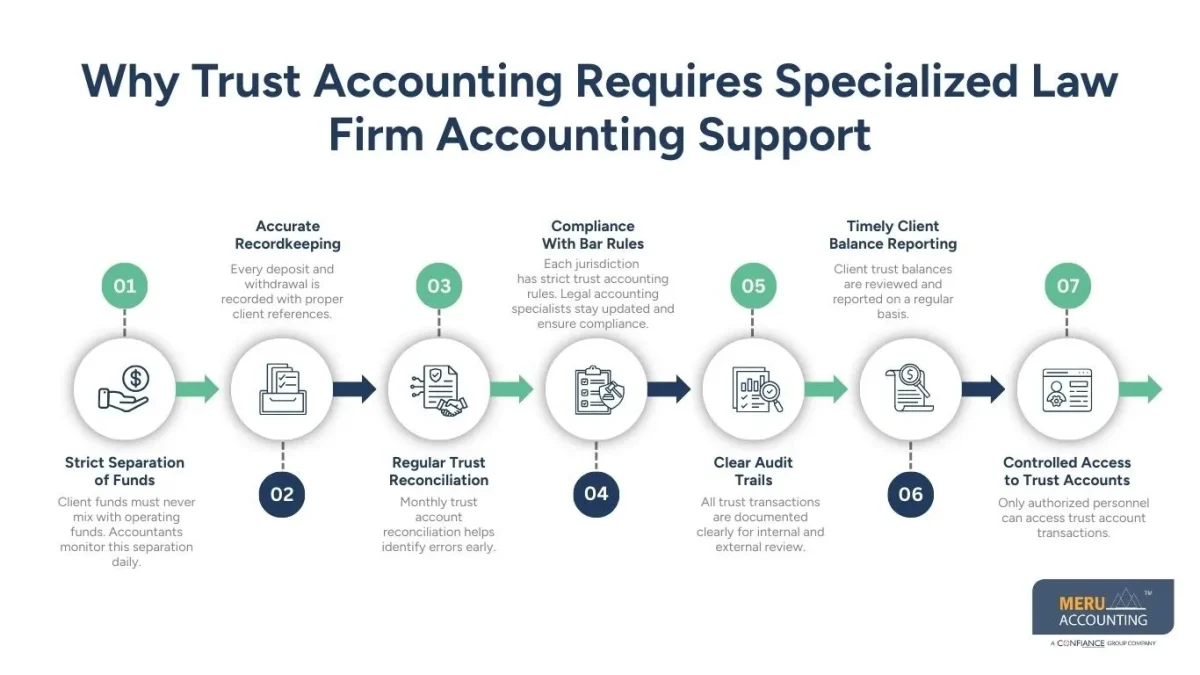
Clear Audit Trails
All trust transactions are documented clearly for internal and external review. This helps law firms respond confidently to audits or inquiries.
Timely Client Balance Reporting
Client trust balances are reviewed and reported on a regular basis. This ensures transparency and prevents accidental overuse of funds.
Controlled Access to Trust Accounts
Only authorized personnel can access trust account transactions. This reduces the risk of errors, misuse, or unauthorized transfers.
Mistakes in trust accounting can damage a law firm’s reputation. Professional legal accountants help prevent these risks.
Best Practices for Managing Work in Progress (WIP) in Law Firms
Work in Progress (WIP) represents unbilled legal work. Poor WIP management leads to lost revenue and billing delays.
Time Entry Monitoring
Ensuring lawyers record time daily and accurately.
Clear WIP Reporting
Regular WIP reports show what work is billable and what needs review.
Timely Billing Cycles
Accountants help convert WIP into invoices without delays.
Revenue Recognition Accuracy
Legal revenue is recognized only when billing conditions are met.
Matter-Level WIP Review
WIP is reviewed by case to identify delays early. This helps ensure billable work is not overlooked.
Regular WIP Aging Analysis
Older WIP balances are reviewed on a scheduled basis. This prevents revenue from remaining unbilled too long.
Clear Approval Processes
Billing approvals follow defined internal review procedures. This reduces write-offs and billing disputes.
With the support of accountants for lawyers, firms gain better visibility into their billable work and cash flow.
How Accountants for Lawyers Streamline Payroll and Compensation
Payroll in law firms involves multiple pay structures and detailed records. Lawyers may be salaried, paid per billable hour, or receive profit shares. Support staff also follow different pay cycles and benefit plans. Without proper systems, payroll errors can occur and affect staff trust.
Accounting professionals for law firms manage payroll processes carefully to ensure accuracy, consistency, and compliance. They help law firms handle compensation correctly while meeting all legal and tax obligations.
Accurate Salary and Bonus Calculations
Ensuring fair and correct payments for lawyers and staff. Bonus structures are calculated based on firm policies.
Handling Partner Draws
Proper tracking of partner distributions and capital balances. Draw schedules are followed to maintain financial clarity.
Payroll Tax Compliance
Meeting all tax filing and payment deadlines. Payroll taxes are calculated and reported correctly.
Employee Benefit Management
Managing benefits, deductions, and reimbursements. Employee records are updated regularly for accuracy.
Consistent Payroll Scheduling
Payroll is processed on fixed schedules without delays. This helps maintain trust among firm employees.
Clear Compensation Records
All compensation details are documented and easy to review. This reduces disputes and supports internal transparency.
Reliable payroll processing by accountants for lawyers helps avoid disputes and keeps staff satisfied.
Using Accounting Software for Lawyers to Improve Accuracy and Efficiency
Technology plays a key role in legal accounting today. Modern accounting software for lawyers helps reduce errors, improve record accuracy, and maintain better financial control.
Trust account tracking
Client funds are tracked separately from business accounts. This helps maintain compliance with trust accounting rules.
WIP and billing integration
Billable time flows directly into invoices without manual entry. This reduces missed charges and billing delays.
Payroll automation
Payroll calculations are processed accurately using stored employee data. This minimizes payment errors and late payroll issues.
Financial reporting
Clear reports show income, expenses, and firm profitability. These reports support better financial review and planning.
System access control
User permissions limit access to sensitive financial information. This improves data security and accountability.
Audit-ready records
All transactions are logged and easy to review later. This supports internal reviews and external audits.
Accountants for lawyers help select, set up, and manage accounting software for lawyers based on firm size and operational needs.
While accounting software for lawyers handles data entry and processing, expert accountants review, adjust, and interpret the information. Software alone is not enough without professional oversight and regular financial review.
How Accountants for Lawyers Add Strategic Value Beyond Compliance
Beyond daily accounting, legal accounting specialists provide valuable insights that support growth.
Strategic Support Includes
- Cash flow planning
- Profitability analysis by practice area
- Cost control guidance
- Budgeting and forecasting
- Financial performance review by case or client
- Support for partner decision-making and financial planning
With the guidance of accountants for lawyers, firms can make informed financial decisions instead of relying on guesswork.
Common Mistakes Law Firms Make Without Dedicated Accountants for Lawyers
Law firms that do not work with specialized legal accountants often face avoidable issues.
- Mixing trust and operating funds
- Incomplete WIP tracking
- Late or incorrect payroll
- Poor use of accounting software
- Missing tax deadlines
Working with experienced accountants for lawyers helps prevent these problems and protects the firm.
How Meru Accounting Supports Law Firms
At Meru Accounting, we specialize in providing accounting services designed specifically for law firms. Our team understands legal trust accounting rules, WIP tracking, and payroll requirements unique to the legal profession.
- Trust account setup and reconciliation
- WIP tracking and billing support
- Payroll and partner compensation management
- Set up and management of accounting software for lawyers
- Ongoing compliance and reporting
- Dedicated support for law firm financial reviews and reporting
- Guidance on improving cash flow and billing timelines
As trusted accountants for lawyers, we help law firms stay compliant, organized, and financially clear, without unnecessary complexity.
Key Takeaways
- Law firm accounting requires specialized knowledge
- Accountants for lawyers manage trust accounts, WIP, and payroll accurately
- Proper WIP tracking improves revenue control
- Payroll accuracy keeps staff satisfied and compliant
- Accounting software for lawyers works best with expert accountants
- Meru Accounting provides reliable legal accounting support
FAQs
Law firms deal with trust accounts, billable hours, and strict rules. Legal accounting specialists understand legal accounting requirements and help firms manage money correctly while staying compliant.
Accountants for lawyers keep client funds separate, record every transaction, and perform regular trust account reconciliation to meet bar association rules.
WIP means unbilled legal work. Proper WIP tracking helps law firms bill on time, avoid missed revenue, and maintain steady cash flow.
Accounting software for lawyers helps track trust balances, billable hours, and invoices in one place, reducing errors and improving accuracy.
Yes. Legal accounting specialists manage payroll for lawyers, paralegals, and staff, including salaries, bonuses, partner draws, and payroll taxes.


