A real estate tax CPA can play a key role when you plan to sell one investment property and buy another. A Section 1031 exchange may let you defer gain when you swap qualifying real property held for business or investment for other qualifying real property. The rules are strict, so the tax plan should start before the sale closes.
A real estate tax CPA can review your basis, gain, debt, cash needs, and new property before the deal moves ahead. Good planning also covers the exchange timeline, use of a qualified intermediary, filing needs, and the risk of taxable cash or other property received.
What You Will Learn From This Blog
- This blog explains how a 1031 exchange works and when it may apply to a real estate investment.
- The section covers who can use a 1031 exchange for qualifying real property.
- The key 45-day identification and 180-day replacement property deadlines are explained in simple terms.
- The discussion shows how a real estate tax CPA can manage the tax side of a 1031 exchange.
- The blog explains how real estate tax planning services can reduce potential tax risks during a property transaction.
- Common 1031 exchange mistakes that may result in taxable gain are also covered.
- The final section explains how Meru Accounting can assist with real estate tax planning and 1031 exchange needs.
What is a 1031 Exchange and How Does It Work?
Basic 1031 Exchange Rule
A 1031 exchange is a tax rule for certain real property swaps. A real estate tax CPA can assess whether your property meets the use and ownership tests before you sell.
The IRS says Section 1031 generally applies to real property held for business or investment, not property held mainly for sale.
Like-Kind Property
Like-kind does not mean that both properties must be the same type. An apartment building may be exchanged for other qualifying real property.
The IRS notes that real property can be like-kind even when the properties differ in grade or quality.
The 45-Day Rule
After you transfer the old property, you have 45 days to name possible replacement property. A real estate tax CPA can review the list and check the tax effect before you make a final choice.
Missing the 45-day limit can cause the planned exchange to fail.
The 180-Day Rule
You must receive the replacement property within 180 days, or by the due date of your tax return with extensions, if that date comes first.
A real estate tax accountant can track the date and work with your legal and exchange team.
Qualified Intermediary
A deferred exchange often uses a qualified intermediary, or QI. The QI holds the sale funds and manages the exchange steps under the applicable rules.
The IRS states that certain related parties and agents cannot serve as the QI.
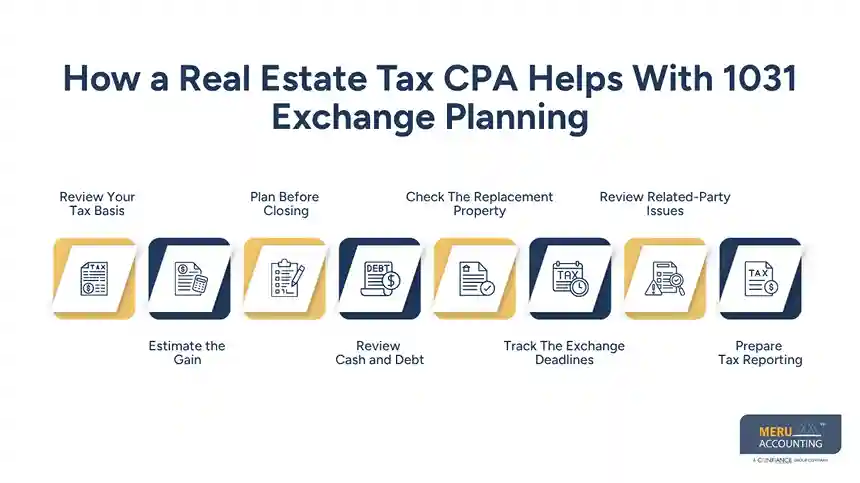
How a Real Estate Tax CPA Helps With 1031 Exchange Planning
Review Your Tax Basis
Your tax basis affects the gain that may arise from the sale. A real estate tax CPA can review the purchase cost, capital work, depreciation, and prior tax records.
Accurate basis records give you a clearer view of the tax result.
Estimate the Gain
Before closing, a real estate tax advisor can estimate the expected gain and potential tax liability. The estimate can include selling costs, debt, depreciation, and cash received.
That estimate gives you a better basis for deciding whether an exchange fits your plan.
Plan Before Closing
1031 planning should not start after the sale is complete. A tax professional with real estate expertise can review the deal before closing and flag issues that may affect the exchange.
Early review also gives your QI, attorney, lender, and tax advisor time to work from the same plan.
Review Cash and Debt
A sale may involve debt payoff, new debt, cash, and other items. A real estate tax specialist can model these parts and show where taxable gain may arise.
Receiving cash or non-like-kind property can lead to recognized gain to the extent of the amount received.
Check The Replacement Property
The replacement property must meet the rules for a 1031 exchange. A real estate tax CPA can review the proposed property and consider how its cost, use, ownership, and financing may affect the tax result.
Reviewing the replacement property before purchase can reduce the risk of making a choice that does not fit the planned exchange.
Track The Exchange Deadlines
The 45-day identification period and 180-day exchange period are key parts of the process. Missing either deadline can put the intended tax treatment at risk.
A tax professional can work with the qualified intermediary to track these dates and keep the tax strategy aligned with the transaction schedule.
Review Related-Party Issues
Special rules may apply when a related person or entity is involved in the exchange. Ownership links should be checked before the transaction moves forward. The parties involved should be reviewed carefully to identify any tax concerns that may require further advice from an attorney or qualified intermediary.
Prepare Tax Reporting
Form 8824 is used to report a qualifying like-kind exchange. A real estate tax CPA can prepare or review the form and the related tax return entries.
The IRS states that Form 8824 reports the exchange and helps calculate deferred gain and the basis of the property received.
optional anymore
on running the business
Key 1031 Exchange Rules Every Real Estate Investor Should Know
Investment or Business Use
The property must meet the required use test. A property held mainly for sale does not qualify under Section 1031.
A real estate tax consultant can review how you hold and use the property before the exchange begins.
Real Property Only
Since 2018, Section 1031 has been limited to real property. Personal and intangible property generally does not receive the same treatment.
A property tax accountant can separate qualifying real property from other assets in a sale.
U.S. Property Limits
U.S. real property and foreign real property are not treated as like-kind for Section 1031.
Cross-border deals need careful review by a real estate tax CPA before the transaction starts.
Related-Party Deals
Special rules apply when related parties take part in an exchange. Such deals can face limits on tax deferral.
A real estate tax specialist should review ownership links before you sign the exchange documents.
Tax Deferral is Not Tax Forgiveness
A 1031 exchange generally defers qualifying gain rather than making the gain disappear. The deferred amount can affect the basis of the replacement property.
A real estate tax CPA can model the future tax impact so you know what the exchange does and does not change.
Using Real Estate Tax Planning Services To Reduce Tax Exposure
Review The Sale Before Listing
Real estate tax planning services can start before you list the property. A tax review can estimate gain and compare a taxable sale with an exchange.
That work can also show how the sale fits your wider investment plan.
Compare Replacement Properties
Real estate tax planning services can assess more than the purchase price. Your review may include expected income, debt, depreciation, cash needs, and future tax effects.
A real estate tax CPA can compare these numbers before you commit funds.
Plan For Depreciation
Depreciation can affect the gain calculation when property is sold. Your tax accountant can review past depreciation records and account treatment.
Strong records matter because old tax filings can affect the current exchange calculation.
Watch For Taxable Cash
Real estate tax planning services can model cash that may be received during the exchange. Cash and non-like-kind property may create current taxable gain.
The IRS confirms that gain can be recognized to the extent of money or other non-like-kind property received.
Build a Future Tax Plan
A real estate tax CPA should look beyond the current transaction. The replacement property’s basis, future sale, estate goals, and holding plan may all matter.
Real estate tax planning services can bring these items into one tax plan.
Common 1031 Exchange Tax Planning Mistakes To Avoid
Starting Too Late
Waiting until the closing date can leave little time for tax review. A real estate tax CPA should be part of the deal before funds change hands.
Early planning gives the team time to check the structure.
Missing The Deadlines
The 45-day and 180-day limits are key. A 1031 exchange tax advisor can track both dates and keep the exchange team informed.
Do not assume that a late identification or late purchase can be fixed later.
Taking Sale Funds Directly
Taking control of sale proceeds can create serious exchange issues. The QI structure must be set up correctly before the transfer.
Your real estate accounting advisor should work with the QI and attorney before closing.
Buying a Non-Qualifying Asset
Not every asset tied to a real estate deal qualifies. Section 1031 applies to qualifying real property, subject to the detailed rules.
A real estate tax CPA can review the purchase contract and asset mix before closing.
Ignoring Related-Party Rules
A related-party exchange can require special treatment and added reporting. The IRS has specific rules for these transactions.
Real estate tax planning services can identify these issues before they affect the deal.
How To Choose The Right Real Estate Tax CPA For Your Investment
Check 1031 Experience
Ask whether the CPA has worked on real estate exchanges. A real estate tax CPA with direct 1031 experience can better understand the timing and tax records involved.
Ask about similar deals, not only general tax work.
Review Real Estate Tax Skills
Real estate tax work can involve depreciation, basis, capital gains, passive activity rules, and entity issues. A real estate tax CPA should understand how these areas connect.
Real estate tax planning services should cover the full deal, not just the tax return.
Ask About Communication
Exchange deals move on fixed dates. Your real estate tax CPA should give clear answers and flag time limits early. Effective communication can prevent avoidable delays.
Confirm Filing Knowledge
Form 8824 is part of the reporting process for qualifying exchanges.
Ask whether the CPA will prepare, review, and explain the required tax filings.
Look For a Planning Mindset
A real estate tax CPA should not only record what happened. The CPA should review what you plan to do and explain the likely tax effect before you act.
That approach gives you more control over major property decisions.
Get Professional 1031 Exchange Tax Services From Meru Accounting
At Meru Accounting, we provide professional tax services for real estate investors involved in 1031 exchanges and other property transactions. Our team handles transaction reviews, gain calculations, basis assessments, depreciation considerations, and related tax reporting requirements.
Our real estate tax planning services are structured around the specific details of each property transaction, helping clients address tax obligations accurately and efficiently. We can also coordinate with qualified intermediaries, attorneys, lenders, and other professionals involved in the transaction when needed.
Our real estate tax advisor services give investors access to professional support for evaluating tax consequences, preparing calculations, and meeting applicable reporting requirements.
Contact Meru Accounting to discuss your 1031 exchange and access professional tax services tailored to your real estate investment needs.
Our Expert Perspective
A 1031 exchange requires tax review before the sale closes, not after problems arise. Our real estate tax planning services cover gain, adjusted basis, depreciation, debt, cash, property use, deadlines, and replacement property requirements.
We also consider the tax reporting and documentation needed throughout the transaction. Coordination with the QI, attorney, lender, and other professionals helps keep the transaction properly aligned.
Because tax outcomes depend on the specific facts, professional review should begin before the exchange is underway.
Key Takeaways
- A 1031 exchange can defer taxable gain from the sale of qualifying real estate.
- Section 1031 generally applies to real property held for business or investment purposes.
- The replacement property must be properly identified within the 45-day identification period.
- The replacement property generally must be acquired within 180 days of the sale.
- A qualified intermediary is typically required for a properly structured deferred exchange.
- Receiving cash or non-like-kind property may result in taxable gain.
- Related-party transactions require additional review because special tax rules may apply.
- A real estate tax CPA can review the transaction before closing and identify potential tax issues.
- Real estate tax planning services can address gain, basis, debt, cash, depreciation, and reporting requirements.
- Form 8824 is generally used to report a qualifying like-kind exchange to the IRS.
FAQs
1031 exchange tax planning is the process of preparing a property exchange to defer eligible tax on gains under Section 1031.
A real estate tax CPA reviews the property basis, gain, depreciation, deadlines, and tax filing needs before the exchange closes.
An investor generally has 45 days to identify replacement property and 180 days to receive it after transferring the old property.
Real estate tax planning services can identify eligible tax deferral options and plan the exchange before the property sale takes place.
A real estate tax CPA should be involved before the sale closes so the exchange structure, deadlines, and tax effects can be reviewed in advance.
optional anymore
on running the business