




Managing bookkeeping for multi-location restaurants takes more than recording sales and bills. Each site may have its own sales, staff, rent, stock, bills, and cash flow. At the same time, the owner needs one clear view of the full business. A strong system keeps each location clear while also giving the group one set of useful reports.
Effective bookkeeping for multi-location restaurants starts with a set process. Each site should use the same account rules, sales checks, expense rules, and close dates. The goal is not only to keep records clean. The goal is to give owners data they can trust when they plan costs, review site results, or make key money choices.
What You Will Learn From This Blog
- Learn how to maintain consistent bookkeeping practices across all restaurant locations.
- Understand how to organize financial records separately for each restaurant location.
- Learn how to track sales, expenses, payroll, inventory, and other operating costs by location.
- Understand how accurate reconciliation supports effective bookkeeping for multi-location restaurants across POS, bank, and accounting records.
- Learn how to identify and correct common bookkeeping errors across multiple restaurant locations.
- Understand how bookkeeping services for restaurants can manage financial records for multi-location businesses.
How to Keep Financial Records Consistent Across Restaurant Locations
Consistent records are a key part of bookkeeping for multi-location restaurants. Each site may have a different sales level, but the way each site records money should stay the same.
Use One Chart Of Accounts
Create one chart of accounts for the full group. Each site can then use the same income and cost codes for rent, food, wages, ads, repairs, and other key costs.
Set One Bookkeeping Process
Write down how each site must record sales, bills, tips, refunds, fees, and cash use. A clear process cuts down on site-by-site changes that can make reports hard to compare.
Use Standard Close Dates
Set one close date for all sites each month. Site managers should send key records by the same cut-off date so the finance team can close the books in a set order.
Keep Vendor Names Clean
Use the same name for the same vendor across all sites. Clean vendor data also supports accurate bookkeeping for multi-location restaurants by keeping supplier costs consistent across sites.
Review Reports In One Format
Use the same report format for each site. A shared format lets owners compare sales, food cost, labor cost, and net income without having to sort through a new report style for each site.
Why Bookkeeping For Multi-Location Restaurants Requires A Different Approach
The needs of bookkeeping for multi-location restaurants grow as more sites open. More sales channels, staff, vendors, bank accounts, and bills can create more points where errors may occur.
Multiple Sales Channels
A single site may take cash, card, app, delivery, and online orders. Several sites multiply these sales records, which makes daily checks more important.
Separate Bank And Card Accounts
Each restaurant location may have its own bank account or credit card, creating more transactions to track and reconcile. Financial records must clearly link each account to the correct location to prevent costs or payments from being recorded under the wrong site.
Location-Based Payroll
Payroll may differ by site due to staff size, pay rates, tips, and work hours. Site-level payroll data should stay linked to the right location for clear cost reports.
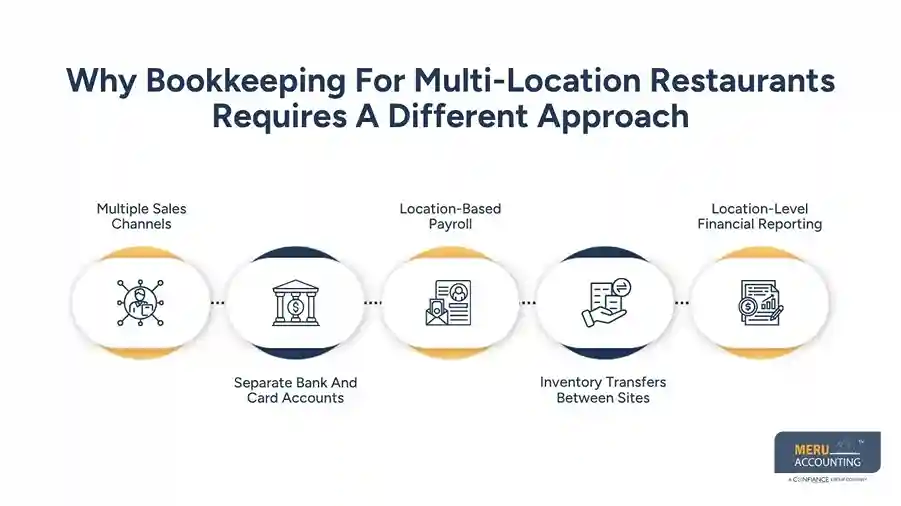
Inventory Transfers Between Sites
Record each stock transfer with the item, quantity, cost, date, sending site, and receiving site. Update inventory at both locations to ensure stock records remain accurate and balanced.
Location-Level Financial Reporting
Group sales alone can hide a weak site. Bookkeeping services for restaurants can provide reports by location so owners can see which sites earn well and which need review.
Set Up Separate Financial Records For Each Restaurant Location
A standardized accounting setup is one of the most useful parts of bookkeeping for multi-location restaurants. Each site needs clear records while the owner still needs group-level results.
Give Each Site A Clear Code
Use a short code for each location in the accounting system. The code can link sales, costs, assets, payroll, and other entries to the right site.
Track Income By Location
Record sales by site and, where useful, by sales type. Owners can then compare dine-in, takeout, delivery, catering, and other income streams.
Track Costs By Location
Rent, wages, food, repairs, utilities, and local ads should be linked to the right site. Shared costs should have a set rule for how they are split.
Separate Shared Costs
Bookkeeping for multi-location restaurants should also account for shared costs, such as head office rent, group software, or central admin pay. Set a clear method for sharing such costs across sites.
Create Site-Level Reports
Build monthly profit and loss reports for each location. Bookkeeping services for restaurants can also bring site reports into one group report for owner review.
Common Bookkeeping Challenges For Multi-Location Restaurants
Many problems in bookkeeping for multi-location restaurants come from poor data flow rather than a lack of sales data. A clear check plan can reduce these gaps.
POS And Bank Totals Do Not Match
POS sales may differ from bank deposits due to fees, tips, refunds, or deposit timing. Each gap should be checked before the books are closed.
Costs Go To The Wrong Site
A bill bought for Site A may be posted to Site B. Such errors can make one site look costly, and another look more profitable than it is.
Cash Counts Do Not Match
Cash sales need a daily count and deposit check. Small gaps can add up when cash records are not checked on a set cycle.
Vendor Bills Are Missed
Late bills can make a site look more profitable than it is. Bills should be logged when received and tied to the right site.
Reports Are Not Closed On Time
Late data from one site can delay the full group report. Bookkeeping services for restaurants can set a close plan and follow up on missing records.
Best Practices For Bookkeeping For Multi-Location Restaurants
Strong bookkeeping for multi-location restaurants depends on repeatable daily, weekly, and monthly checks. The process should be easy for site teams to follow.
Set Daily Sales Checks
Compare daily POS sales with cash, card, delivery, and other payment records to confirm that all sales are recorded correctly. Any difference should be reviewed, documented, and reported to the bookkeeping team for correction.
Review Costs Each Week
Review food spend, labor, repairs, and other key costs each week. A weekly check can spot a sharp rise before it affects the full month.
Close Books Each Month
Set a fixed month-end close process. All bank, card, payroll, POS, bill, and sales records should be checked before reports are sent to owners.
Compare Sites
Review key results across locations. Sales per site, labor cost, food cost, and other core figures can show where a site needs closer review.
Keep A Review Trail
Keep notes for major changes, corrections, and unusual entries. Bookkeeping services for restaurants can maintain review records so the finance team can trace key changes later.
How To Reconcile POS, Bank, And Accounting Records
POS and bank checks are a core part of bookkeeping for multi-location restaurants. The aim is to make sure recorded sales match the money that should reach the bank.
Start With POS Sales
Pull the daily POS report for each site. Check gross sales, refunds, discounts, tips, taxes, and payment types before posting the data.
Match Payment Deposits
Compare POS payment totals with bank deposits. Keep in mind that payment processors may deduct fees before money reaches the bank.
Check Cash Deposits
Match the cash shown in the POS report with the cash count and bank deposit. Any gap should have a clear note and review result.
Record Processing Fees
Card and delivery fees should be posted as costs. Recording only the net bank deposit can hide the true sales and fee figures.
Review Unmatched Items
Keep a list of items that do not match. Bookkeeping services for restaurants can review these items, trace the source, and clear old unmatched entries.
How Meru Accounting Can Support Multi-Location Restaurant Bookkeeping
Bookkeeping for multi-location restaurants requires consistent processes to keep sales, expenses, deposits, and financial records organized across every location. Meru Accounting can help organize these records through consistent processes that work across the full restaurant group.
Location-Level Record Management
We can help maintain separate financial records for each restaurant location while keeping the overall accounting structure consistent.
Sales And Bank Reconciliation
Our team can review POS sales, payment records, bank deposits, and processing fees to help identify differences and keep records accurate.
Expense Tracking
Restaurant costs can be assigned to the correct location and account. Shared expenses can also be tracked using an agreed allocation method.
Monthly Financial Reporting
We can prepare location-level and group-level reports that support bookkeeping for multi-location restaurants and help owners compare sales, labor costs, food costs, operating expenses, and profitability.
Ongoing Accounting Support
Meru Accounting can provide ongoing accounting support based on the needs of multi-location restaurant businesses. A consistent process can make financial reviews easier and reduce the routine workload for restaurant owners and management teams.
Our Expert Perspective
At Meru Accounting, our expert perspective is that multi-location restaurants should maintain consistent financial processes while keeping each location’s sales, expenses, payroll, inventory, and other costs clearly separated.
Effective bookkeeping for multi-location restaurants includes standard account rules, regular POS and bank reconciliations, fixed month-end procedures, and location-level reporting to help owners compare performance and identify unusual costs.
Key Takeaways
- Maintain one consistent chart of accounts across all restaurant locations.
- Assign a clear location code to track each restaurant separately.
- Record sales, expenses, payroll, and other costs by location.
- Reconcile POS, bank, cash, and payment records on a regular basis.
- Daily reviews support reliable bookkeeping for multi-location restaurants by identifying sales and payment errors early.
- Apply clear rules for allocating shared costs across locations.
- Follow the same monthly bookkeeping and closing process at every site.
- Compare sales, labor costs, food costs, and profit across locations.
- Document unusual transactions, corrections, and missing records for future review.
- Use bookkeeping services for restaurants when managing multiple locations becomes complex.
FAQs
Bookkeeping for multi-location restaurants means tracking sales, costs, payroll, cash, bank activity, and other records for each restaurant while also managing group-level financial data.
Use a separate location code or class for each site. Record sales, costs, payroll, and other key entries against the correct location.
POS checks compare recorded sales with deposits and accounting records. Reconciliation can find missing sales, wrong entries, fees, refunds, and cash gaps.
Daily sales checks are useful, while bank and card accounts should be checked on a regular close schedule. Monthly review gives owners a clear view of each site’s results.
Yes. Bookkeeping services for restaurants can manage records for several sites, including reconciliations, bills, payroll records, reports, and location-based financial data.


