Choosing bookkeeping services for dentists takes more than comparing monthly fees. Your bookkeeper will handle financial records that help you track revenue, expenses, cash flow, and the overall health of your practice. A provider who understands dental practices can make that work more useful and much easier to manage.
The challenge is knowing what separates a reliable provider from one that simply offers basic bookkeeping. Dental practices have their own mix of patient payments, insurance income, payroll, lab fees, supplies, and equipment costs. That makes industry experience, a clear process, accurate reporting, and familiarity with dental software worth checking before you hire.
In this guide, we’ll cover what to look for in dental bookkeeping services, the questions to ask potential providers, and a practical checklist to help you choose the right fit for your practice.
What You Will Learn From This Blog
In this guide, you will learn:
- What dental bookkeeping services should cover
- What to look for when comparing dental bookkeeping services providers
- Questions to ask before you hire a bookkeeper
- Red flags that may point to a poor fit
- A simple checklist to help you compare dental bookkeeping services providers
- How outsourced bookkeeping can support your dental practice
What Should Bookkeeping Services for Dentists Include?
A reliable provider should do more than enter transactions. The service should help keep your financial records accurate, current, and easy to review.
Here are some core tasks to look for:
Transaction recording: Income and expenses should be recorded and placed in the right accounts. This gives you a clean view of where your money comes from and where it goes.
Bank and credit card reconciliation: Your books should be checked against bank and card records on a set schedule. This helps spot missing entries, errors, and duplicate transactions.
Accounts receivable tracking: A dental practice may have money due from both patients and insurance plans. Your bookkeeper should track receivables and help you see what is still unpaid.
Expense tracking: Dental supplies, lab fees, rent, equipment, software, and other costs should be tracked in a clear way.
Financial reports: You should receive useful reports, such as a profit and loss statement and balance sheet. These reports can help you review the financial health of your practice.
Tax-ready records: Your books should be kept in a form that makes it easier for your CPA or tax professional to prepare returns and plan for tax needs.
The exact scope can vary by provider. Before you sign an agreement, ask what is included in the monthly fee and what services cost extra.
8 Things to Look for in Bookkeeping Services for Dentists
Here are 8 things to look for when choosing bookkeeping services for dentists:
Experience With Dental Practices
Industry experience matters. A bookkeeper who works with dental offices may have a better grasp of common income and expense types than someone who mainly serves unrelated businesses.
Ask how many dental practices they support and what types of dental offices they have worked with.
Knowledge of Dental Revenue and Expenses
Your provider should understand the way a dental practice earns and spends money. This may include patient payments, insurance income, dental labs, supplies, equipment, rent, staff costs, and other practice expenses.
They should also know how to set up accounts in a way that gives you useful financial data.
Clear Monthly Reporting
Good books are useful only when you can understand them.
Ask what reports you will get each month and when they will be ready. A good provider should be able to explain key numbers in plain language, not just send a report and leave you to work it out.
Familiarity With Dental Practice Software
Many dental offices use practice management systems along with accounting software. Your bookkeeper should know how to work with the systems your practice uses or have a clear process for moving data between them.
This can help reduce manual work and lower the risk of data errors.
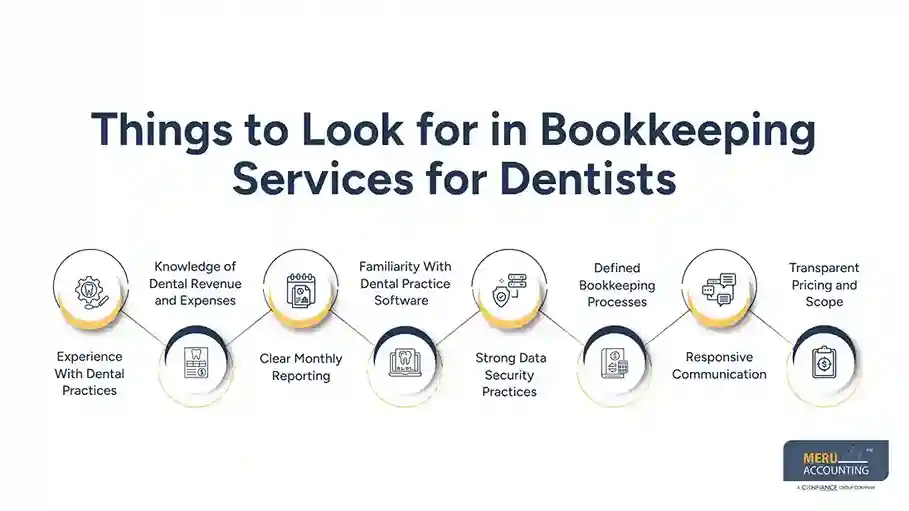
Strong Data Security Practices
Financial records contain sensitive business data. Ask how the provider stores files, controls access, and shares financial information.
A professional provider should have clear rules for protecting client data and limiting access to people who need it.
Defined Bookkeeping Processes
Ask how the work is done from month to month.
A strong process may include transaction review, reconciliation, account checks, and a final review before reports are sent to you. Clear steps help reduce missed work and make the service easier to manage.
Responsive Communication
You should know who to contact when you have a question about your books.
Ask how often you will hear from the team, how quickly they respond, and whether you will have a set point of contact. Good communication can make outsourced bookkeeping much easier.
Transparent Pricing and Scope
Do not judge a service by price alone.
Compare what each provider includes, how often work is done, what reports you receive, and which tasks cost extra. A low monthly fee may not be a good deal if key work is left out.
optional anymore
on running the business
Questions to Ask Before Choosing From Bookkeeping Services for Dentists
Before choosing from bookkeeping services for dentists, ask direct questions to the provider about work and process.
- Do you have experience with dental practices?
- What tasks are included in your monthly service?
- How often do you reconcile bank and credit card accounts?
- What financial reports will I receive?
- Can you work with my current accounting and dental practice software?
- Who will handle my account?
- How do you review the books for errors?
- How do you protect client financial data?
- What happens if I need help outside the normal monthly work?
- Is there a long-term contract?
- Are there setup fees or extra charges for certain tasks?
The answers can help you see how the dental bookkeeping services provider works before you hand over your financial records.
A Practical Checklist for Choosing From Bookkeeping Services for Dentists
Use this checklist for choosing from bookkeeping services for dentists and compare providers:
What to Check | What to Look For |
Dental experience | Past work with dental practices |
Service scope | Clear list of included tasks |
Reconciliation | Regular bank and card checks |
Reporting | Timely, easy-to-read reports |
Software | Support for your current systems |
Security | Clear data protection practices |
Communication | Easy access to the bookkeeping team |
Pricing | Clear fees with no hidden scope gaps |
Review process | Checks for errors before reports are sent |
Scalability | Ability to support your practice as it grows |
Do not choose a dental bookkeeping services provider based on one factor. Look at the full service, then compare it with your practice needs.
Meru Accounting’s Bookkeeping Services for Dentists
Dental practices have financial activity that goes well beyond daily sales. Insurance payments, patient balances, payroll, lab bills, supplies, and equipment purchases all need to be recorded and tracked correctly. Meru Accounting supports dental practices with bookkeeping built around these day-to-day needs.
Our bookkeeping services for dentists:
Area | What We Handle |
Daily bookkeeping | Recording and categorizing practice income and expenses |
Bank reconciliation | Matching bank and credit card activity with accounting records |
Accounts receivable | Tracking patient and insurance balances and payments |
Expense tracking | Organizing supplies, lab fees, equipment, and other practice costs |
Financial reporting | Preparing financial reports for regular practice review |
Month-end bookkeeping | Keeping records current and resolving outstanding items |
Our role is to keep the bookkeeping side of the practice consistent throughout the year, so your financial records don’t become a last-minute cleanup task. With the right records in place, you and your CPA have better information to work with when reviewing the practice.
Our Expert Insight
In our experience, dental bookkeeping can look accurate on the surface while still missing useful detail. Insurance payments, patient collections, adjustments, and deposits need to line up with the practice’s financial records. When they don’t, the reports may not give the owner a clear picture of actual collections or outstanding balances.
That’s why we look beyond whether the books are simply reconciled. Choosing bookkeeping services for dentists wisely can make it easy to trace important numbers, spot unusual changes, and understand where the practice stands each month. For dental practices, that level of detail can make financial reports far more useful for day-to-day decisions and long-term planning.
Key Takeaways
- Look for a bookkeeper with real experience in dental practices.
- Check the full service scope before comparing prices.
- Make sure bank and credit card accounts are reconciled on a regular basis.
- Ask for clear and timely financial reports.
- Confirm that the provider can work with your current software.
- Ask how financial data is stored and protected.
- Choose a provider with a clear process and reliable communication.
- Think about whether dental bookkeeping services can support your practice as it grows.
FAQs
Ask whether they have experience with dental-specific income, expenses, insurance payments, patient balances, and practice management systems.
At minimum, you should be able to review a profit and loss statement, balance sheet, and cash flow information. Your reporting needs may vary by practice size and goals.
Not always. It depends on your workflow and the tasks they handle. If access is needed, confirm what data they will use and how access will be controlled.
Yes. A bookkeeper can reconcile accounts, review transactions, and flag items that don’t match your records. Complex accounting or tax issues may require a CPA.
Be prepared to share your accounting records, bank and credit card information, prior financial reports, software details, and details about your practice’s current bookkeeping process.
optional anymore
on running the business