Meru Accounting

How to Claim Landlord Tax Deductions for Repairs, Maintenance, and Property Expenses

Contents
Looking for Reliable Accounting Support?

Let our experts help you simplify accounting, manage compliance and focus on growing your business.


    How to Claim Landlord Tax Deductions for Repairs, Maintenance, and Property Expenses

    A rental property can bring in steady income, but one unexpected repair can eat into your profit. The bigger issue? Not every dollar you spend on the property can be deducted right away. Knowing how landlord tax deductions work can help you avoid costly tax mistakes and make better decisions about property expenses.

    For instance, fixing a broken water heater and installing a brand-new one may seem like similar expenses, but the IRS may treat them very differently. The same goes for routine upkeep, major upgrades, and costs tied to a vacant rental.

    Understanding these differences can help you claim eligible expenses, keep better records, and make the most of the tax benefits for landlords without running into trouble at tax time.

    What You Will Learn From This Blog

    • Which rental costs may qualify as tax deductions.
    • How to tell the difference between repairs and upgrades.
    • How to claim landlord tax deductions on your tax return.
    • What rules apply to vacant and part-time rental homes.
    • How good records can help support your claims.

    What Are Landlord Tax Deductions?

    Landlord tax deductions are costs you can subtract from your rental income when you work out your taxable income. These costs must be ordinary and needed to run, care for, or manage your rental property.

    For example, if you collect $30,000 in rent and have $8,000 in valid rental costs, you may report $22,000 before other tax items, such as depreciation and any limits that apply.

    The IRS allows many common rental costs as deductions. These can include repairs, upkeep, insurance, mortgage interest, property taxes, and fees paid to a property manager.

    These tax benefits for landlords can lower the share of rental income subject to tax. Still, you must meet IRS rules, keep proof of each cost, and report the right amount on your return.

    One key point: a tax deduction does not mean the IRS pays you back for the full cost. It lowers your taxable income. The tax saved will depend on your tax rate and other parts of your tax return.

    Which Rental Property Expenses Qualify for Tax Deductions?

    The IRS lists many costs that landlords may deduct from rental income. The exact amount you can claim depends on how the property is used and whether the cost is a repair, an upgrade, or a personal expense.

    Here are some common costs that may qualify.

    Expense type

    Examples

    Tax treatment

    Repairs

    Fixing a leak, patching a wall, or replacing a broken lock

    Often deductible in the year paid

    Upkeep

    Lawn care, pest control, and cleaning

    Often deductible

    Insurance

    Rental home and liability cover

    Deductible share may apply

    Property taxes

    Local real estate taxes

    Often deductible

    Mortgage interest

    Interest on a loan used for the rental home

    Often deductible

    Utilities

    Water, gas, power, and trash service paid by the landlord

    Often deductible

    Property management

    Fees paid to a rental manager

    Often deductible

    Legal and tax fees

    Fees for rental matters and tax return work

    Often deductible

    Ads

    Online rental ads and tenant search costs

    Often deductible

    Note: These costs must relate to the rental activity. Some may need to be split between rental and personal use, while others may be subject to special tax rules.

    Repairs and Upkeep

    Costs to keep a rental home in good shape may qualify as deductions. These include fixing a pipe, clearing a drain, repainting a room, mowing the lawn, and hiring a pest control service.

    For example, if you pay $350 to fix a leaking sink, the cost may be a repair expense. If you pay a cleaner $150 to get the home ready for a new tenant, that cost may also qualify.

    Insurance and Property Taxes

    Landlords may deduct the cost of insurance for their rental homes. This can include fire, theft, and liability cover. If you pay for more than one year of cover in advance, you may need to deduct the cost over the period it covers.

    Real estate taxes paid on a rental property may also qualify. Keep tax bills and proof of payment with your records.

    Mortgage Interest and Utilities

    The interest paid on a loan used to buy or improve a rental home may be deductible. The loan’s principal payments are not rental expense deductions.

    If you pay for water, gas, power, or trash service for your tenants, these costs may also qualify. Keep bills and payment records to show that the costs relate to the rental home.

    Management and Professional Fees

    Fees paid to a property manager, tax preparer, lawyer, or other service provider may qualify when they relate to your rental activity.

    For example, a fee paid to a manager to find tenants or collect rent may be a rental expense. Fees for personal legal work are not rental costs.

    These are some of the tax benefits for landlords that can help lower taxable rental income. The key is to claim only costs that meet the tax rules.

    Good financial management isn't
    optional anymore
    Meru Accounting handles the accuracy, so you can focus
    on running the business

    Repairs vs. Improvements: What Can Landlords Deduct?

    One of the most common mistakes landlords make is treating every property expense as a repair. The IRS views repairs and improvements in different ways, and this can change when you get a tax deduction.

    What Counts as a Repair?

    A repair fixes a problem or keeps a rental home in working order. It does not add major value to the home or make it last much longer.

    Common examples include:

    • Fixing a broken door or window.
    • Patching small holes in walls.
    • Repairing a leaking pipe.
    • Replacing a broken lock.
    • Fixing a faulty light switch.
    • Repainting a room to keep it in good shape.

    These costs may qualify as current rental expense deductions if they meet IRS rules and do not need to be added to the property’s cost basis.

    What Counts as an Improvement?

    An improvement makes a home better, brings it back to a like-new state, or changes it for a new use. These costs must usually be added to the property’s cost basis and recovered over time through depreciation.

    Examples include:

    • Adding a new room or garage.
    • Replacing the whole roof.
    • Installing a new heating or cooling system.
    • Making major kitchen upgrades.
    • Adding a new fence or deck.
    • Replacing a large part of the plumbing system.

    For example, fixing a few roof shingles may count as a repair. Replacing the full roof is more likely to count as an improvement.

    How to Tell the Difference

    Ask three key questions when you review a property cost:

    1. Does it make the home better? If the work adds value or improves its use, it may be an improvement.
    2. Does it restore a major part? Work that brings a major part of the home back to like-new shape may need to be capitalized.
    3. Does it change how the home is used? Work that adapts the home for a new use may count as an improvement.

    The IRS also has safe harbor rules for some small costs and routine upkeep. These rules have set limits and terms, so check if your cost meets them before you claim it.

    Keep repair bills and upgrade costs in separate records. This makes it easier to claim valid landlord tax deductions and track the cost of assets that must be depreciated.

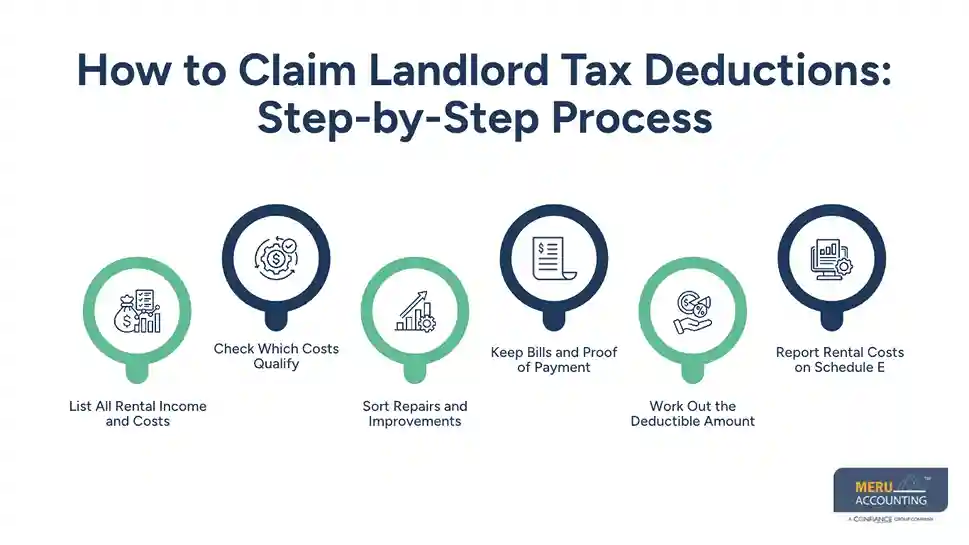
    How to Claim Landlord Tax Deductions: Step-by-Step Process

    Claiming rental costs starts with good records and the right way to sort each expense. Follow these steps to make the process easier.
    How to Claim Landlord Tax Deductions: Step-by-Step Process

    Step 1: List All Rental Income and Costs

    Start by making a list of all rent received and costs paid during the tax year. Include repair bills, upkeep, insurance, property taxes, loan interest, utility bills, and management fees.

    Use a separate bank account or card for rental costs if you can. This helps keep personal spending apart from rental activity.

    Step 2: Check Which Costs Qualify

    Review each cost and ask if it was needed to manage, care for, or run the rental home. Do not claim personal costs as rental expenses.

    For example, a repair made to a rental home may qualify. A repair made to your own home does not count as a rental cost.

    Step 3: Sort Repairs and Improvements

    Place each cost in the right group. Repairs and routine upkeep may qualify for a current deduction. Major upgrades may need to be added to the property’s cost basis and claimed over time.

    If a bill has both repair and upgrade work, ask the service provider for a clear split. This can help you report each part in the right way.

    Step 4: Keep Bills and Proof of Payment

    Save receipts, bills, bank records, tax bills, and signed work orders. Each record should show:

    • The date you paid.
    • The amount paid.
    • The type of work done.
    • The rental home linked to the cost.
    • The name of the service provider.

    A short note on why the work was needed can also help. For example, write “fixed water leak in the upstairs bath” rather than just “plumbing.”

    Step 5: Work Out the Deductible Amount

    Add up the costs that qualify for a deduction. If you own only part of a rental home, you can claim only your share of the costs you paid.

    Also, split costs that relate to both rental and personal use. Do not claim the full amount if only part of the cost relates to the rental activity.

    Step 6: Report Rental Costs on Schedule E

    Most landlords who rent homes, rooms, or flats and provide basic services report rental income and costs on Schedule E (Form 1040), Part I.

    You will list income, costs, and depreciation for each rental home. Keep your records in case the IRS asks you to show how you worked out a deduction. Some cases may need other tax forms or extra steps.


    Example: How Rental Property Deductions Work

    Suppose you own a rental home and collect $24,000 in rent during the year. You also pay the costs below.

    Expense

    Amount

    Plumbing repair

    $450

    Pest control

    $250

    Property insurance

    $900

    Property tax

    $2,000

    Mortgage interest

    $3,000

    Lawn care

    $400

    Total costs

    $7,000

    Your rental income after these costs is $17,000 before depreciation and any other tax items.

    Illustrative example only. It assumes all listed costs qualify and relate fully to the rental home. It does not include capital upgrades or limits that may apply.

    This is why sound records matter. They help you find valid landlord tax deductions and show how you worked out your rental income.

    Special Tax Rules for Vacant, Partially Rented, and Personal-Use Properties

    Not all rental homes are used in the same way. The IRS has special rules for homes that sit empty, are partly rented, or are also used by the owner.

    Vacant Rental Homes

    You may still be able to deduct normal and needed costs while a rental home is vacant, as long as you hold it for rent and keep it ready and open for tenants.

    For example, you may still pay for insurance, lawn care, basic upkeep, and other costs while looking for a new tenant. These costs may qualify even if you did not earn rent during that time.

    However, you cannot claim a deduction for rent you hoped to earn but did not receive. If you take the home off the rental market and hold it for personal use, the tax rules may change.

    Internal Revenue Service

    Partly Rented Homes

    If you rent out only part of your home, you must split shared costs between rental and personal use.

    For example, if you rent out one room in a 2,000-square-foot home and that room is 200 square feet, you may use a 10% share for costs that apply to the whole home, if square footage is a fair way to split them.

    Costs that relate only to the rented room may be fully linked to the rental activity. Keep a clear record of how you split each shared cost.

    Internal Revenue Service

    Homes Used for Personal Reasons

    If you use a rental home for your own stay or let family use it, your rental expense claims may be limited.

    For a home used as a residence, the IRS generally looks at whether personal use is more than the greater of 14 days or 10% of the days it is rented at a fair rental price.

    There is also a special rule for homes used as a residence and rented for fewer than 15 days in the year. In that case, the rent may not need to be reported as rental income, and rental expense rules are different.

    These rules can affect your landlord tax deductions and the tax benefits for landlords you may claim. Check the IRS rules before filing if you use the home for both rental and personal stays.

    Tax Services for Your Rental Properties by Meru Accounting

    A repair invoice, a contractor’s bill, and a property improvement may all appear under the same expense category in your books, but they can have very different tax implications. Getting these details right takes more than basic bookkeeping. It requires careful expense classification, proper records, and a clear understanding of rental property tax rules.

    Meru Accounting helps landlords organize their rental finances and prepare for tax filing with services that include:

    • Rental Expense Tracking: Record and categorize repair, maintenance, insurance, utility, and property management costs.
    • Repair and Improvement Classification: Review property expenses to help distinguish current repairs from capital improvements that may require depreciation.
    • Rental Property Bookkeeping: Maintain clear income and expense records for each rental property.
    • Depreciation Tracking: Track property assets, qualifying improvements, and depreciation records for tax reporting.
    • Landlord Tax Preparation: Organize tax documents, review eligible rental expenses, and prepare rental income and expense details for tax filing.
    • Financial Reporting: Provide clear reports that help landlords review property expenses, rental income, and operating costs.

    From a single rental home to a portfolio of properties, our accounting team helps keep financial records organized and rental expenses properly documented. This gives landlords a clearer picture of their property finances and helps support accurate tax reporting.

    Our Expert Insight

    One detail landlords often overlook is the cost of work done after a tenant moves out. A $1,200 turnover bill may include carpet cleaning, lock changes, minor fixes, and a few upgrades. Rather than treating the full bill as one expense, review each charge on its own. The tax treatment can vary based on the work performed, not the contractor’s invoice title.

    We recommend reviewing rental expenses each month instead of waiting until tax season. This makes it easier to catch missing bills, spot unusual costs, and keep each property’s records up to date. It also gives you a clearer view of which properties are costing more to maintain and where your rental income is going.

    Key Takeaways

    • Many rental costs, such as repairs, upkeep, insurance, and property taxes, may qualify as tax deductions.
    • Repairs may be deducted in the year paid, while major upgrades are often claimed through depreciation.
    • Keep repair and improvement costs in separate records.
    • You may claim some costs while a rental home is vacant if it remains held and ready for rent.
    • Split shared costs between rental and personal use when needed.
    • Use Schedule E to report most rental income and expenses.
    • Keep bills, receipts, and proof of payment to support your claims.

    FAQs

    Yes. Landlords can generally deduct routine repairs, such as fixing leaks, broken locks, and damaged walls, if the work does not qualify as a capital improvement.

    Yes. Costs for lawn care, pest control, cleaning, and routine upkeep are generally deductible when they relate to rental use.

    Generally, no. Major upgrades, such as a new roof or HVAC system, must usually be capitalized and recovered through depreciation.

    Yes. Eligible expenses may still be deductible while a property is vacant, as long as it remains available for rent.

    Most individual landlords report rental income, expenses, and depreciation on Schedule E (Form 1040), Part I.

    Good financial management isn't
    optional anymore
    Meru Accounting handles the accuracy, so you can focus
    on running the business