Your first business tax return can raise a question you may not have thought about when you launched: where did all that startup money go, and how much of it can you write off? Not every dollar spent before opening day gets the same tax treatment. Understanding which business startup costs are tax deductible can help you avoid missed write-offs and keep your first tax filing on track.
The challenge isn’t just knowing what you spent. It’s having the right records to show what each payment was for, when you made it, and how it relates to your business. From a lawyer’s bill to a website payment or a piece of office equipment, each cost needs the right entry in your books. Let’s look at how to track these costs, follow IRS rules, and keep your tax records in good shape.
What You Will Learn From This Blog
- Which early business costs may qualify for tax relief.
- How the IRS treats startup costs and sets limits on the first-year write-off.
- How to record startup costs in your books.
- Which receipts, bills, and tax records to keep.
- How good bookkeeping can help small businesses avoid tax filing errors.
Understanding Business Startup Costs and Their Tax Treatment
Startup costs are costs you pay while setting up a new trade or business, or while looking into whether a business idea is worth pursuing. These costs are often paid before the firm starts active work. For tax purposes, the IRS has rules that help decide when and how these costs can be claimed.
For example, a person who plans to open a small café may pay for market research, staff training, ads, and advice from an expert before the doors open. Some of these costs may count as startup costs if they meet IRS rules.
The key point is that business startup costs tax deductible does not mean every pre-opening cost can be written off at once. Some costs may qualify for a first-year deduction, while others must be spread over time. Some may need to be recorded as assets and treated under a different tax rule.
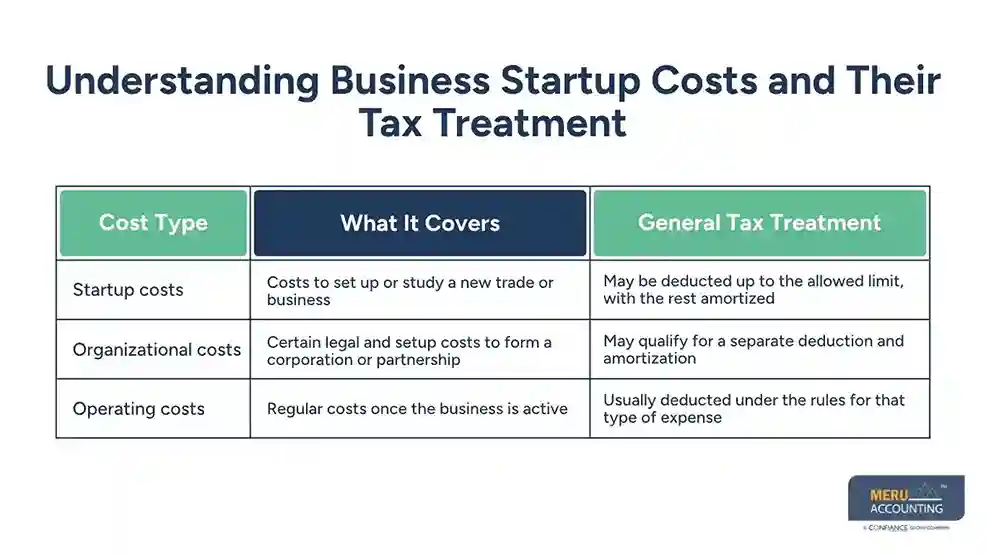
It’s also vital to know the difference between three types of costs:
Cost Type | What It Covers | General Tax Treatment |
Startup costs | Costs to set up or study a new trade or business | May be deducted up to the allowed limit, with the rest amortized |
Organizational costs | Certain legal and setup costs to form a corporation or partnership | May qualify for a separate deduction and amortization |
Operating costs | Regular costs once the business is active | Usually deducted under the rules for that type of expense |
This split helps you keep clean books and avoid placing all early costs in one broad account.
optional anymore
on running the business
Which Business Startup Costs Are Tax Deductible?
Not all early costs get the same tax treatment. The IRS looks at the purpose of each cost and whether it was paid to study, create, or prepare a new business for active work.
The following are common examples of deductible startup costs for small businesses, subject to the rules for each type of expense.
Market Research and Feasibility Studies
Before opening a business, you may pay for surveys, market reports, competitor research, or customer studies. These costs can help you decide whether your idea has a real chance of success. Qualifying research costs may count as startup costs.
Advertising and Marketing
You may spend money on a website, brand design, launch ads, flyers, or other early marketing work. These costs may qualify if they relate to setting up a new business and meet the IRS rules.
Employee Training and Recruitment
Costs to find and train staff before the business starts work may qualify as startup costs. Keep job ads, training bills, payment records, and details of the work done.
Travel and Professional Fees
Travel to study a new market, meet vendors, or assess a business site may qualify in some cases. Fees paid to an accountant, lawyer, or business adviser may also qualify if they relate to setting up the new trade or business.
Pre-Opening Rent and Other Costs
Rent, utilities, and other costs paid before opening may need a close review. The purpose and timing of each cost matter. Do not assume that every bill paid before launch is a startup cost.
Some costs need a different tax treatment. For example, office desks, computers, tools, and machines are often business assets. Their cost may be recovered through depreciation or another allowed tax rule. Inventory is also not treated as a regular startup expense. Its cost is usually handled through the rules for inventory and cost of goods sold.
This is why business owners should not put every early payment under one startup expense account. A clear split helps show which costs may qualify for a deduction and which need a separate tax review.
IRS Rules for Deducting Startup Costs
The IRS has set rules for how a new business can recover its startup costs. These rules are key to knowing whether business startup costs are tax deductible in the first year or over a longer time.
The $5,000 Startup Cost Deduction
A new business may elect to deduct up to $5,000 in eligible startup costs in the tax year it begins active work. This is not a flat tax credit or an automatic refund. It is a deduction that may lower the business’s taxable income.
The full $5,000 deduction is available only when total eligible startup costs do not exceed $50,000.
The $50,000 Phaseout Rule
If total startup costs go above $50,000, the $5,000 first-year deduction is cut by the amount over that limit.
For example:
Total Startup Costs | First-Year Deduction |
$20,000 | $5,000 |
$50,000 | $5,000 |
$52,000 | $3,000 |
$55,000 | $0 |
If eligible costs reach $55,000 or more, the first-year deduction is fully phased out. The costs that are not deducted may still be recovered through amortization, if they qualify.
The 180-Month Amortization Rule
Any eligible startup costs not deducted in the first year are generally spread over 180 months, or 15 years. This process is known as amortization.
The period starts in the month the business begins active work. For example, if a business starts in July, the amortization period begins in July, not when the owner first pays a bill.
For tax filing, the business may need to report this amount on Form 4562, depending on its tax setup and filing rules. The IRS explains these rules in its Instructions for Form 4562.
Startup Costs and Organizational Costs Are Not the Same
Startup costs relate to setting up or studying a new trade or business. Organizational costs relate to forming a legal business entity, such as a corporation or partnership.
For example, market research and pre-launch ads may be startup costs. Certain legal fees paid to form a corporation may be organizational costs. These costs have separate tax rules and limits, so they should be tracked in separate accounts.
The tax treatment may also vary by business type. A sole owner, partnership, S corporation, and C corporation may report these costs on different tax forms. A tax expert can help confirm the right method before filing.
How to Record Deductible Startup Costs in Your Bookkeeping
Good bookkeeping helps you track every early cost and gives your tax preparer a clear view of what the business spent. It also helps avoid errors when you decide which business startup costs are tax deductible.
Here are some steps to follow.
Create a Separate Startup Cost Account
Set up a separate account in your chart of accounts for startup costs. You can also use subaccounts for market research, ads, staff training, travel, and expert fees.
Keep organizational costs in a separate account. This makes it easier to review each type of cost at tax time.
Record Expenses Paid Before the Business Opens
Do not leave early costs out of your books just because the business has not started sales yet. Record the date, amount, vendor, payment method, and reason for each cost.
For example, if you pay $600 for market research in March and open the business in June, record the payment in March. The tax treatment can then be worked out based on the date the business began active work.
Track Costs Paid With Personal Funds
Many owners use their own money to pay for early business needs. These costs still need to be tracked in the business books.
For example, if an owner pays $1,200 for a website using a personal credit card, the business may record the cost and the amount owed to the owner. If the owner does not expect repayment, the entry may instead be treated as an owner contribution, based on the business structure and facts.
Do not record the payment as a business bank expense if it never went through the business bank account. Keep the receipt and a clear note of who paid it.
Separate Expenses From Assets
A laptop, machine, or office desk may last for more than one year. Such items may need to be recorded as assets rather than regular expenses.
The same care applies to stock bought for resale. It should be tracked as inventory, not mixed with general startup costs.
Reconcile Your Records
Match your books with bank and card statements each month. Check for missing bills, duplicate entries, and costs paid from personal funds. This helps keep the records right before tax filing.
Essential Bookkeeping and Tax Records to Keep
Knowing which business startup costs are tax deductible is only part of the task. You also need proof to support each cost. If the IRS asks about an expense, your books should show what you paid, who you paid, when you paid, and why the cost was linked to your business.
Here are the key records to keep.
Record Type | What It Should Show | Why It Matters |
Receipts and invoices | Vendor name, date, amount, and item or service | Supports the cost claimed |
Bank statements | Payments made from business accounts | Helps match costs with cash flow |
Credit card statements | Card payments and vendor details | Helps track business purchases |
Contracts and agreements | Work agreed on, fees, and service dates | Supports legal and expert fees |
Payroll records | Wages, staff details, and training costs | Helps support staff-related costs |
Travel records | Date, place, purpose, and cost of the trip | Shows the business reason for travel |
Business formation papers | Filing dates and legal setup costs | Helps support organizational costs |
Asset records | Purchase date, cost, and date placed in service | Helps track assets and depreciation |
Keep Receipts and Invoices
Save a copy of each bill or receipt. A bank entry alone may show that you paid a vendor, but it may not explain what you bought. For example, a $900 card payment to a design firm should have an invoice that shows whether the work was for a new website, a logo, or another service.
Add a short note to each record if the business reason is not clear from the bill.
Save Bank and Credit Card Statements
Keep monthly statements for all accounts used to pay business costs. If you use a personal card for a business purchase, save that statement too. Mark the business item and link it to the right receipt.
This helps you match each payment to your books and avoid missing costs.
Keep Travel and Staff Records
For travel, record the date, place, cost, and business reason. Keep tickets, hotel bills, and other proof of payment.
For staff costs, save job ads, offer letters, payroll data, and training bills. These records can help show what the cost was for and when it took place.
Store Records in a Safe Place
You can keep digital copies in a secure cloud folder or document system. Use clear file names, such as:
- 2026-03-Market-Research-Invoice.pdf
- 2026-04-Staff-Training-Receipt.pdf
- 2026-05-Office-Rent-Invoice.pdf
A set file naming rule makes it easier to find proof when you need it. Keep records for as long as the tax rules require. The right period can vary by record type. For many tax items, the IRS uses a three-year period as a general rule, but some records must be kept longer. For example, records that support an asset’s tax basis may be needed until the period for that asset has passed. Payroll tax records generally need to be kept for at least four years. Check the IRS guidance for your case rather than using one period for every file.
Meru Accounting’s Business Tax Services for Startups
A new business can have dozens of expenses before its first sale. A founder might pay a lawyer to form the company, hire a designer for the website, buy office equipment, and cover staff training from a personal account. If these transactions aren’t tracked properly, sorting out startup costs at tax time can become a difficult task.
Meru Accounting helps new businesses bring order to these early financial records. Our team works on the bookkeeping and tax support tasks that help owners understand where their startup money goes and prepare for tax filing.
Our services include:
- Startup Cost Tracking: Record pre-opening payments and maintain a clear list of launch expenses.
- Expense Classification: Separate potential startup costs from organizational expenses, fixed assets, inventory, and regular operating costs.
- Founder Expense Recording: Track business purchases paid through personal bank accounts or credit cards and record the right owner contribution or amount due.
- Account Reconciliation: Match bank and credit card transactions with receipts, invoices, and bookkeeping entries.
- Bookkeeping Cleanup: Review past entries, correct account errors, and organize missing transaction records.
- Business Tax Preparation Support: Prepare well-organized financial records for tax review and filing.
- Financial Reporting: Provide clear reports that help owners review startup spending, cash flow, and ongoing business costs.
Our focus is to make sure your startup expenses don’t remain a pile of unclassified transactions. With the right bookkeeping process, you can give your tax professional a clearer record of what you spent, when you spent it, and why. Meru Accounting helps you build that record while you focus on getting your business off the ground.
Our Expert Insight
A bookkeeping issue worth watching is how founders handle costs paid personally before opening a business bank account. For example, an owner may pay a $4,000 software developer using a personal credit card, then transfer $4,000 from the business account to cover the bill. Recording both payments as business expenses would double-count the cost and overstate expenses.
The correct entry should reflect the original purchase and how the owner funded it, such as an owner contribution or an amount owed to the owner, based on the business structure. When reviewing startup books, we pay close attention to these entries because even a small error can affect expense totals, owner equity, and tax records. Keeping the original invoice and linking it to the payment makes the transaction much easier to verify.
Key Takeaways
- Some business startup costs may qualify for a first-year tax deduction, while others must be amortized.
- The IRS allows an eligible first-year deduction of up to $5,000, subject to the $50,000 phaseout rule.
- Remaining eligible startup costs are generally amortized over 180 months.
- Organizational costs, startup costs, assets, and inventory need separate bookkeeping treatment.
- Keep receipts, invoices, bank statements, contracts, and travel records to support your expenses.
- Record costs paid with personal funds and keep proof of who paid them.
- Review your books before filing so your tax preparer can identify the right deductions.
FAQs
Yes. Eligible startup costs may be deductible even if the business hasn’t made its first sale. The IRS allows up to $5,000 in first-year deductions, subject to income and startup cost limits.
Common examples include market research, advertising, employee training, business travel, and certain professional fees. Equipment and inventory follow different tax rules.
Yes. Qualifying business expenses paid personally may still be deductible. Keep the original receipts and record the payments correctly in your business books.
Keep tax records for at least three years in many cases. Asset, employment tax, and other records may need to be kept longer, depending on the applicable IRS rules.
Create separate accounts for startup costs and organizational costs. Record each transaction with its date, amount, vendor, and business purpose. Track equipment and inventory separately.
optional anymore
on running the business