A building may look like one asset, but its cost is rarely made up of just one type of property. A lighting system, parking area, flooring, wiring, and other parts may have different tax treatment. This is where cost segregation for real estate becomes important for accounting teams.
The real challenge starts after the study is done. The findings must be placed into the right records without mixing tax treatment with book accounting. A clear process for cost segregation for real estate can keep depreciation schedules, fixed asset records, and tax workpapers aligned.
What You Will Learn From This Blog
- How cost segregation breaks a property into different asset groups.
- Why the study can change the timing of tax depreciation.
- How to record the results in fixed asset and tax records.
- How recording cost segregation can affect depreciation and financial statements.
- Which mistakes can create wrong asset or tax records.
- What accounting teams should check before closing the books.
What Is Cost Segregation?
Cost segregation for real estate treats a property as a collection of different assets rather than one single building asset. A cost segregation study reviews the property and identifies qualifying components based on their use, function, and tax treatment.
In cost segregation for real estate, the purchase or construction cost may include structural elements, electrical systems, fixtures, site improvements, and other components that can fall into different tax asset categories.
Different property components can have different depreciation recovery periods. Some qualifying assets may have shorter recovery periods than the building itself, allowing eligible costs to be depreciated over fewer years and potentially moving more deductions into earlier tax years.
A cost segregation study provides the supporting allocation by documenting the property details, asset groups, costs, classifications, and applicable depreciation treatment.
The study also affects how accounting and tax records should be maintained. Tax depreciation may use a different method or recovery period from the depreciation reported in financial statements, so the tax schedule should not simply be copied into the accounting books. Instead, the cost allocation and depreciation treatment should be reviewed and recorded appropriately in both tax and book records.
Why Cost Segregation Matters in Real Estate Accounting
Better Asset Detail
A single building balance can hide a lot of useful detail. Cost segregation for real estate creates a clearer view of the different asset groups and gives the tax record a stronger link to the property.
Correct Depreciation
Depreciation in cost segregation for real estate depends on the asset’s basis, recovery period, method, and placed-in-service date. IRS Publication 946 explains the federal rules used to determine depreciation for business and income-producing property.
Tax Planning
When qualifying assets receive shorter recovery periods, deductions may occur sooner. The actual tax result depends on the property, taxpayer, placed-in-service date, and rules that apply for that tax year.
Better Records
Recording cost segregation with a clear trail makes it easier to answer a simple question later: where did this number come from? The study, source documents, and depreciation schedule should tell the same story.
Avoiding Mixed Records
Cost segregation for real estate can involve tax depreciation treatments that differ from financial reporting depreciation. Keeping the two treatments clear prevents tax adjustments from being placed into the general ledger by mistake.
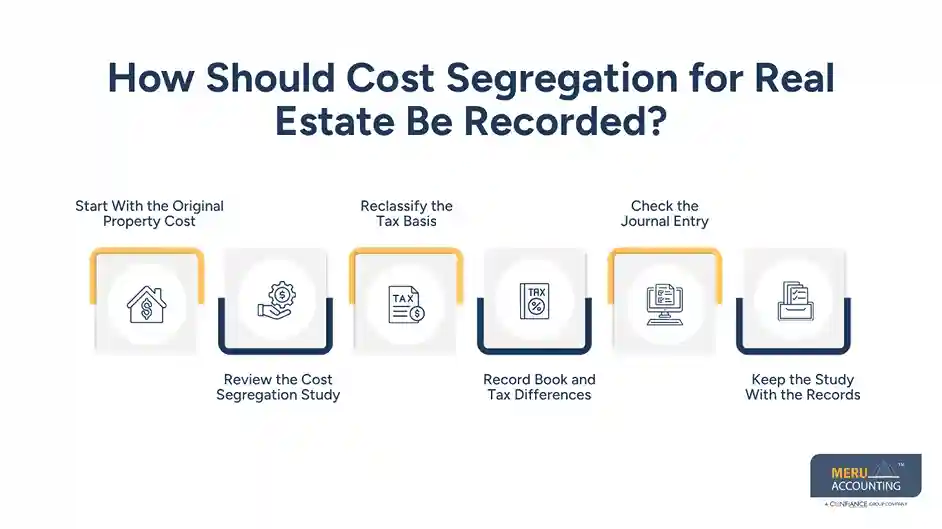
How Should Cost Segregation for Real Estate Be Recorded?
Start With the Original Property Cost
Before making changes, confirm what was actually capitalized for cost segregation for real estate. Review the closing statement, purchase agreement, construction costs, invoices, and existing fixed asset schedule so the starting balance is clear.
Review the Cost Segregation Study
Next, compare the study with the existing records before recording cost segregation in the appropriate tax schedules. Each identified asset group should have a clear description, allocated cost, placed-in-service date, and tax recovery period.
Reclassify the Tax Basis
If part of the building cost moves into shorter-life tax categories under cost segregation for real estate, update the tax fixed asset schedule. The revised categories should still reconcile to the proper property basis after all valid adjustments.
Record Book and Tax Differences
Do not assume that every tax adjustment belongs in the general ledger. When recording cost segregation, book records should follow the company’s accounting policy, while tax records should reflect the applicable tax rules.
Check the Journal Entry
The right entry depends on what is being changed. A tax-only reclassification may require a tax schedule update rather than a book entry, while a change to the financial records needs review under the company’s accounting policy.
Keep the Study With the Records
Do not let the study sit in a separate tax folder with no link to the books. Keep it with the supporting invoices, property records, depreciation schedules, and related workpapers.
How Cost Segregation Affects Depreciation Expense
More Depreciation in Early Years
Cost segregation for real estate may move deductions into earlier years when qualifying assets have shorter recovery periods. It does not mean the entire property cost becomes an immediate expense.
Different Tax Schedules
Each asset group may need its own tax schedule. The schedule should show its basis, recovery period, depreciation method, placed-in-service date, and accumulated depreciation.
Bonus Depreciation
Special depreciation rules can further affect qualifying property. IRS guidance states that certain qualified property acquired and placed in service after January 19, 2025, may qualify for a 100% special depreciation allowance, subject to the applicable rules and elections.
Book Depreciation
The tax result does not automatically rewrite the financial statements. Book depreciation may continue to use the useful life and method set by the company’s accounting policy.
Deferred Tax Effects
When book value and tax basis move at different rates, a temporary difference may arise. The accounting team should assess the related deferred tax effect under the applicable reporting framework.
How Cost Segregation for Real Estate Affects Financial Statements
Balance Sheet
The balance sheet normally reflects property based on book accounting rules. A tax-only allocation does not automatically require the same asset split in the general ledger.
Income Statement
Book depreciation follows the company’s financial reporting policy. Faster tax depreciation resulting from cost segregation for real estate may lower taxable income without changing the depreciation expense reported on the income statement.
Deferred Taxes
A difference between the book carrying value and tax basis can affect deferred tax balances. The amount should be calculated using the rules that apply to the reporting entity.
Cash Flow Statement
Cost segregation itself does not create cash. The cash effect may come from lower current tax payments when earlier tax deductions are allowed.
Notes and Workpapers
Material differences should be backed by clear workpapers. The cost segregation study and related schedules give the accounting team a clear record for reviewing cost segregation for real estate, depreciation, and tax basis.
optional anymore
on running the business
Common Accounting Mistakes When Recording Cost Segregation
Changing Book Assets Without Review
When recording cost segregation, a tax study should not be treated as an automatic instruction to change the general ledger. First decide whether the finding affects book accounting, tax accounting, or both.
Losing the Original Basis
A new schedule is not useful if no one can explain how its numbers were reached. Keep a reconciliation from the original property cost to the amounts assigned to each asset group.
Wrong Placed-in-Service Date
Even a correct asset classification can produce the wrong result if the date is wrong. The placed-in-service date used for cost segregation for real estate should be checked against property and tax records.
Missing Prior-Year Adjustments
A study performed after depreciation has already been claimed can raise additional tax questions. Some changes may fall under an accounting method change, so the filing requirements should be reviewed.
Poor Asset Descriptions
“Building adjustment” tells the reviewer very little. A useful description should identify the asset or class and connect it to the cost segregation study.
Ignoring Tax Rule Changes
Depreciation rules can change from one year to another. Using an old schedule without checking the current rules can lead to an incorrect tax calculation.
Best Practices for Recording Cost Segregation in Real Estate Books
Use a Separate Tax Fixed Asset Schedule
Keep the tax schedule detailed enough to show each relevant asset class. This keeps tax depreciation separate from book depreciation when the two treatments differ.
Reconcile Every Major Change
After recording cost segregation for real estate, compare the revised schedule with the study and prior records. Check the total basis before the information reaches the tax return.
Link Source Documents
The numbers should not stand alone. Keep the study, purchase records, invoices, settlement documents, and depreciation schedules together so each major amount has support.
Review Prior-Year Property
Older properties need extra care because the change may involve an accounting method issue. IRS Form 3115 is used for certain accounting method changes, including some depreciation changes.
Check Book-Tax Differences
Tax depreciation and book depreciation may differ, and that difference is not automatically an error. Review the gap and assess its effect on deferred taxes when required.
Update the Records Each Year
The study may be done once, but the records continue to change. New additions, disposals, depreciation, and tax rule changes should be reflected in the schedules each year.
Partner With Meru Accounting for Real Estate Accounting
Cost segregation for real estate can identify the right asset categories, but the work does not end when the study is completed. Those numbers still need to find their way into fixed asset schedules, depreciation records, reconciliations, and supporting workpapers without creating confusion between book and tax records. This is where an organized accounting process makes a practical difference.
Meru Accounting provides real estate accounting services for businesses that need their property records to stay organized after a cost segregation study. From tracking fixed assets and depreciation to maintaining reconciled accounts and tax-ready bookkeeping, Meru Accounting provides services that keep the accounting records connected to the underlying property costs. The result is a clearer trail from the original property purchase to the asset schedules and supporting records used for tax review.
Our Expert Perspective
The most important part of recording cost segregation is not the number of asset categories. It is being able to trace each number back to a real property cost and then see where that number went.
For cost segregation for real estate, the accounting process should connect the study, fixed asset schedule, tax depreciation, and source documents. When these records agree, later reviews become much easier and the risk of duplicate or missing depreciation is lower.
For an older property, the next question is often more complex: should the change simply update the current schedule, or does it require an accounting method change? That question should be reviewed before the tax return is prepared.
Key Takeaways
- Cost segregation for real estate breaks qualifying property costs into different tax asset groups.
- Recording cost segregation should start with the study and the original property records.
- Tax depreciation and book depreciation can follow different rules.
- A tax fixed asset schedule should be kept separate when tax and book treatment differ.
- The total property basis should be checked after each major allocation.
- Older properties may require review of accounting method change rules.
- Depreciation rules should be checked for the tax year being reported.
FAQs
Cost segregation for real estate is recorded by allocating qualifying property costs to appropriate tax asset categories and updating the related depreciation schedules.
A cost segregation study does not always require a journal entry because some adjustments may apply only to the tax fixed asset schedule.
Cost segregation can place qualifying property components into shorter recovery periods, changing the timing of tax depreciation deductions.
A tax cost segregation study does not automatically change book depreciation because financial reporting follows the applicable accounting policies.
For an existing property, review the cost segregation study, original property basis, depreciation history, and applicable tax accounting rules before updating the records.
optional anymore
on running the business