A property can be full of tenants and still tell an owner very little about its actual financial health. Imagine a building collected $80,000 in rent last month. That sounds strong until the owner sees $18,000 in repairs, $12,000 in property tax, $9,000 in loan payments, $6,000 in management fees, and several unpaid tenant bills. Now the real question is not how much rent came in. It is where the money went and what the property actually earned. That is where what does a property accountant do becomes an important question for real estate owners and property managers.
A property accountant takes the many money movements tied to a property and turns them into records that can be checked and understood. Rent, vendor bills, repairs, deposits, loans, insurance, taxes, and asset costs all need a place in the books. When these records are kept well, owners can see the numbers behind each property instead of relying on a bank balance alone.
What You Will Learn From This Blog
- What does a property accountant do for property owners, and which accounting responsibilities typically fall within the role?
- What a property accountant does for property managers.
- How property accountants prepare reports for real estate.
- How bank reconciliation and month-end close work.
- What can affect property accountant cost.
- How outsourced property accounting can fit into a real estate business.
What Does a Property Accountant Do for Property Owners?
Tracks Rent and Other Property Income
One part of what does a property accountant do is keeping a clear record of money earned from each property. This may include rent, parking income, storage fees, late charges, or other property-related receipts.
The key is not just recording the total. The books should show where the income came from and whether any amount is still due.
Records Property-Level Expenses
A property can have a long list of bills even when there is no major repair. Insurance, utilities, cleaning, property tax, management fees, supplies, and routine repairs can all add up.
A property accountant sorts these costs into suitable accounts and links them to the right property. This makes it easier to see what is driving monthly spending.
Separates Repairs From Major Improvements
A $500 plumbing repair and a $50,000 building upgrade should not be treated as if they are the same type of cost.
A property accountant reviews the nature of the spending and records it in the proper account. Major improvements may need to be treated as assets and depreciated rather than treated as a regular expense.
Tracks Loans and Property Assets
Real estate accounting often includes large loans and high-value assets. Monthly loan payments may contain both principal and interest, and the two amounts do not serve the same purpose in the books.
A property accountant records these items correctly and keeps the loan and asset records updated. This gives the owner a clearer view of debt and property investment.
Gives Owners a Property-Level View
A portfolio can hide problems. One property may be producing a healthy return while another keeps absorbing cash through repairs and other costs.
What does a property accountant do to bring this out? They prepare records and reports by property so owners can see income, costs, cash movement, and other key figures for each site.
What Does a Property Accountant Do for Property Managers?
Records Tenant and Lease Transactions
Property managers may deal with rent charges, payments, credits, fees, deposits, and adjustments every month. If these entries are not kept in order, tenant balances can become hard to trace.
A property accountant records these transactions and checks them against the available property and rent data.
Manages Vendor Bills
Think of a property manager handling ten repair jobs in one week. Each job may have its own vendor, invoice, property, and payment date.
A property accountant records these bills, assigns them to the right property and account, and tracks what remains unpaid. This creates a better record of the property’s true costs.
Prepares Owner Statements
Property owners often want more than a bank statement. They may want to know rent collected, repairs paid, management fees charged, and the amount due to them.
A property accountant can turn these transactions into monthly owner statements that show how the property’s money moved during the period.
Tracks Security Deposits
Security deposits need careful treatment because money held for a tenant is not automatically the owner’s income.
A property accountant keeps deposit balances separate in the records and tracks movements when deposits are returned or applied under the terms of the tenancy.
Reviews Property Cash Position
A property manager may have $40,000 in the bank but also have $25,000 in unpaid vendor bills and a large repair due next week.
What does a property accountant do in this case? They bring cash, receivables, payables, and other open items together so the manager has a more useful view of available funds.
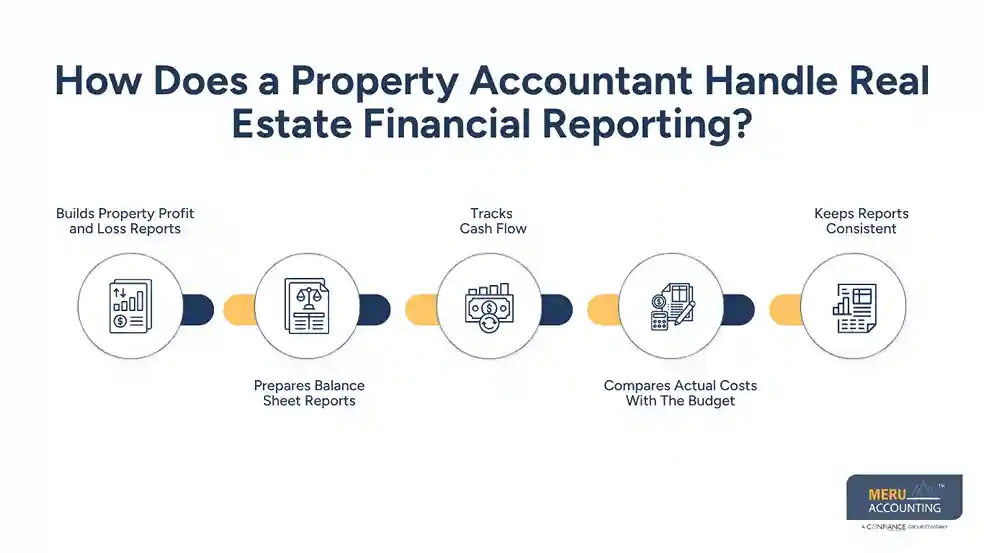
How Does a Property Accountant Handle Real Estate Financial Reporting?
Builds Property Profit and Loss Reports
A property profit and loss report tells the story of income and spending during a period. Instead of one large expense figure, the report can show repairs, insurance, utilities, management fees, taxes, and other costs.
This lets an owner ask a better question: why did the property’s result change this month?
Prepares Balance Sheet Reports
To understand what does a property accountant do beyond tracking income and expenses, it is also important to look at how they prepare the property’s balance sheet. It shows assets, liabilities, and equity at a certain date.
For a property business, this may include buildings, cash, receivables, loans, deposits, and owner equity.
Tracks Cash Flow
A profitable property can still face a cash squeeze. A tenant may owe rent, a loan may be due, or a major repair may have taken cash out of the bank.
A property accountant tracks these movements so owners can see the difference between accounting profit and actual cash movement.
Compares Actual Costs With The Budget
Suppose a property budget allows $7,000 for repairs in a quarter, but actual spending reaches $11,000. The $4,000 gap needs a closer look.
A property accountant can show this variance in the report, giving the owner or manager a clear figure to investigate.
Keeps Reports Consistent
Reports lose value when the same type of cost is coded in different ways from month to month.
What does a property accountant do here? They keep account use and reporting methods consistent so that one month can be compared with another without having to rebuild the numbers.
What Does a Property Accountant Do During Bank Reconciliation and Month-End Close?
Matches Books With Bank Records
Bank reconciliation is where the accounting records meet the actual bank activity. The accountant compares deposits and payments in the books with the bank statement.
A mismatch is not simply ignored. It is traced to find out what caused it.
Finds Missing Or Duplicate Entries
A payment may appear in the bank but not in the books. An entry may also have been recorded twice.
These small errors can change reported cash and expenses, which is why reconciliation is a key part of what does a property accountant do.
Checks Outstanding Payments
Some checks and electronic payments may be recorded before they clear the bank. Deposits may also take time to appear.
The accountant reviews these items so the difference between the book balance and bank balance has a clear reason.
Reviews Receivables And Payables
Month-end is also a time to look at money still owed to and by the property.
Old tenant balances, unpaid vendor bills, and other open entries can be reviewed before the monthly reports are issued.
Closes The Accounting Period
Once the main accounts have been checked and needed adjustments are posted, the month can be closed.
This gives owners and managers a stable set of numbers to use when reviewing the property’s performance.
optional anymore
on running the business
How Much Does a Property Accountant Cost?
Number Of Properties
Property accountant cost can vary greatly between a single rental and a portfolio of 30 properties. More properties usually mean more accounts, bills, rent entries, reconciliations, and reports.
The number of properties is therefore one of the first factors to review.
Number Of Monthly Transactions
A property with 50 monthly transactions has a different workload from a busy commercial property with hundreds of entries.
Rent payments, vendor bills, bank transfers, loan activity, and adjustments show what does a property accountant do and can affect property accountant cost.
Type Of Accounting Work
Basic bookkeeping and full monthly accounting are not the same service. Month-end close, bank reconciliation, financial statements, fixed asset records, loan schedules, and owner reports require more work.
The scope of work should therefore be clear before comparing property accountant cost.
Type Of Real Estate
Residential rentals, commercial buildings, and mixed-use properties can have different accounting needs. A commercial property may have complex tenant charges and several types of operating costs.
As the accounting needs become more detailed, property accountant cost can change as well.
In-House Or Outsourced Accounting
An in-house hire can include salary, benefits, payroll costs, software, equipment, and training. Outsourced property accounting uses an outside accounting firm for an agreed scope of work.
The comparison should include the full service scope, not just the quoted monthly fee.
Why Choose Meru Accounting for Outsourced Property Accounting?
Property Accounting Services
We provide outsourced property accounting for real estate owners and property managers who need regular accounting work.
Services can cover transaction records, account reviews, reconciliations, and financial reporting based on the needs of the business.
Property-Level Books
Meru Accounting provides services to keep property income and expenses organized by property where the accounting setup requires it.
This allows owners to review the numbers for individual properties rather than relying only on portfolio-level figures.
Monthly Accounting Work
At Meru Accounting, we provide services for bank reconciliation, month-end close, account review, and financial statements.
A defined monthly process keeps accounting work moving throughout the year instead of leaving a large backlog for tax time.
Accounting Software
Meru Accounting provides accounting services using QuickBooks, Xero, Zoho Books, NetSuite, and Odoo based on the client’s accounting setup.
The records can be structured around the reports and property details the business needs to track.
Our Expert Perspective
What does a property accountant do is not just a question about data entry. The real value lies in what happens after each transaction is recorded: accounts are checked, property costs are classified, bank data is matched, loans and assets are tracked, and reports are built from the final figures.
For growing real estate portfolios, outsourced property accounting can be a practical way to keep recurring accounting work on a set process without adding every accounting task to an internal role.
Key Takeaways
- A property accountant records and reviews the money activity tied to real estate.
- The role covers rent, expenses, vendor bills, deposits, loans, assets, and financial reports.
- Property managers can use accounting records to track tenant balances and owner statements.
- Bank reconciliation and month-end close are key parts of property accounting.
- Property accountant cost depends on property count, transaction volume, service scope, and property type.
- Outsourced property accounting can cover recurring accounting work for owners and managers.
FAQs
A property accountant records rent and expenses, reconciles bank accounts, tracks assets and loans, and prepares financial reports for real estate owners.
A property accountant tracks tenant payments, vendor bills, property expenses, security deposits, owner statements, and monthly financial records for property managers.
Property accountant cost varies based on the number of properties, monthly transactions, bank accounts, reporting needs, and accounting services included.
Outsourced property accounting means an outside accounting firm handles tasks such as bookkeeping, bank reconciliation, month-end close, property reports, and account reviews.
A real estate owner may hire a property accountant when managing several properties, handling many transactions, or needing regular financial reports.
optional anymore
on running the business