

Accounting for Multifamily Properties During Development
Keep Development and Operations Apart
A building under construction has a different cost profile from an occupied apartment property. Accounting for multifamily properties should keep construction activity separate from rent, repairs, utilities, and normal operating costs.
Track Costs By Phase
Break the project into useful stages such as land acquisition, design, permits, site work, structure, interiors, and final work. This gives multifamily real estate accounting a better view of where the budget is being used.
Use a Budget-To-Actual Report
Suppose electrical work has a $400,000 budget but posted and accrued costs reach $465,000. The $65,000 gap deserves review. A budget-to-actual report makes this type of issue visible during the project.
Track Change Orders
Construction rarely stays exactly the same from the first plan to the final build. Each change order should show what changed, why it changed, who approved it, and how it affects multifamily development costs.
Reconcile Vendor Accounts
A vendor may have unpaid invoices, retainage, credits, or payments that have not been matched correctly. Regular reconciliation gives accounting for multifamily properties a more accurate view of project liabilities.
Review the Asset at Completion
Completion is a key point in accounting for multifamily properties. Before moving costs out of WIP, review final project costs, open bills, accruals, retainage, and major adjustments so the completed asset starts with a sound cost base.
Smarter Ways to Manage WIP and Multifamily Development Costs
Build a Standard Cost Structure
A clear chart of accounts and project structure makes multifamily real estate accounting easier to review. If each property uses different labels for the same cost, comparing projects can become hard.
Use Monthly Close Checks
A monthly close can cover bank reconciliations, vendor balances, WIP, accruals, project costs, and budget variances. This gives multifamily real estate accounting a regular review point instead of pushing all clean-up work to year-end.
Keep Source Records Together
A project cost should be easy to trace back to its source. Keep invoices, contracts, approvals, payment records, change orders, and related documents together. IRS guidance also stresses keeping records that show the amount, date, and purpose of expenses.
Separate Cost From Cash Flow
Cash paid does not always equal cost incurred. An owner may pay a contractor in advance, while another contractor may complete work before sending an invoice. Multifamily real estate accounting should reflect the correct accounting period, not just bank activity.
Review Costs Before Year-End
A year-end review can uncover old WIP balances, missing invoices, duplicate postings, incorrect cost codes, and items that need tax review. This gives owners a cleaner base for year-end accounting for multifamily properties.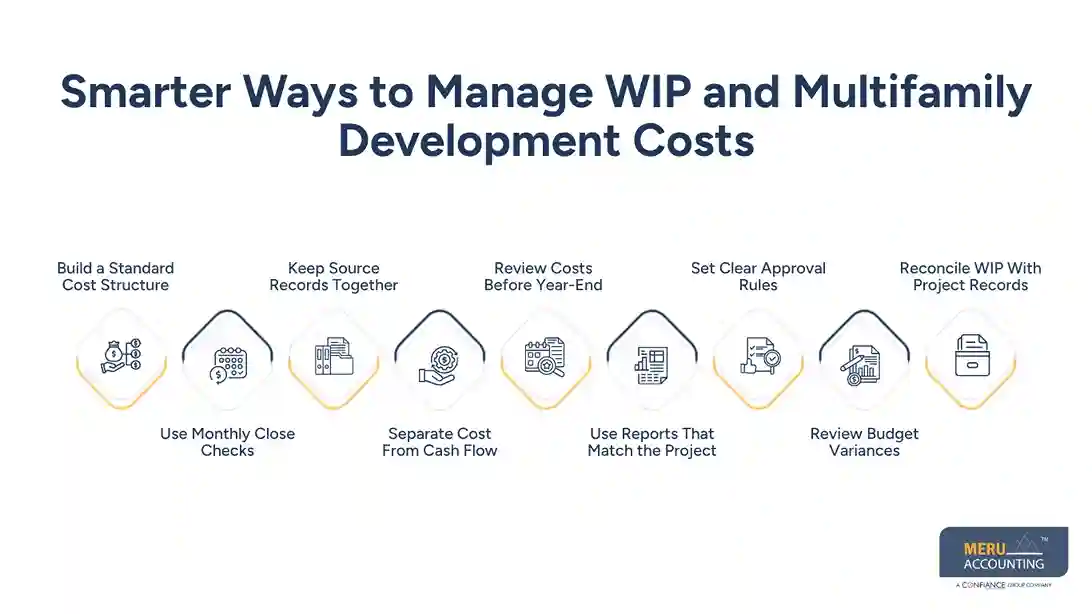
Use Reports That Match the Project
Owners should not need to search through hundreds of transactions to answer basic questions. Precise multifamily real estate accounting reports can show project cost, WIP, budget variance, unpaid amounts, and major cost groups in one clear view.
Set Clear Approval Rules
Set approval limits for major invoices, change orders, and project payments so large costs are reviewed before they enter the records. This creates a clear control process for high-value transactions.
Review Budget Variances
Compare actual spending with the approved budget for each project phase and review major differences. Regular variance checks can show where spending is rising before it affects the full project budget.
Reconcile WIP With Project Records
Compare the WIP balance with invoices, contracts, payment records, and completed work during each review period. This makes it easier to find missing entries, duplicate costs, and balances that need further review.
Common Multifamily Real Estate Accounting Errors to Avoid
Mixing Multiple Properties
When costs for several properties are posted to the same project or account, the true cost of each property becomes harder to identify. Separate property and project codes keep multifamily real estate accounting more precise.
Expensing Capital Costs
A major construction cost posted as a current expense can distort the period’s results and understate the asset balance. Each large project cost should be reviewed before its treatment is decided.
Capitalizing Normal Repairs
The reverse error can also occur. A routine repair should not automatically become part of the building’s capital cost just because it relates to the property. The nature of the work matters in accounting for multifamily properties.
Leaving WIP Open Too Long
An old WIP balance may point to an invoice that was never cleared, a completed phase that was never transferred, or a cost that needs further review. A regular WIP review keeps multifamily development costs from becoming hidden balances.
Missing Accrued Costs
If work is done but the invoice has not arrived, the project may still have a cost that belongs in the current period. Missing these amounts can make multifamily development costs appear lower than they really are.
Ignoring Supporting Records
A transaction without a clear source can be difficult to verify months later. Strong documentation gives accounting for multifamily properties a clear trail from the report back to the original transaction.
How Meru Accounting Provides Multifamily Real Estate Accounting Services
A development project can have hundreds of invoices, vendor bills, payments, and cost changes moving at the same time. Meru Accounting brings these records into one clear accounting process, so owners can see how each property is performing and where project funds are being used.
Project-Based Accounting
One project may have land costs, another may be in the construction phase, while a third may already be earning rent. Meru Accounting keeps these activities separate through project-level multifamily real estate accounting, with costs grouped by property, phase, vendor, and account.
WIP and Cost Tracking
A WIP balance should tell you what is still being built, not leave you guessing about old entries. Meru tracks WIP, reviews cost codes, and reconciles project activity so multifamily real estate accounting reflects the current stage of development.
Property-Level Reporting
When several properties are under the same ownership, one combined report can hide useful details. We provide property-level reports that show development costs, income, operating expenses, and asset balances, making accounting for multifamily properties easier to read and review.
Reconciliation and Review
Small accounting gaps can add up during a large development. Meru reviews transactions and reconciles accounts to spot duplicate entries, missing items, unusual balances, and misplaced costs, keeping multifamily development costs clearer while the project is still active.
Our Expert Perspective
The best time to fix a WIP problem is while the project is still active. Once hundreds of invoices, change orders, and payments build up, finding one missing cost becomes much harder. In our view, strong multifamily real estate accounting starts with monthly WIP checks, vendor reviews, accrual checks, and budget comparisons rather than a large clean-up at year-end.
Key Takeaways
- Multifamily real estate accounting should show where each project dollar goes.
- WIP should be reviewed each month rather than left untouched until completion.
- Multifamily development costs need clear project and cost codes.
- Land, construction, professional fees, permits, financing, repairs, and improvements may have different treatment.
- Budget-to-actual reports can flag cost gaps during the project.
- Change orders should be recorded with approval and supporting details.
- Vendor balances and accrued costs need regular review.
- Accounting for multifamily properties should keep development activity separate from normal property operations.
- Source records should be kept with the related project information.
- Tax treatment should be checked against the rules that apply to the specific cost.