




8 Ways an S Corp Simplifies Commission Tracking, Splits & Fees
Track Gross Commissions and Net Income Separately
Suppose a home closes with a $15,000 gross commission. The agent’s business may not receive all $15,000. A broker split and referral fee could reduce the amount that reaches the bank.
For an S Corp for real estate agent, recording gross commission first and then each deduction shows the full path from sale to net income.
Record Brokerage Splits Accurately
Broker splits can change based on the agent’s agreement, commission cap, deal type, or other terms. A simple bank entry does not show those details.
Record the gross amount, broker share, and final amount received. This gives an S Corp for real estate business a deal-level record that can be checked against the closing statement.
Categorize Transaction and Referral Fees
A referral fee and a transaction fee may both reduce a commission, but they are not the same cost. Putting every deduction into one account makes later review harder.
Separate categories let an S Corp for real estate agent see which fees are taking money from commissions and how often they occur.
Separate Business and Personal Finances
Picture two transactions on the same day: a $9,000 commission enters the business account, while a personal grocery bill leaves it. If both sit together, the books become harder to read.
A separate business account keeps an S Corp for real estate business focused on actual business income and costs.
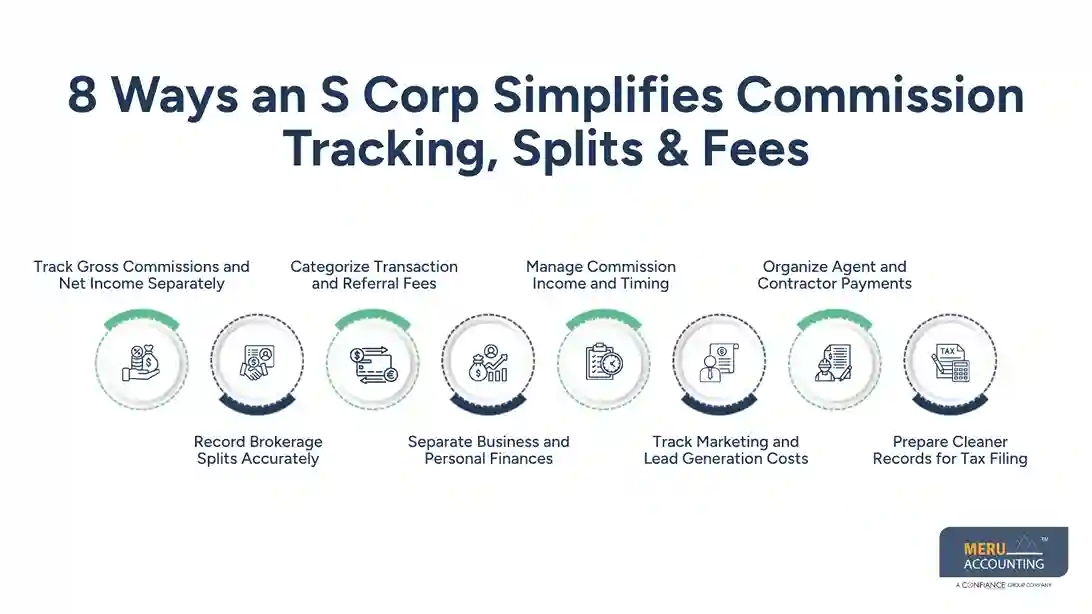
Manage Commission Income and Timing
A closing may happen in one month while the commission arrives later. Adjustments or chargebacks may also appear after the first payment.
For an S Corp for real estate agent, each payment should be matched to its deal, closing record, and related fees rather than being treated as an unexplained deposit.
Track Marketing and Lead Generation Costs
A lead may cost $40, $400, or much more depending on the source. Over a year, these small payments can add up to a large business cost.
An S Corp for real estate business should group marketing, ads, lead fees, signs, photography, and similar costs so the owner can review spending by type.
Organize Agent and Contractor Payments
Real estate businesses may pay photographers, virtual assistants, transaction coordinators, marketing staff, or other service providers.
Before recording a payment as contractor cost, the business should determine whether the worker is an employee or independent contractor under the applicable rules.
Prepare Cleaner Records for Tax Filing
Tax filing becomes much easier when the numbers can be traced back to actual transactions. A commission report, closing statement, bank deposit, and expense record should tell the same story.
For an S Corp for real estate agent, that trail can make year-end review more direct and reduce the need to rebuild old transactions.
S Corp for Real Estate Business: Key Tax and Payroll Considerations
Reasonable Compensation
An S Corp for real estate business cannot simply label all money paid to its owner as a distribution. The IRS requires reasonable compensation for shareholder-employees who provide services.
The amount depends on facts such as duties, time, experience, and pay for similar work.
Payroll Taxes
Owner wages can be subject to Social Security and Medicare taxes, as well as other payroll requirements that apply to the business.
For an S Corp for real estate agent, payroll records should match the books and the amounts reported on payroll tax forms.
Shareholder Distributions
A distribution is not the same as a paycheck. Mixing the two can make the books unclear and may create tax issues.
The IRS can question compensation when payments do not reflect the services performed by a shareholder-employee.
Tax Basis
Shareholder basis is another item that should not be judged from the bank balance alone. Basis can affect whether certain distributions or losses receive the intended tax treatment.
An S Corp for real estate business should keep tax records that allow basis to be tracked over time.
State Requirements
A business can meet federal S Corporation rules and still have separate state filing or tax duties.
An S Corp for real estate agent should review the rules of each state where the business has relevant filing obligations.
How to Set Up Commission Accounting for an S Corp
Create Commission Accounts
Start with accounts that match the way money moves through a real estate deal. These may include gross commissions, broker splits, referral fees, transaction fees, marketing, software, and other operating costs.
This gives the S Corp for real estate agent a simple structure that can be used month after month.
Use Transaction-Level Records
Give each deal its own record with details such as property, closing date, gross commission, broker split, referral fee, and final deposit.
When a bank deposit appears, the accounting team can trace it back to the related transaction instead of guessing its source.
Reconcile Each Month
Monthly reconciliation is a useful checkpoint. Compare the bank balance with commission reports, brokerage statements, and accounting records.
An S Corp for real estate business can then catch missing deposits, duplicate entries, or incorrect fees while the details are still easy to find.
Review Owner Payments
Owner wages, reimbursements, capital contributions, and distributions should have separate records.
This is especially important for an S Corp for real estate agent, where treating different owner payments as one type can create tax and reporting issues.
Keep Source Documents
Keep closing statements, invoices, receipts, bank statements, commission reports, and payroll records with the accounting file.
When a number is questioned months later, the source document can show where it came from and why it was recorded.
Common Accounting Mistakes Real Estate Agents Make With an S Corp
Mixing Personal and Business Costs
A personal payment may seem harmless when it is made from an S Corp for real estate agent business account, but repeated personal transactions can make the books hard to review.
Keeping those costs separate gives the business a cleaner financial trail.
Recording Only Net Deposits
A $7,500 bank deposit does not always tell the full story. It may be what remains after a broker split, referral payment, or transaction charge.
Recording only the net amount can hide the true commission activity.
Treating All Owner Payments as Distributions
An owner may take money from the company in several ways, but those payments do not all have the same tax treatment.
For an S Corp for real estate business, wages and distributions should be recorded according to their actual purpose and tax treatment.
Missing Referral Fees
Referral fees can be taken from a commission before the remaining money reaches the business account. That makes them easy to overlook.
A deal-level record can show the referral fee for an S Corp for real estate agent even when it does not appear as a separate bank payment.
Waiting Until Tax Season
Trying to sort through twelve months of commissions, fees, and owner payments at once can turn a simple bookkeeping task into a large cleanup project.
For an S Corp for real estate agent, a monthly review gives the business a chance to fix errors before they pile up.
Partner With Meru Accounting for Real Estate Accounting
Real estate accounting is not just about entering bank transactions. Each closing can bring its own commission split, referral fee, transaction charge, marketing cost, and payment timing.
Meru Accounting provides bookkeeping, payroll, tax, accounts payable and receivable, and virtual CFO services. Meru also works with accounting platforms such as QuickBooks, Xero, Zoho Books, NetSuite, and Odoo.
For an S Corp for real estate agent, Meru can organize commission income, broker splits, fees, expenses, payroll records, and other business transactions into a clear accounting system.
Our Expert Perspective
A well-organized commission record should make it easy to answer one key question: Where did the money from this deal go?
The record should show the gross commission, brokerage split, referral or transaction fees, final deposit, and related business expenses. This gives the business a clear view of what each closing earned and spent. For an S Corp for real estate business, keeping these details in one place also makes monthly reviews and tax preparation more straightforward.
Key Takeaways
- An S Corp for real estate agent should maintain clear records of commissions, brokerage splits, fees, payroll, and owner payments.
- Gross commissions should be recorded before brokerage splits, referral fees, and other deductions are applied.
- Personal spending should be kept separate from business transactions and business accounts.
- Referral fees and transaction fees should be recorded under separate categories for easier review.
- Each commission deposit should be matched with the related closing and supporting transaction records.
- The books should be reviewed each month rather than waiting until tax filing season.
- Shareholder-employees who provide services generally need to receive reasonable compensation for their work.
- An S Corp for real estate agent should be reviewed under both applicable state requirements and federal tax rules before making a structural change.


