Corporate taxes in the USA are based on taxable income, not simply the profit shown in a company’s financial statements. This distinction can matter when a business has large expenses, asset purchases, unpaid customer balances, or costs that receive special treatment under federal tax rules. The number shown as book income may therefore differ from the amount ultimately subject to federal income tax.
This is where corporate tax reconciliation becomes important. It connects the financial results of a business with the income reported for tax purposes. A company may record $500,000 of profit in its books, but tax adjustments can move taxable income above or below that figure.
The US corporate tax rate for a regular C corporation is generally 21%. However, that rate is applied to taxable income after the required adjustments, not directly to accounting profit. For businesses dealing with corporate taxes in the USA, understanding this difference is key to reading the tax calculation correctly.
What You Will Learn From This Blog
- Why book income and taxable income can differ when calculating corporate taxes in the USA.
- How corporate tax reconciliation moves book income toward taxable income.
- How the US corporate tax rate applies after tax adjustments are made.
- Which common expenses can create book-to-tax differences.
- How temporary and permanent differences affect corporate taxes in the USA.
- How depreciation, meals, interest, bad debts, and donations affect taxable income.
- How to understand a simple corporate tax reconciliation example.
- Which common mistakes can affect a business tax return.
What is Book-to-Tax Reconciliation for U.S. Businesses?
Book Income
Book income is the profit or loss shown in a company’s financial statements. It reflects transactions recorded under the accounting rules used by the business.
For corporate taxes in the USA, however, book income is only the starting point. Tax rules may require several changes before the company reaches taxable income.
Taxable Income
Taxable income is the amount used under federal tax rules to work out the corporation’s income tax. It may be different from book income because certain expenses, deductions, or income items receive different tax treatment.
This difference is one of the main reasons a book-to-tax review is needed.
The Reconciliation Bridge
Think of corporate tax reconciliation as a bridge between two figures. One side shows income from the books, while the other shows income for tax purposes.
For corporate taxes in the USA, this bridge can include additions, deductions, timing differences, and items that receive no tax deduction.
Schedule M-1
Schedule M-1 reports differences between income or loss shown in the books and income or loss reported on the tax return. It is part of the Form 1120 filing for corporations that use it.
This provides a clear reconciliation of the items that cause reported book income and taxable income to differ.
Schedule M-3
Schedule M-3 provides a more detailed view of book-to-tax differences. The IRS generally requires it for corporations with total assets of $10 million or more at year-end, subject to the applicable filing rules.
For larger businesses, this detailed tax adjustment review can show where financial statement amounts differ from tax amounts.
How Corporate Tax Reconciliation Works
Start With Book Profit
The process begins with the company’s book income. This figure reflects the financial results before the tax adjustments needed for corporate taxes in the USA.
It should be taken from finalized financial records rather than an early or incomplete trial balance.
Add Back Items Not Allowed
Some expenses lower book profit but do not receive a full tax deduction. These amounts may need to be added back during corporate tax reconciliation.
For example, a nondeductible part of a business expense can remain an accounting cost but cannot reduce taxable income.
Find Tax Deductions
Tax rules can also allow deductions that do not match the book expense for the same period. These deductions can reduce taxable income.
This means the tax adjustment process does not only add expenses back; it can also reduce book income when tax treatment allows a different deduction.
Separate Timing Differences
Some differences are caused only by timing. A cost may be recorded in the books this year but deducted for tax in another year.
These timing gaps can affect the current year’s federal tax liability while reversing later.
Reach Taxable Income
After the required adjustments are reviewed, the company reaches taxable income. The US corporate tax rate is then applied to the amount subject to federal tax.
This is why applying the US corporate tax rate directly to book profit can produce the wrong result.
Common Book-to-Tax Adjustments for U.S. Businesses
Depreciation and Amortization
Depreciation is one of the most common areas where book and tax amounts differ. A business may use one method for its financial statements and another method for federal tax.
For corporate taxes in the USA, this can create a larger tax deduction in one year and a smaller deduction in another. The difference should be recorded as part of the corporate tax reconciliation.
Meals and Entertainment
A business may record the full cost of a qualifying meal in its financial records, while federal tax rules can limit the deductible amount. Certain entertainment costs generally receive different tax treatment.
For example, if $10,000 of qualifying meals is recorded in the books and only $5,000 is deductible, the remaining $5,000 can create a book-to-tax adjustment.
This adjustment changes taxable income and can therefore affect corporate taxes in the USA.
Interest Expense
Interest expense can also create a difference between book income and taxable income. Federal tax law can limit the amount of business interest that is deductible in a year, depending on the company’s facts.
Therefore, the interest shown in the books should not automatically be treated as the final tax deduction when preparing the corporate tax return.
Bad Debts and Accruals
A company may record an allowance for doubtful accounts in its financial statements before the amount qualifies for a tax deduction.
The book expense and tax deduction may therefore fall in different years. This creates a timing item that should be tracked through corporate tax reconciliation.
Charitable Contributions
A corporation can record a charitable contribution as an expense in its books, but the federal tax deduction may be subject to specific limits and conditions.
As a result, the book expense may not equal the current tax deduction. The difference should be identified when calculating corporate taxes in the USA.
Permanent Vs. Temporary Differences in Corporate Tax Reconciliation
Temporary Differences
A temporary difference affects book income and taxable income in different periods but can reverse later.
Different depreciation methods are a common example. The total treatment may spread across several years, but the book and tax deductions can occur at different times.
Permanent Differences
A permanent difference does not reverse in a later tax year. If an expense is permanently nondeductible, it can remain a difference between book income and taxable income.
This type of item can have a direct effect on corporate taxes in the USA without creating a future tax deduction.
Why Timing Matters
Timing can change the amount of tax due in a particular year. Two businesses with the same book profit may have different taxable income because their tax adjustments occur at different times.
That makes timing an important part of the tax reporting process.
Track the Reversal
A temporary difference should remain on the tax workpaper until it reverses. Without a proper record, the business may miss the tax adjustment in a later year.
Documenting these differences also gives the tax team a clearer view of future federal tax obligations.
Review Prior Adjustments
A tax return should not be viewed as a stand-alone yearly task. Prior differences should be checked before new adjustments are added.
This prevents duplicate entries and keeps corporate tax reconciliation consistent from one year to the next.
optional anymore
on running the business
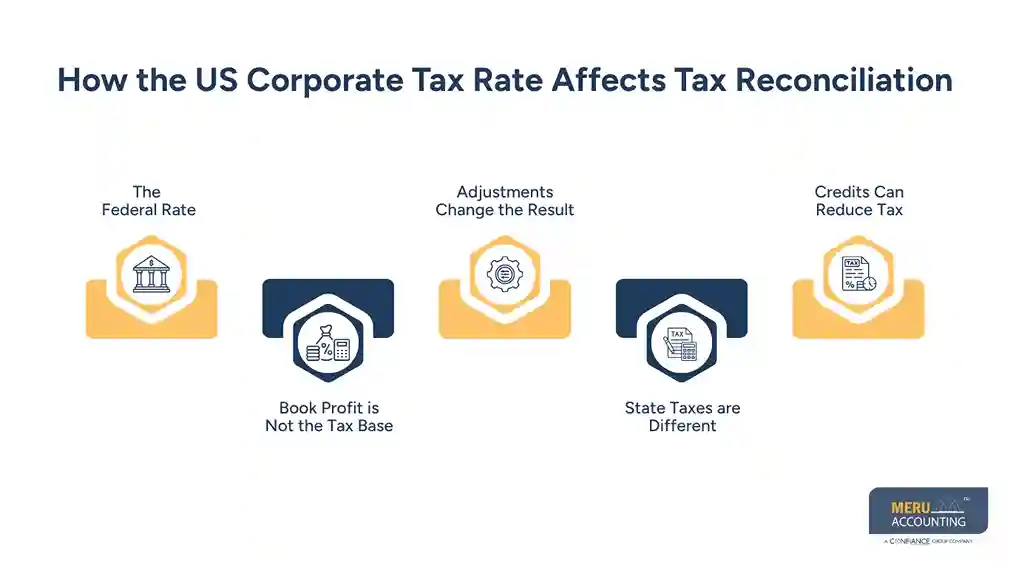
How the US Corporate Tax Rate Affects Tax Reconciliation
The Federal Rate
The US corporate tax rate for a regular C corporation is generally 21%. The rate is applied to taxable income under federal tax rules.
For businesses dealing with corporate taxes in the USA, the important point is that taxable income must be established before the rate is applied.
Book Profit is Not the Tax Base
Suppose a company reports $1 million of book income. It does not automatically mean that the federal tax calculation is based on $1 million.
Depreciation, meals, interest, and other adjustments can change taxable income through the book-to-tax adjustment process.
Adjustments Change the Result
If tax deductions are higher than book expenses, taxable income may fall. If nondeductible expenses are added back, taxable income may rise.
These changes directly affect the amount to which the US corporate tax rate applies and therefore affect corporate taxes in the USA.
State Taxes are Different
The federal US corporate tax rate does not cover state corporate income taxes. State rules vary, and some states may use different rules for specific deductions or income items.
A business calculating corporate taxes in the USA should therefore keep federal and state tax calculations separate.
Credits Can Reduce Tax
Tax credits can reduce the amount of tax calculated after taxable income is determined. This means the final tax liability may not equal taxable income multiplied by the US corporate tax rate.
Credits and other tax items should be reviewed separately from the book-to-tax calculation.
Corporate Taxes in the USA: A Corporate Tax Reconciliation Example
Start With $600,000
Assume a C corporation reports $600,000 in book income before federal income tax. As part of calculating corporate taxes in the USA, the company now begins its reconciliation to identify the differences between book and taxable income.
Check Depreciation
Book depreciation is $70,000, but the tax deduction is $90,000.
The $20,000 additional tax deduction lowers taxable income and changes the calculation of corporate taxes in the USA.
Check Meals
The company records $12,000 in qualifying business meals. Assume $6,000 is deductible under the applicable 50% rule.
The remaining $6,000 becomes a tax adjustment.
Check Bad Debts
The books include a $15,000 bad-debt provision, but only $5,000 is deductible for tax in the current year.
The $10,000 difference is added back during the tax adjustment process.
Find The Tax Base
The simplified calculation is:
Book income: $600,000
Nondeductible meals: +$6,000
Bad-debt adjustment: +$10,000
Additional tax depreciation: −$20,000
Taxable income: $596,000
At the general 21% federal US corporate tax rate, the basic tax would be $125,160, before credits and other tax items.
This example shows why corporate taxes in the USA cannot be calculated by simply multiplying book profit by 21%.
Common Corporate Tax Reconciliation Errors and How to Avoid Them
Using Book Profit as Tax Income
One common mistake is taking book profit and applying the US corporate tax rate without checking the required tax adjustments.
How to avoid it: Start with finalized book income and prepare a separate corporate tax reconciliation.
Missing Old Tax Differences
A temporary difference can remain open for more than one year. If the reversal is missed, taxable income may be wrong in a later period.
How to avoid it: Keep a running schedule of temporary differences linked to the relevant corporate taxes in the USA workpapers.
Treating Every Expense the Same
Not every expense follows the same tax rule. Meals, interest, depreciation, bad debts, and charitable contributions can all require different treatment.
How to avoid it: Review each major expense category before completing the book-to-tax review.
Mixing State and Federal Data
Federal and state rules may treat the same item differently. Combining both calculations can make the tax return difficult to review.
How to avoid it: Maintain separate federal and state adjustment schedules when calculating corporate taxes in the USA.
Keeping Weak Support
A tax adjustment should have a clear amount, reason, and source. Unsupported adjustments can make later review harder.
How to avoid it: Keep the ledger, calculation, tax workpaper, and supporting records together for each material corporate tax reconciliation item.
Why Choose Meru Accounting For Corporate Tax Reconciliation?
Reviews Financial Data
Meru Accounting provides accounting and bookkeeping services for U.S. businesses, with a focus on keeping financial data organized for tax review. Our team reviews income, expenses, assets, liabilities, and other accounting data that can affect corporate taxes in the USA.
Checks Book-To-Tax Differences
Book income does not always match taxable income. Meru Accounting reviews areas such as depreciation, meals, interest, bad debts, and other adjustments that may affect the tax adjustment review.
Maintains Tax-Ready Records
Clear records make it easier to trace the figures used in a tax calculation. Meru Accounting organizes accounting data so businesses can review book figures and tax adjustments without searching through disconnected records.
Reviews U.S. Accounting Requirements
U.S. businesses need accounting records that are suitable for financial reporting and tax review. Meru Accounting works with U.S. businesses and uses accounting systems such as QuickBooks, Xero, Zoho Books, NetSuite, and Odoo to maintain structured financial data.
Supports Business Tax Review
The US corporate tax rate is only one part of the tax calculation. Meru Accounting reviews the underlying financial data and book-to-tax differences so businesses have a clearer base for reviewing corporate taxes in the USA.
Our Practical Insights
Businesses can make corporate tax reconciliation easier by reviewing major book-to-tax differences before tax season, focusing on material changes in depreciation, interest, bad debts, meals, and charitable contributions, keeping current and prior-year schedules together, checking how each adjustment affects taxable income and the US corporate tax rate, and maintaining a clear trail from each tax adjustment back to the financial statement, ledger, calculation, and supporting records for corporate taxes in the USA.
Key Takeaways
- Corporate taxes in the USA are based on taxable income rather than book profit alone.
- Corporate tax reconciliation connects financial statement income with tax income.
- The US corporate tax rate for a regular C corporation is generally 21%.
- Depreciation can create temporary book-to-tax differences.
- Meals may be subject to federal deduction limits.
- Interest expense may require a separate tax review.
- Bad debts can create timing differences between books and tax.
- Charitable contributions can have tax limits.
- Temporary differences can reverse in later years.
- Permanent differences generally do not reverse.
- Schedule M-1 and Schedule M-3 provide ways to report book-to-tax differences.
- Clear corporate tax reconciliation records make corporate taxes in the USA easier to review.
FAQs
Book-to-tax reconciliation is the process of adjusting book income to calculate taxable income under U.S. tax rules for corporate taxes in the USA.
The US corporate tax rate is generally 21% for a regular C corporation, with the rate applied to taxable income after applicable tax adjustments.
To calculate corporate taxes in the USA, start with book income, make required tax adjustments, calculate taxable income, and apply the applicable tax rate and credits.
Common corporate tax reconciliation adjustments include depreciation, business meals, interest expense, bad debts, charitable contributions, and other items with different book and tax treatment.
Book income can differ from taxable income because financial accounting rules and tax rules may use different deduction limits, recognition methods, and timing.
optional anymore
on running the business