Meru Accounting

US Federal Corporate Tax Rates: Book-to-Tax Reconciliation Checklist for Form 1120

Contents
Want to learn more?

Subscribe for business tips, tax updates, financial fundamental and more


    US Federal Corporate Tax Rates: Book-to-Tax Reconciliation Checklist for Form 1120

    US federal corporate tax rates may look simple on paper: a C corporation has taxable income, and the federal tax rate is applied to it. The real work starts when the number on the profit and loss statement does not match the number used on Form 1120.

    Imagine a company closes its books with $1 million in profit. The tax team cannot simply multiply $1 million by 21% and finish the return. A portion of the expenses may not be deductible. Some costs may be deductible in another year. Depreciation may also differ between the books and tax records.

    That is where book-to-tax reconciliation comes in. It takes the final book income, checks the differences, and builds a clear path to taxable income. For 2025, Schedule J of Form 1120 directs corporations to multiply taxable income by 21% for the regular income tax calculation.

    For companies using corporate tax outsourcing, this process also gives the tax team a clear review trail. Instead of looking only at the final tax number, the reviewer can see how each major adjustment reached Form 1120.

    What You Will Learn From This Blog

    • How US federal corporate tax rates apply to C corporations filing Form 1120.
    • Why book income and taxable income can be different.
    • How to identify permanent and temporary tax differences.
    • Which common expenses need a closer tax review.
    • How Form 1120 schedules fit into the reconciliation process.
    • How corporate tax outsourcing can be used for recurring Form 1120 work.

    Understanding US Federal Corporate Tax Rates and Form 1120

    Form 1120 and C Corporations

    Form 1120 is used by domestic corporations to report income, gains, losses, deductions, credits, and federal income tax liability. When reviewing US federal corporate tax rates, the key point is that the rate is applied to taxable income. Taxable income is reached after the required tax adjustments have been made.

    Book Income and Tax Income

    Book income answers an accounting question: how much income did the company report under its financial accounting method? Tax income answers a different question: how much income is taxable under federal tax law?

    That difference can show up in a simple case. A company may record an expense this year, while the tax deduction is allowed later. The expense is valid in the books, but the tax return needs a timing adjustment.

    Why Reconciliation Matters

    A reconciliation is not just another tax form task. It explains the gap between two numbers that may look similar but are built under different rules.

    This becomes important when US federal corporate tax rates are applied. If taxable income is wrong, the tax calculation will also be wrong. Corporate tax outsourcing teams can use the reconciliation as a review sheet rather than treating it as a last-minute filing step.

    Role of Form 1120

    Form 1120 brings the corporation’s federal tax information into one return. The return includes income, deductions, taxable income, tax, credits, and other required information.

    The 2025 instructions state that Schedule J, line 1a, is calculated by multiplying Form 1120 taxable income by 21%. This makes the book-to-tax review important before the final tax figure is reached.

    Need For a Clear Work File

    A reviewer should be able to pick an adjustment from the reconciliation and trace it back to the books. If a $25,000 expense is added back, the file should show what the expense was and why it was not deductible.

    A clear work file also makes corporate tax outsourcing easier to review because another tax professional can follow the same trail without rebuilding the calculation.

    What Are US Federal Corporate Tax Rates For C Corporations?

    Standard Federal Corporate Rate

    For most C corporations, the regular federal corporate income tax rate is 21%. The 2025 Form 1120 instructions specifically direct taxpayers to multiply taxable income by 21% for the regular income tax calculation.

    US federal corporate tax rates therefore apply after the taxable income calculation. The rate should not be applied blindly to the book profit shown in the financial statements.

    Taxable Income Matters

    Suppose a corporation reports $1 million of book income. During the tax review, $80,000 of expenses are found to be nondeductible. If no other adjustments apply, taxable income could be higher than book income by that amount.

    At 21%, the $80,000 difference represents $16,800 of federal tax before other tax items are considered. The example shows why even a single reconciliation item can affect the final result.

    State Tax is Separate

    US federal corporate tax rates apply to federal income tax. State corporate income taxes are separate and can use different rules and rates.

    A corporation filing Form 1120 should not assume that a federal adjustment automatically gives the correct state treatment. State tax work may need its own review.

    Special Tax Rules

    The 21% rate is only one part of the tax calculation. A corporation may also have tax credits, net operating losses, interest limitations, special deductions, foreign-related items, or other rules that affect the return.

    Corporate tax outsourcing may be useful when several of these items appear together, and the internal finance team needs a second review of the federal tax calculation.

    Rate and Reconciliation Link

    US federal corporate tax rates have a direct link to the final taxable income number. A permanent difference can change taxable income for the current year, while a temporary difference can shift the tax effect from one year to another.

    That is why a good reconciliation should explain not only the amount of an adjustment, but also its tax treatment.

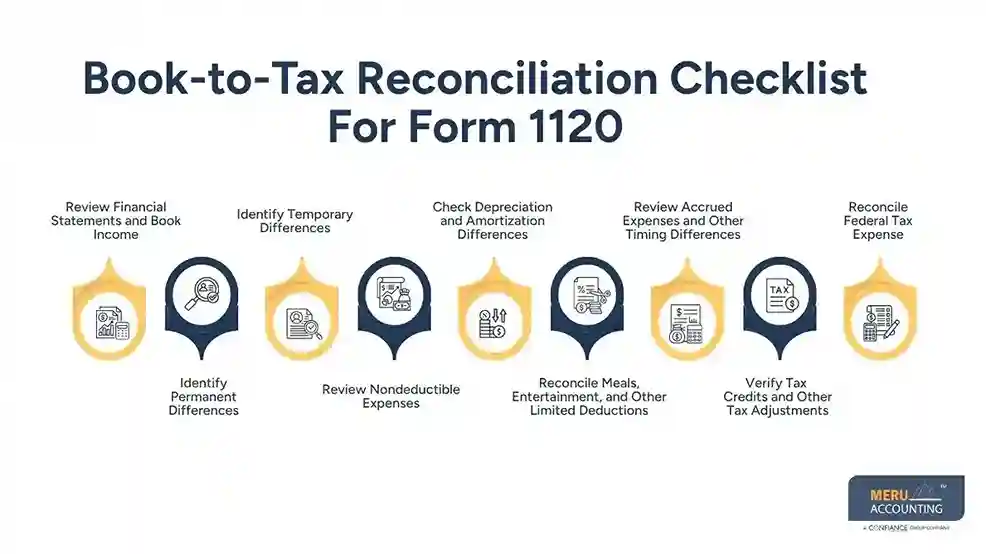
    Book-to-Tax Reconciliation Checklist For Form 1120

    Review Financial Statements and Book Income

    Begin with the final trial balance rather than an early draft of the accounts. Check that revenue, expenses, gains, losses, depreciation, interest, and tax expense are complete.

    Then tie the starting book income to the financial statements. This gives the reconciliation a firm starting point before US federal corporate tax rates are applied.

    Identify Permanent Differences

    Permanent differences do not reverse in a later tax year. Certain nondeductible expenses and tax-exempt income can create this type of difference.

    For example, if a $10,000 expense is permanently nondeductible, the amount may remain an expense in the books but must be removed from the tax deduction. Marking it as permanent prevents the item from being carried into a future-year tax schedule.

    Identify Temporary Differences

    Temporary differences are different because the tax effect may change later. Depreciation is a common example: the book amount and tax amount can differ in one year and then reverse over time.

    Track these items by year. A corporate tax outsourcing team can use a roll-forward schedule to show the opening difference, current-year change, and closing balance.

    Review Nondeductible Expenses

    Do not review the expense accounts only by their account names. A broad account such as “business expenses” can contain both deductible and nondeductible items.

    Check penalties, certain meals, entertainment, club dues, and other expenses against the current tax rules before calculating their effect under the US federal corporate tax rates. The Form 1120 instructions contain specific rules for several of these categories.
    US Federal Corporate Tax Rates: Book-to-Tax Reconciliation Checklist for Form 1120

    Check Depreciation and Amortization Differences

    A company may depreciate an asset one way for its financial statements and another way for federal tax. That difference can change taxable income even though the asset itself has not changed.

    Compare the fixed asset register with the tax depreciation schedule. Check additions, disposals, placed-in-service dates, and tax depreciation amounts before finalizing the adjustment.

    Reconcile Meals, Entertainment, and Other Limited Deductions

    Meals and entertainment are a common source of book-to-tax adjustments. Under current IRS guidance, qualifying business meals are generally subject to a 50% deduction limit, while entertainment expenses are generally nondeductible, subject to exceptions.

    A $20,000 account balance should therefore not automatically become a $20,000 tax deduction when calculating taxable income under the US federal corporate tax rates. Review the receipts and the nature of each cost before deciding the tax treatment.

    Review Accrued Expenses and Other Timing Differences

    An expense can be recorded in the books before the tax deduction is allowed. Accrued bonuses, certain compensation, reserves, and other accrued costs may require a timing review.

    Do not simply add the amount back and forget it. Record when the difference is expected to reverse so the deduction can be checked in the correct year.

    Verify Tax Credits and Other Tax Adjustments

    Tax credits and deductions should not be mixed together. A deduction changes taxable income, while a credit generally reduces the tax calculated after taxable income is determined.

    Review each credit against its related form and eligibility rules. This keeps the effect of US federal corporate tax rates separate from the later credit calculation.

    Reconcile Federal Tax Expense

    Federal income tax expense on the books needs a separate tax review. It should not simply be treated like an ordinary operating expense when calculating federal taxable income.

    Compare the book tax expense, tax provision, estimated payments, and final tax calculation. Any large difference should have a clear explanation before Form 1120 is filed.

    Good financial management isn't
    optional anymore
    Meru Accounting handles the accuracy, so you can focus
    on running the business

    Key Form 1120 Schedules Used in Book-to-Tax Reconciliation

    Schedule L

    Schedule L reports balance sheet amounts per the corporation’s books. The IRS instructions state that these balance sheets should agree with the corporation’s books and records.

    This makes Schedule L useful during the final review because balance sheet data can reveal items that were missed in the tax workpapers and may affect the application of US federal corporate tax rates to taxable income.

    Schedule M-1

    Schedule M-1 is designed to reconcile income or loss per books with income or loss reported on the return. It gives the reader a view of the items creating the difference.

    For smaller corporations that are not required to file Schedule M-3, Schedule M-1 may be the main book-to-tax reconciliation schedule.

    Schedule M-3

    Schedule M-3 provides a more detailed reconciliation for corporations that meet its filing requirements. Generally, a Form 1120 corporation with total assets of $10 million or more at year-end must file Schedule M-3 instead of Schedule M-1.

    Schedule M-3 Parts II and III reconcile financial statement net income to taxable income reported on Form 1120.

    Schedule J

    Schedule J is where the regular federal income tax calculation is made. For the 2025 Form 1120, line 1a calls for taxable income multiplied by 21%.

    This is where the effect of US federal corporate tax rates becomes visible in the final tax calculation. Any error carried from the reconciliation can therefore affect this stage.

    Schedule K and Other Schedules

    Schedule K contains additional information required for the return, while other schedules apply based on the corporation’s transactions and tax position.

    The right schedule set depends on the corporation. A corporate tax outsourcing review should therefore begin with the company’s actual activities rather than a fixed checklist copied from another return.

    How US Federal Corporate Tax Rates Affect the Tax Reconciliation Process

    Tax Rate Comes After Taxable Income

    US federal corporate tax rates are applied after taxable income is determined. That means the first question is not “How much tax is 21%?” but “What amount is actually taxable?”

    Once the reconciliation is complete, the tax calculation can be made from the correct taxable income figure.

    Adjustments Can Change Tax

    Consider a $40,000 adjustment that increases taxable income. At a 21% rate, that change represents $8,400 of additional federal tax before other tax items.

    This is why a small-looking reconciliation item deserves attention. The dollar amount may be modest compared with total revenue, but its tax effect can still be material.

    Credits Work Differently

    A tax credit does not work in the same way as a deduction. A deduction generally reduces taxable income, while a credit generally reduces the tax after the tax amount has been calculated.

    Keeping these items separate gives the tax preparer a cleaner view of how US federal corporate tax rates affect the return.

    Timing Differences Need Tracking

    A timing difference can change the tax result in the current year without being a permanent tax cost. The same item may affect a later tax year when it reverses.

    For corporate tax outsourcing, a good tracking schedule should show both the current-year adjustment and the future reversal. That is more useful than a one-year list of add-backs.

    Review Before Filing

    The final review should connect the trial balance, tax adjustments, reconciliation schedule, supporting documents, Form 1120, and tax calculation.

    The last question should be simple: does the taxable income on the return make sense based on the books and the adjustments? If the answer is unclear, the reconciliation needs another look before filing.

    Meru Accounting For Form 1120 Tax Support

    Form 1120 Preparation

    Meru Accounting provides corporate tax outsourcing for businesses that need support with Form 1120 preparation and review. Our process can start with the financial statements and continue through tax adjustments and return checks.

    Book-To-Tax Reconciliation

    Our corporate tax outsourcing work can include a review of book income, permanent differences, temporary differences, depreciation, meals, accrued expenses, and other tax adjustments that affect taxable income and the application of US federal corporate tax rates.

    Tax Workpaper Review

    Each major adjustment should have a clear reason and source. Meru Accounting can review tax workpapers to trace adjustments from the accounting records to the relevant Form 1120 schedules.

    Federal Tax Calculation

    US federal corporate tax rates are applied to taxable income after the required adjustments have been made. Our team can review the reconciliation before the final federal tax calculation is completed.

    Recurring Corporate Tax Work

    Businesses with recurring Form 1120 filings may use corporate tax outsourcing for regular tax preparation, reconciliation, workpaper review, and filing support. A set process can also make year-to-year tax review easier.

    Our Expert Perspective

    A reliable book-to-tax reconciliation should start with book income, clearly explain each permanent or temporary adjustment, track differences that will reverse in future periods, and keep the tax rate separate from the calculation of taxable income. Before Form 1120 is filed, the financial statements, supporting workpapers, reconciliation, and tax calculation should be reviewed together, including whether the calculation reflects the applicable US federal corporate tax rates; corporate tax outsourcing can provide an additional review point and recurring tax preparation capacity when needed.

    Key Takeaways

    • US federal corporate tax rates are generally 21% for most C corporations under the regular federal corporate income tax calculation.
    • US federal corporate tax rates apply to taxable income rather than simply to book profit.
    • Form 1120 should be built from reviewed tax income, not copied directly from the profit and loss statement.
    • Permanent and temporary differences should be identified separately.
    • Depreciation, meals, entertainment, accrued costs, and federal tax expense can create book-to-tax differences.
    • Schedule M-1 reconciles book income with income reported on the return, while Schedule M-3 provides a more detailed reconciliation for corporations that meet its filing requirements.
    • Corporations with total assets of $10 million or more at year-end generally must file Schedule M-3 instead of Schedule M-1.
    • Corporate tax outsourcing can provide recurring review of tax adjustments, workpapers, and Form 1120 data.
    • A clear reconciliation shows how book income becomes taxable income before applying the US federal corporate tax rates to determine the corporation’s federal tax liability.

    FAQs

    US federal corporate tax rates are generally 21% for most C corporations, applied to taxable income after allowable tax adjustments.

    Book-to-tax reconciliation adjusts book income for permanent and temporary differences to arrive at income reported for federal tax purposes.

    Schedule M-1 reconciles income or loss reported in the books with income or loss reported on the Form 1120 tax return.

    A corporation generally must file Schedule M-3 instead of Schedule M-1 when its total assets are $10 million or more at year-end.

    Book income can differ from taxable income because federal tax rules may treat deductions, depreciation, income, and timing items differently from accounting rules.

    Good financial management isn't
    optional anymore
    Meru Accounting handles the accuracy, so you can focus
    on running the business