
Returns and refunds can make ecommerce accounting hard to track. A monthly bookkeeping service for ecommerce must record each sale, return, refund, fee, tax change, and inventory movement in the right place. When these entries do not match, your sales, cash balance, inventory value, and profit can all show the wrong figures.
For an ecommerce store, a refund is not only a payment going back to a customer. It can also change sales revenue, sales tax, shipping income, payment fees, and inventory. The IRS states that sales returns and allowances are deducted from gross sales when calculating net sales.
This is why online bookkeeping for ecommerce needs regular checks between the store, payment processor, bank, and accounting system.
What You Will Learn From This Blog
- Why returns and refunds need careful accounting in ecommerce.
- Which common return and refund errors can affect financial reports.
- How a monthly bookkeeping service for ecommerce can correct these errors.
- How online bookkeeping for ecommerce connects store data with payment and accounting records.
- How to perform a month-end return and refund check.
- What steps can reduce repeat errors in future accounting periods.
Monthly Bookkeeping Service For Ecommerce: Why Returns and Refunds Need Accurate Accounting
Returns Change Net Sales
A returned product is no longer part of the final sale value in the same way as a completed order. The original sale and the return need to be linked so that net sales show the right amount.
Shopify, for example, records sales as positive values and sales reversals as negative values when returns or other order changes are processed.
Refunds Change More Than Cash
A refund reduces the amount the business keeps from a sale. Depending on the order, it may also change tax, shipping, discounts, and payment records.
A monthly bookkeeping service for ecommerce should check these related entries instead of recording only the money sent back to the customer.
Inventory Can Change Too
When a customer sends an item back, the product may return to sellable stock, damaged stock, or a separate return area. The accounting entry should match what happened to the item.
If the returned item is put back into stock but inventory records are not updated, the financial statements may show the wrong inventory balance.
Payment Data May Differ
A store platform and payment processor do not always show the same type of data. Shopify notes that sales reports track sales and reversals, while payment reports track money received and refunded.
This makes online bookkeeping for ecommerce useful for checking both sides before a month is closed.
Timing Can Create Differences
A customer may request a refund on the last day of a month, while the payment processor completes it in the next month. This can create a timing difference.
A monthly bookkeeping service for ecommerce should identify these items and check the supporting records before final month-end figures are prepared.
Common Returns and Refund Accounting Issues in Ecommerce
Refunds Recorded Before the Actual Payment is Processed
A refund request does not always mean that money has already left the payment account. Recording the cash movement too early can create a mismatch between the books and the payment processor.
The accounting record should match the actual transaction status and the store’s reporting method.
Returned Orders Still Included in Sales
An order may remain in a sales report even after a return is processed because sales and returns can appear as separate entries. Shopify states that returns and refunds can appear in different reports and that date ranges can also create differences.
A monthly bookkeeping service for ecommerce should link the return to the original order before reviewing net sales.
Shipping Charges Handled Incorrectly
Some stores refund the product but not the original shipping charge. Others refund all or part of the shipping amount.
These amounts should be reviewed separately by a monthly bookkeeping service for ecommerce because shipping charges can have their own accounting and tax treatment.
Restocking Fees Missed From Accounting Records
Some stores charge a fee when a customer returns an item. Shopify identifies return fees as amounts charged for returns, such as restocking or return shipping fees.
If the fee is collected but not recorded, the books may not agree with the store’s transaction data.
Refunds Recorded in the Wrong Accounting Period
A refund can start in one month and finish in another. Posting the amount to the wrong period can make one month’s sales look too high and another month’s sales look too low.
A monthly bookkeeping service for ecommerce should flag these timing differences during each month-end review of online bookkeeping for ecommerce.
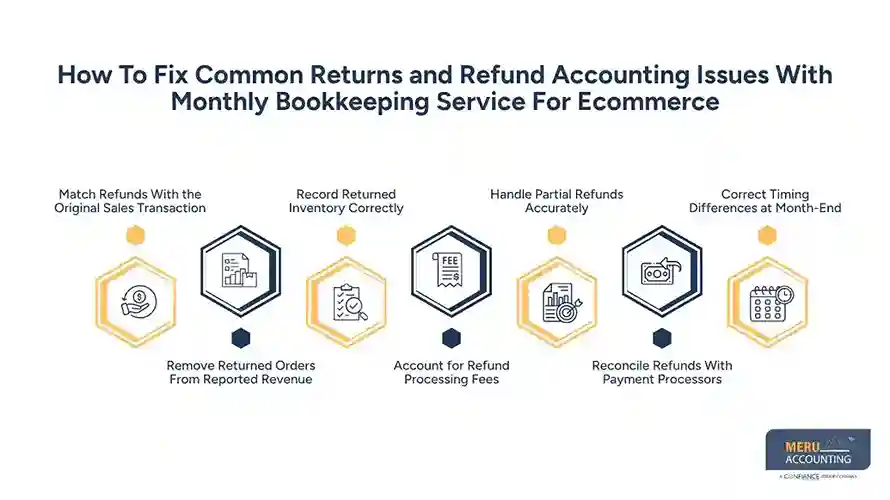
How To Fix Common Returns and Refund Accounting Issues With Monthly Bookkeeping Service For Ecommerce
Match Refunds With the Original Sales Transaction
Start with the order number, customer transaction, refund date, refunded amount, and payment reference. Match these details before posting the refund. As part of a monthly bookkeeping service for ecommerce, this matching process can be performed regularly to keep sales and refund records aligned.
Remove Returned Orders From Reported Revenue
Review gross sales, discounts, returns, and refunds as separate figures before calculating net sales. The IRS treats sales returns and allowances as deductions from gross sales.
A monthly bookkeeping service for ecommerce can check whether the accounting system reflects the same treatment used in the store reports.
Record Returned Inventory Correctly
The physical condition of the item matters. A sellable item may return to normal inventory, while a damaged item may need a different stock category or write-down.
The inventory entry in a monthly bookkeeping service for ecommerce should agree with the warehouse or fulfillment record, not just the refund amount.
Account for Refund Processing Fees
Payment processors may charge fees that do not return to the merchant when a customer receives a refund. These costs should be reviewed against processor statements.
Online bookkeeping for ecommerce should keep refund amounts and payment fees separate so that the business can see the actual cost of returns.
Handle Partial Refunds Accurately
A customer may receive a refund for one item, part of an order, or only a shipping charge. A partial refund should not be treated as a full order reversal.
Shopify’s reporting also distinguishes full refunds, partial refunds, custom refunds, and other sales reversals.
Reconcile Refunds With Payment Processors
Compare store refund reports with payment processor data and the bank statement. Check the order ID, refund amount, date, fee, and settlement amount.
A monthly bookkeeping service for ecommerce should investigate unmatched amounts rather than forcing the bank balance to agree through a general adjustment.
Correct Timing Differences at Month-End
List refunds that were approved but not yet settled, along with refunds that were settled but have not been posted in the accounting system.
Online bookkeeping for ecommerce can then separate true month-end activity from transactions that belong to the next accounting period.
How Online Bookkeeping For Ecommerce Helps Reconcile Sales, Returns and Refunds
Connect Store and Accounting Data
Store reports show order activity, while accounting records show financial entries. Comparing both sets of data gives a clearer view of what was sold, returned, and refunded.
This is a key part of online bookkeeping for ecommerce because one report may not show the full payment movement.
Check Payment Processor Reports
Payment processors can have their own settlement dates, fees, refunds, and adjustments. These figures should be checked against store records.
A monthly bookkeeping service for ecommerce can include these checks as part of the regular reconciliation process.
Review Tax Amounts
A refund can affect the tax linked to the returned product. Shopify notes that refunds can reduce the related tax amount in its finance reports.
Tax treatment can vary by state and transaction type, so businesses should use their tax rules and professional tax advice where needed.
Compare Inventory Changes
The number of returned items should agree with inventory records. Differences may point to missing returns, damaged stock, duplicate entries, or delayed warehouse updates.
Online bookkeeping for ecommerce can bring these records together during the monthly review.
Track Unusual Refund Patterns
A sudden rise in refunds for one product or sales channel may need further review. The reason could be product quality, shipping issues, order errors, or customer policy changes.
The accounting data can show the financial effect, while operational data can explain the cause.
optional anymore
on running the business
Month-End Returns and Refund Reconciliation For Ecommerce Businesses
Export Store Reports
A monthly bookkeeping service for ecommerce typically starts the reconciliation process by collecting sales, returns, refunds, payment, and inventory reports for the month. Shopify allows reports to be exported in formats such as CSV and JSONL.
Keep the same date range across reports before comparing totals.
Match Refund Transactions
Match each refund with its original order and payment record. Look for duplicate refunds, missing refunds, and amounts that do not match.
A monthly bookkeeping service for ecommerce can keep an exception list for items that need further review.
Check Bank and Processor Settlements
Compare the net amount received or paid with payment processor statements and bank transactions. Include processing fees and other adjustments.
This step can show whether a difference comes from a real accounting error or simply from settlement timing.
Review Inventory Entries
Compare returned units with warehouse records. Check whether returned goods went back into sellable stock or were moved to another category.
This prevents the refund entry from being correct while the inventory figure remains wrong during monthly bookkeeping service for ecommerce.
Review Tax and Shipping
Check refunded tax, shipping refunds, and return fees separately. Do not assume that every refund affects each part of the original order in the same way.
Online bookkeeping for ecommerce should keep these amounts visible for review.
Practical Tips For Preventing Recurring Returns and Refund Accounting Errors
Use One Order Reference
Keep the store order number or transaction ID with the accounting entry. This makes later checks much easier.
Set a Monthly Cutoff
Choose a clear month-end cutoff for a monthly bookkeeping service for ecommerce to review refunds and returns. Items processed after the cutoff can then be checked in the next period.
Keep Refund Reports
Save monthly refund and return reports with the related accounting records. This creates a clear audit trail for later review.
Review Partial Refunds
Partial refunds deserve special attention because the customer may still have an active balance or part of the order may remain valid.
Separate Fees From Refunds
Do not combine payment fees, return fees, shipping refunds, and product refunds into one unclear amount. Separate entries make reports easier to review.
Investigate Repeat Differences
If the same mismatch appears every month, find the source rather than posting a repeated correction. The cause may be a report setting, integration issue, or posting rule.
How Meru Accounting Handles Ecommerce Returns and Refund Bookkeeping
Ecommerce Sales Reconciliation
Meru Accounting provides bookkeeping services for ecommerce businesses that need regular checks on sales, returns, refunds, payment fees, and bank settlements. Meru Accounting compares ecommerce platform data with accounting records to identify differences before month-end reports are closed.
Returns and Refund Review
Returns and refunds can affect more than sales revenue. At Meru Accounting, we review refund entries as part of a monthly bookkeeping service for ecommerce against original orders, payment records, shipping amounts, and related fees so each transaction is posted to the right account.
Payment Processor Reconciliation
Payment processors may show gross sales, refunds, fees, and net settlements as separate amounts. We reconcile these figures with bank transactions and accounting records to identify missing, duplicated, or unmatched entries.
Inventory and Return Entries
A returned product may go back into sellable stock or may need a different inventory treatment. Meru Accounting reviews return data with inventory records so the accounting entry reflects the actual movement of goods.
Monthly Accounting Review
A regular monthly bookkeeping service for ecommerce creates a set process for reviewing sales and refund activity each month. Meru Accounting provides bookkeeping using QuickBooks, Xero, Zoho Books, NetSuite, and Odoo based on the business’s accounting setup.
Our Expert Perspective
Returns and refunds should be reviewed as complete transactions, not only as money sent back to customers. The original sale, returned item, tax, shipping, payment fee, and inventory entry should match across the ecommerce platform, payment processor, bank, and accounting system. Extra attention is useful for large refunds, partial refunds, duplicate entries, and transactions near month-end because timing or missing entries can affect financial reports. If records do not match, the cause should be traced before making an adjustment, while monthly review of refund trends can also show repeated issues linked to certain products, sales channels, or order types.
Key Takeaways
- Returns and refunds can affect sales, cash, tax, inventory, shipping, and payment fees.
- Each refund should be matched with its original order and payment record.
- Returned inventory should agree with the actual stock position.
- Partial refunds and shipping refunds need separate review.
- Month-end timing differences should be identified before financial reports are closed.
- Online bookkeeping for ecommerce should compare store, payment processor, bank, and accounting data.
- A monthly bookkeeping service for ecommerce can create a regular process for finding and correcting these differences.
FAQs
Ecommerce returns and refund accounting records the effect of returned goods and customer refunds on sales, cash, inventory, fees, and related taxes.
Refunds can be processed on a different date from the original sale, and store, payment, bank, and accounting reports may show different details.
Refunds should be checked at least once each month, with extra review when refund volume is high or large transactions are involved.
Online bookkeeping for ecommerce can include sales reconciliation, bank reconciliation, payment processor checks, refund reviews, inventory entries, accounts payable, accounts receivable, and month-end reporting.
A monthly bookkeeping service for ecommerce creates a regular process to match sales, returns, refunds, payments, fees, and inventory before monthly financial reports are finalized.
optional anymore
on running the business