
Managing inventory gets a lot harder when materials, WIP, and finished goods are spread across several plants or warehouses. A transfer may be recorded at one location but not yet at another, or the books may show a different balance than what is actually on hand. Strong inventory management for manufacturing helps keep these moving parts under control.
For manufacturers, inventory accounting is about more than counting stock. Finance teams need to track where inventory is held, how much it costs, what has been used in production, and whether each location’s records match the books. Without clear controls, small gaps in transfers, production usage, or stock counts can turn into bigger problems at month-end.
The good news is that multi-location inventory does not have to be difficult to manage. With consistent records, clear transfer rules, regular reconciliations, and the right reports, manufacturers can improve accuracy and get a clearer view of inventory across every location.
What You Will Learn From This Blog
- What inventory management for manufacturing means in a multi-site setup
- Why plant-to-plant stock moves can cause book gaps
- 10 ways to improve stock control and cost records
- How manufacturing inventory reconciliation helps find stock and book gaps
- Key stock and cost metrics for plant teams
- How an outsourced accounting team can help keep stock data clean
What Is Inventory Management for Manufacturing?
Inventory management for manufacturing is the process of tracking the stock a firm buys, stores, uses, makes, and sells. It covers more than raw goods. It may also include WIP, finished goods, spare parts, and items used to run a plant.
A good process links stock data with the flow of work. For each site, a firm should know what came in, what was used, what was made, what was moved, and what was sold or held.
The main stock types are:
- Raw materials: Items used to make a product
- Work in process: Goods that are still in the build stage
- Finished goods: Items that are ready to sell
- MRO stock: Parts and goods used to run and fix plant assets
For firms with many sites, the process must also track where stock sits. A raw good held in Plant A should not look like stock held in Plant B. Clear site codes, item codes, and stock rules help keep each balance tied to the right place.
Why Multi-Location Inventory Accounting Is Challenging
Multi-site stock can be hard to track because the stock moves more often and the data may sit in more than one system.
A plant may ship goods to another plant. A warehouse may send parts to a plant. One site may make a part that another site uses in its own build. Each move needs the right entry in both the stock system and the books.
Timing can also cause gaps. A site may ship stock on the last day of a month, while the other site does not post the receipt until the next day. The goods are in transit, but each site may show a different balance.
Cost can add more risk. Labor, plant costs, freight, and other costs may be added to goods as they move through the build. If sites use different rules or old cost data, the value in the books may not match the true cost.
This is why manufacturing inventory reconciliation should be part of the close process, not a task saved for year-end.
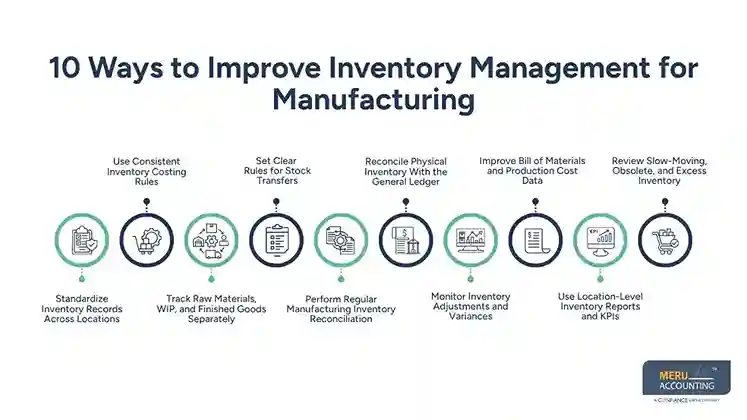
10 Ways to Improve Inventory Management for Manufacturing
1. Standardize Inventory Records Across Locations
Use the same item codes, site codes, units, and stock terms across all plants and warehouses. A part should not have one code at one site and a second code at another unless there is a clear reason.
A shared data rule makes reports easier to read and cuts the risk of duplicate stock records.
2. Use Consistent Inventory Costing Rules
Each site should follow the same approved rules for stock cost where the business model calls for it. The team should know how to treat raw goods, WIP, finished goods, freight, labor, and other costs that form part of stock value.
Cost rules should also be reviewed when a firm adds new sites, changes its build process, or makes major changes to its ERP setup.
3. Track Raw Materials, WIP, and Finished Goods Separately
Do not treat all stock as one pool. Raw goods, WIP, and finished goods serve a different role in the build cycle.
Separate records make it easier to see where stock is tied up. They also help the finance team trace a cost from the buy stage through the build and into the sale.
4. Set Clear Rules for Stock Transfers
Plant-to-plant moves need a set process. The shipping site should post the issue, while the receiving site should post the receipt based on the same transfer record.
The process should also cover goods in transit. This helps stop one site from showing the stock as gone while the other site has not yet added it to its balance.
Clear transfer rules are a key part of inventory management for manufacturing because stock can cross site lines many times before it is sold.
5. Perform Regular Manufacturing Inventory Reconciliation
A set manufacturing inventory reconciliation process can help find gaps between stock records and the accounting books.
At a basic level, the team can compare:
- Inventory subledger totals
- General ledger balances
- Physical count results
- Open transfer records
- Production usage
- Inventory adjustments
The goal is not just to find a gap. The team should also find out why the gap took place and record the fix.
6. Reconcile Physical Inventory With the General Ledger
A physical count can show how much stock is on hand, but it does not by itself show if the books are right.
After a count, finance should compare the count result with the stock system and then tie the value to the general ledger. Any gap should have a clear reason, such as a count error, damaged goods, timing gap, unposted receipt, or stock adjustment.
This step gives inventory management for manufacturing a strong link to the financial close.
7. Monitor Inventory Adjustments and Variances
Large or frequent stock adjustments can point to a process issue. A firm should track who made the change, what item was changed, the site, the value, and the reason.
Look for repeat gaps by item, site, shift, or process. If one plant has far more stock adjustments than the others, the cause may be a count issue, poor scan data, a process gap, or a posting delay.
8. Improve Bill of Materials and Production Cost Data
A bill of materials (BOM) tells the team what parts and amounts are needed to make a product. If the BOM is out of date, the stock and cost records can also drift.
Review BOMs when product design, material use, labor needs, or build steps change. Keep the production data in sync with the accounting rules used to value WIP and finished goods.
Good inventory management for manufacturing depends on good production data. The accounting team cannot fix a cost gap if the source data is wrong.
9. Use Location-Level Inventory Reports and KPIs
A single company-wide stock total can hide a lot. Build reports that show stock by site, item group, and stock type.
Useful measures may include:
- Inventory turnover
- Days of inventory on hand
- Stock variance
- WIP balance
- Slow-moving stock
- Obsolete stock
- Raw material usage
Site-level reports help managers see where cash is tied up and where stock control may need work.
10. Review Slow-Moving, Obsolete, and Excess Inventory
Stock that sits too long can tie up cash and may lose value. Review old stock by site and item on a set schedule.
Ask why it has not moved. It may be tied to an old product, a canceled order, a change in demand, or a buy that was too large.
The review should also feed into the books when an adjustment or reserve is needed under the firm’s accounting policy.
Key Inventory Accounting Metrics for Manufacturers
The right metrics can turn stock data into useful action. Manufacturers may track:
Inventory turnover: Shows how often stock is used or sold over a set period.
Days inventory on hand: Shows how many days of stock the current balance may cover based on use or sales.
Inventory variance: Shows the gap between book or system stock and the result of a count.
WIP balance: Helps show how much cost is tied up in goods that are still in production.
Slow-moving inventory: Flags goods that have had little or no use or sale for a set time.
These metrics work best when viewed by site as well as at the company level. A firm may have a healthy total stock level while one plant holds far more stock than it needs.
optional anymore
on running the business
Meru Accounting’s Inventory Management for Manufacturing Businesses
Multi-location manufacturing requires more than basic bookkeeping. Inventory has to be tracked through purchasing, production, transfers, and finished goods, while the related costs need to flow into the books correctly. At Meru Accounting, we support manufacturers with the accounting work behind these processes, helping keep inventory records, production costs, and financial reports aligned across locations.
Our inventory management for manufacturing includes:
Inventory & Production Accounting
- Raw material, WIP, and finished goods tracking
- Inventory account review and month-end close support
- Production cost and inventory adjustment review
- Slow-moving and obsolete inventory review
Multi-Location Inventory Support
- Plant and warehouse inventory tracking
- Inter-location transfer review
- Inventory balance and variance checks
- Manufacturing inventory reconciliation
- Physical count and book balance support
Ongoing Accounting Support
- Bank and credit card reconciliation
- Monthly financial statements
- Catch-up and cleanup bookkeeping
- Tax-ready financial records
We work with the accounting and inventory systems already used by your business, so the process can fit your existing workflows rather than adding unnecessary steps.
Our Expert Insight
A clean inventory balance does not always mean the inventory records are in good shape. A manufacturer can have books that tie out while still carrying excess stock, old WIP, repeated adjustments, or costs in the wrong production stage.
That is why we look beyond the final balance. High-value adjustments, unusual material usage, long-open WIP, and large differences between locations can point to issues worth reviewing. A strong manufacturing inventory reconciliation should help explain these patterns, not just confirm that the numbers match.
For multi-location manufacturers, this approach gives finance teams a better view of where inventory costs and process gaps may be affecting the business.
Key Takeaways
- Inventory management for manufacturing should cover raw goods, WIP, finished goods, and MRO stock.
- Multi-site firms need clear rules for stock moves, costs, and site records.
- Manufacturing inventory reconciliation helps tie stock data to the general ledger.
- Physical counts should be checked against both the stock system and the books.
- Old BOMs, poor transfer data, and untracked adjustments can lead to stock and cost gaps.
- Site-level reports can show issues that a company-wide stock total may hide.
- A monthly process can reduce year-end cleanup and improve financial reporting.
FAQs
Inventory management for manufacturing tracks the flow, cost, and value of materials from purchase through production and sale. It covers raw materials, WIP, finished goods, and other plant stock.
Manufacturers can use shared item codes, site-level records, standard cost rules, transfer controls, and regular stock counts. Each site should also follow the same core accounting process.
Manufacturing inventory reconciliation compares inventory records with the accounting books and physical stock. It helps find gaps caused by transfers, counts, production use, timing, or posting errors.
Many manufacturers review inventory each month as part of the close. Higher-volume sites may also use cycle counts or more frequent checks for key items.
Common causes include late transfers, unposted receipts, count differences, wrong item codes, production usage errors, and inventory adjustments that were not posted correctly.
optional anymore
on running the business