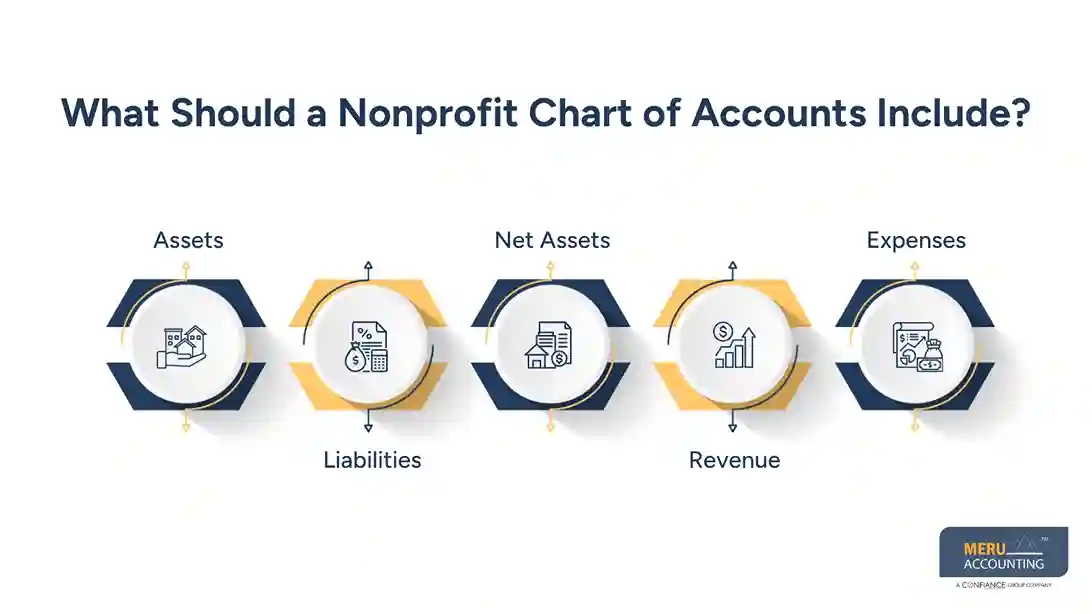
What Should a Nonprofit Chart of Accounts Include?
Each nonprofit should build its chart based on its own work. Still, most charts use five main account groups.
Assets
Assets are things the nonprofit owns or controls. They may include:
- Checking and savings accounts
- Cash funds
- Accounts receivable
- Prepaid costs
- Equipment
- Buildings or other property
Liabilities
Liabilities are amounts the nonprofit owes. These may include:
- Accounts payable
- Credit card balances
- Accrued payroll
- Loans
- Other unpaid bills
Net Assets
Nonprofits do not use owner equity in the same way as a for-profit firm. Instead, net assets show the group’s net financial position.
Net assets are often shown based on whether donor limits apply. The exact account setup should fit the nonprofit’s reporting needs and its accounting policy.
Revenue
Revenue accounts can track the main ways a nonprofit brings in funds. These may include:
- Individual gifts
- Foundation grants
- Government grants
- Member dues
- Program fees
- Event income
- Interest income
Separate revenue accounts can make it easier to see which sources support the group.
Expenses
Expense accounts show how funds are used. A nonprofit may track:
- Program costs
- Salaries and wages
- Rent
- Insurance
- Office costs
- Technology
- Fundraising
- Marketing
- Professional fees
- Travel
A good non profit bookkeeping setup should make it easy to sort costs by their real purpose. This is key when the group needs to show how much it spends on its core work.
Best Practices for Bookkeeping for Non Profit Organizations
Good bookkeeping for non profit organizations starts with a chart that is simple, clear, and made for the group’s needs. But the chart is only one part of the process.
Keep account names clear
Use names that staff can grasp at a glance. Avoid vague labels that can lead to mixed use.
Set rules for data entry
Create basic rules for how gifts, grants, bills, and costs are coded. This helps keep records more steady when more than one person enters data.
Reconcile accounts each month
Bank and card accounts should be checked against the books. Regular checks can help find missed items, duplicate entries, and errors before they grow.
Track restricted funds with care
Do not assume all cash can be used for any need. Review grant terms and gift terms to see if limits apply. Your accounting process should show these limits in a clear way.
Keep source records
Save bills, gift records, grant docs, bank data, and other key proof. Good source records make it easier to support the numbers in your books.
Review reports on a set cycle
Do not wait until year-end to look at the books. Monthly review can help the board and staff spot odd trends, cash needs, or cost issues sooner.
Keep the chart lean
A chart with too many accounts may add work with little gain. Add a new account when it gives useful data for a report, budget, grant, or key review.
These steps make bookkeeping for non profit organizations more useful for both day-to-day work and long-term planning. They also give non profit bookkeeping a clear process that can scale as the group grows.
Bookkeeping for Non profit Organizations by Meru Accounting
A nonprofit’s books need to do more than show income and expenses. They should help your team track funds, monitor program costs, and prepare clear financial reports. That requires an accounting setup that fits how your organization operates.
At Meru Accounting, we support nonprofits with accounting work built around their day-to-day financial needs. Our services can include:
- Chart of accounts setup: We help structure accounts for nonprofit income, expenses, assets, liabilities, and net assets.
- Transaction recording and review: We classify financial activity and review entries for accuracy and consistency.
- Bank and credit card reconciliation: We match account activity with the books and help identify missing or incorrect entries.
- Grant and fund tracking: We help organize financial records so your team can better monitor funds and their intended use.
- Month-end bookkeeping: We keep records current and help prepare the books for regular financial review.
- Financial reporting: We prepare clear reports that can help management and board members understand the organization’s financial position.
Our approach to bookkeeping for non profit organizations focuses on building records that are useful beyond year-end. With a well-structured chart of accounts and consistent non profit bookkeeping practices, your team can spend less time sorting through transactions and more time using financial data to guide the organization.
Our Expert Insight
One thing we look for when reviewing nonprofit books is whether the chart of accounts matches the way the organization actually operates. A nonprofit may have accurate entries but still lack clear data on program costs, grant use, or fundraising spend.
For bookkeeping for non profit organizations, the account structure should answer real questions, not just sort transactions. We also check how restricted funds and functional expenses are tracked, since these areas can affect financial reports and year-end work.
At Meru Accounting, we focus on making the books useful for both daily decisions and financial reporting. A clear account structure, consistent records, and regular review can give nonprofit leaders a much better view of their finances.
Key Takeaways
- Bookkeeping for non profit organizations keeps financial data clear, complete, and easy to review.
- A nonprofit chart of accounts gives structure to income, costs, assets, liabilities, and net assets.
- The chart should reflect the nonprofit’s real work and reporting needs.
- Restricted funds need careful tracking and clear records.
- Monthly reconciliation and report review can help find errors early.
- Good non profit bookkeeping depends on clear rules and steady data entry.
- A lean chart can be easier to manage than one with too many accounts.
- Outside accounting help can be useful as a nonprofit grows.