Ecommerce accounting gets harder when a seller takes orders from several sales channels. A store may sell through its own website, Amazon, eBay, Walmart, Etsy, or other platforms. Each channel can send sales data, fees, refunds, taxes, and payouts at a different time.
This can make it hard to match sales with the cash that reaches the bank. A seller may see $10,000 in orders but receive less in the bank due to fees, refunds, returns, chargebacks, and other deductions. This is why ecommerce accounting must track both the sale and the final payment.
For multi-channel sellers, payment checks are not just a month-end task. They need a clear process that links orders, payment records, fees, refunds, and bank deposits.
What You Will Learn From This Blog
- Why payment reconciliation matters for ecommerce accounting in 2026.
- How multi-channel sales can create gaps in financial data.
- How ecommerce payment reconciliation links sales to actual payouts.
- How accounting for ecommerce store payments should treat fees, refunds, and chargebacks.
- A simple process for checking payments across many sales channels.
- Practical ecommerce accounting steps that sellers can use during 2026.
Ecommerce Accounting in 2026: Why Payment Reconciliation Matters
Sales Do Not Equal Bank Deposits
A sales report shows what customers paid or owed, while a bank statement shows the cash that was sent to the business. The two figures may not match because a payment platform can take fees before sending the balance.
For example, a $1,000 sales total may lead to a $970 bank deposit after fees and other deductions. Accurate ecommerce accounting records both amounts.
Multiple Payout Dates
Payment platforms may send money on different days. Some may pay each day, while others may group several orders into one payout.
This makes ecommerce payment reconciliation useful because it links the payout to the orders that made up that amount.
Fees Can Cut Into Margin
Transaction fees, platform fees, shipping fees, and other charges can lower the amount received by the seller. If these costs are not posted in the right account, profit reports may not show the true cost of sales.
Refunds Change Sales Data
A refund can happen days or weeks after the first sale. If the refund is not matched to the original order, sales and income figures can be overstated.
Chargebacks Need Clear Tracking
A chargeback can remove cash from a payout and may also include a separate fee. Ecommerce accounting should record the sale, chargeback, fee, and related cash movement so the entry can be checked later.
Better Data Leads to Better Review
When sales and cash data are matched, owners can review revenue, fees, refunds, and cash flow with more clarity. This gives them a better base for monthly reports and tax work.
How Multi-Channel Selling Creates Ecommerce Accounting Challenges
Different Sales Reports
Each sales channel may use its own report format. One platform may show gross sales, while another may show sales after refunds or fees.
This creates extra work when accounting for ecommerce store activity across several channels.
Different Fee Rules
A marketplace may charge listing fees, selling fees, payment fees, or other costs. These charges can appear as separate lines or as deductions from a payout.
Orders and Payouts Use Different Dates
An order date is not always the same as the payment date or bank deposit date. This timing gap can make month-end reports hard to match.
Returns Can Cross Months
A customer may buy an item in March and return it in April. If the return is posted in the wrong period, the monthly sales report may not show the right amount.
Sales Tax Adds More Detail
Sales tax may be collected by the seller or handled by a marketplace, based on the applicable rules. Sellers need clear records to know what was charged, collected, and remitted.
Currency Can Add Another Layer
A seller using channels in more than one country may receive funds in different currencies. Ecommerce accounting must account for exchange rates and any related bank or payment fees.
Understanding Ecommerce Payment Reconciliation Across Sales Channels
Start With the Sales Report
The first step is to collect the sales report from each channel. Check orders, refunds, discounts, taxes, and other amounts shown by the platform.
This gives ecommerce payment reconciliation a clear starting point.
Match Orders to Payment Data
Payment records should be checked against order records. The goal is to confirm that the amount charged to customers agrees with the payment data.
Match Payment Data to Payouts
The next step is to match the payment balance to the actual payout. This is where platform fees, refunds, chargebacks, and other deductions need close review.
Match Payouts to the Bank
The final cash check is the bank statement. Each payout should be tied to the correct bank deposit, with any timing gap clearly noted.
Review Unmatched Items
An unmatched amount should not be forced into a random account just to make the report balance. The source should be checked first, such as a missing refund, fee, timing issue, or duplicate entry.
Keep a Clear Audit Trail
Keep the sales report, payout report, bank record, and adjustment details together. A clear trail makes later checks much easier and gives useful proof for tax and financial review.
Accounting for Ecommerce Store Payments, Fees, Refunds, and Chargebacks
Record Gross Sales
Sales should be recorded based on the business’s accounting method and the nature of the transaction. The gross sale and related deductions should be clear in the records.
This is a key part of accounting for ecommerce store transactions.
Record Payment Fees
Payment fees are a business cost and should be posted to the right expense account. This prevents fees from being hidden inside the net bank deposit.
Track Refunds Separately
Refunds should be linked to the original sale where possible. This gives a clearer view of net sales and makes customer return trends easier to review.
Post Chargebacks With Care
A chargeback can affect sales, cash, and fees. The entry should show what was reversed and what fee was charged so that the bank balance and sales report can be matched.
Check Discounts and Credits
Coupons, store credits, and discounts can change the amount paid by a customer. These items should be reviewed so the sales figure does not include amounts that were never collected.
Review Net Payouts
The final payout should be checked against gross sales and all related deductions. This is one of the core checks in ecommerce accounting for sellers with high order volume.
optional anymore
on running the business
A Practical Ecommerce Payment Reconciliation Process for Multi-Channel Sellers
Gather the Source Reports
Collect sales, payment, refund, fee, and payout reports from every active channel. Use the same date range for each report before starting the check.
Set a Reconciliation Period
Choose a fixed period, such as one week or one month, so your ecommerce accounting records follow a consistent reconciliation cycle. A fixed period makes ecommerce payment reconciliation easier to track and reduces missed items.
Compare Gross Sales
Compare the sales total in the accounting system with the source reports. Look for missing orders, duplicate entries, cancelled sales, and timing gaps.
Check Every Deduction
Review fees, refunds, chargebacks, discounts, and other deductions. The total deductions should explain the difference between gross sales and the net payout.
Match Bank Deposits
Match each payout with the related bank deposit. If a payout was sent on one day and posted by the bank on another, record the timing difference rather than treating it as an error.
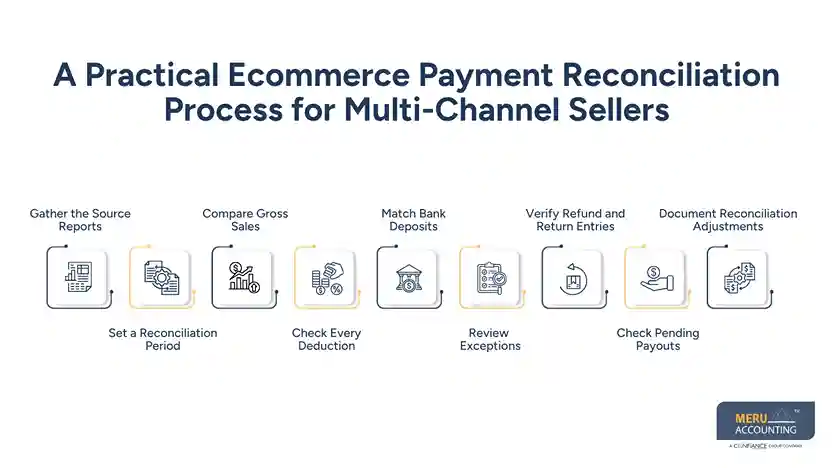
Review Exceptions
Keep a list of items that do not match. Assign a reason to each item and clear the list before closing the period.
Verify Refund and Return Entries
Check that refunds and returns in the payment platform also appear correctly in the accounting records. Match each refund with the related order to avoid overstated sales or unexplained cash differences.
Check Pending Payouts
Review payouts that have been approved but have not yet reached the bank. This can explain why the payment report and bank statement show different balances at the end of a period.
Document Reconciliation Adjustments
Record the reason for each adjustment made during the reconciliation. Keep notes and source reports for items such as fee corrections, timing differences, refunds, and chargebacks so the entries can be checked later.
Ecommerce Accounting Best Practices for Multi-Channel Sellers in 2026
Use One Clear Account Structure
Create clear accounts for sales, refunds, platform fees, payment fees, shipping income, chargebacks, and other key items. This makes reports easier to read.
Reconcile on a Set Schedule
High-volume sellers may need checks more often than once a month. Regular ecommerce accounting reviews can catch errors before they grow.
Keep Channel Data Separate
Track each major channel in a way that lets you compare sales, fees, refunds, and payouts. This can show which channels create the most revenue and cost.
Review Gross and Net Figures
Do not rely only on the amount that reaches the bank. Review gross sales, deductions, and net payouts to understand the full cash flow.
Keep Source Reports
Save key platform reports for each reconciliation period. Good records can make tax review, financial checks, and error research much easier.
Use a Clear Exception Log
When a number does not match, write down the reason and action taken. This creates a simple record of what was checked and why an adjustment was made.
Why Choose Meru Accounting For Ecommerce Accounting
Multi-Channel Record Review
Meru Accounting provides ecommerce accounting services for sellers that receive orders and payouts from more than one channel. The review can cover sales, refunds, fees, payouts, and bank activity.
Payment Reconciliation
Meru Accounting provides ecommerce payment reconciliation to compare platform reports, payment records, payouts, and bank deposits. Differences can then be reviewed against the source data.
Clear Fee Tracking
Payment and marketplace fees can be reviewed and posted to suitable expense accounts. This gives sellers a clearer view of the cost linked to each sales channel.
Refund and Chargeback Review
At Meru Accounting, we can review refunds and chargebacks against the related sales and payment data. This can reduce unexplained differences in monthly reports.
Accounting For Ecommerce Store Activity
Meru Accounting provides accounting for ecommerce store transactions, including sales, fees, refunds, and related entries. The work can be aligned with the seller’s accounting setup and reporting needs.
Monthly Financial Review
Meru Accounting can review financial data across sales channels and provide reports based on the records available. This gives owners a clearer base for reviewing revenue, costs, and cash movements.
Our Expert Perspective
In our view, the key issue in multi-channel ecommerce accounting is not just recording sales. It is making sure the sales report, payment report, payout, and bank deposit tell the same story.
A seller may have strong sales but still face poor cash visibility if fees, refunds, and chargebacks are not tracked well. A set reconciliation process gives each difference a reason instead of leaving unexplained gaps in the accounts.
For 2026, sellers should treat payment reconciliation as a regular finance task rather than a last-minute month-end check.
Key Takeaways
- Ecommerce accounting must connect sales data with actual cash received.
- Gross sales and bank deposits can differ because of fees, refunds, discounts, and chargebacks.
- Ecommerce payment reconciliation should cover sales reports, payment records, payouts, and bank deposits.
- Accounting for ecommerce store activity should clearly track fees, refunds, and chargebacks.
- Multi-channel sellers should use a fixed reconciliation process and keep source reports.
- Unmatched amounts should be checked and explained before financial reports are closed.
- Regular ecommerce accounting reviews can give sellers a clearer view of revenue and cash movement.
FAQs
Ecommerce accounting is the process of recording and checking online sales, fees, refunds, payments, expenses, and other financial transactions.
Ecommerce payment reconciliation is the process of matching online sales and payment records with payouts and bank deposits to find and explain differences.
Sales may not match bank deposits because payment platforms can deduct fees, refunds, chargebacks, discounts, or other costs before sending a payout.
Accounting for ecommerce store payments should track sales, payment fees, refunds, chargebacks, discounts, taxes, payouts, and bank deposits based on the business’s accounting method.
High-volume sellers may reconcile payments weekly, while smaller sellers may use a monthly schedule. The right timing depends on sales volume, payment risk, and the number of sales channels.
optional anymore
on running the business