Pay runs and ledgers take more time than most owners expect. Payroll and bookkeeping services place this work with trained professionals, so owners can give their attention to clients and growth. This blog explains what the work covers, what it costs, and how to choose a setup that suits your business. It also draws on real client work, so your decisions rest on facts. Many owners consider outsourced payroll and bookkeeping once the team grows beyond a few people.
What You Will Learn From This Blog
- What payroll and bookkeeping services include each month
- Typical price ranges and the factors behind the final bill
- The value of outsourced payroll and bookkeeping for cash and time
- Tax and record rules every employer must follow
- The six steps to hand your work to a provider
What are Payroll and Bookkeeping Services?
A Simple Definition
Payroll and bookkeeping services cover two duties: paying your staff accurately and recording every dollar that enters or leaves your business. One provider or one team manages both.
The Payroll Side
Payroll covers hours, pay rates, taxes, and pay slips. Employees notice errors quickly, so every pay run must be correct.
The Bookkeeping Side
Bookkeeping records sales, bills, and bank activity. Clean books show what you earn, what you owe, and what remains.
Why the Two Belong Together
Wages are often the highest cost in a business. When one team keeps both records, the figures agree, and fewer errors pass through. Combined payroll and bookkeeping services also give you a single point of contact.
Who Uses Them
Shops, clinics, agencies, and growing firms rely on them. So do owners who run a lean business with a few part-time workers.
What Tasks are Included in Payroll and Bookkeeping Services?
Employee Payroll Processing and Wage Calculations
The provider tracks hours, overtime, bonuses, and leave, then calculates net pay. Employees are paid on schedule by check or direct deposit.
Payroll Tax Calculations, Deductions, and Reporting
Your provider calculates withholding, benefit deductions, and employer taxes. It also files quarterly returns such as IRS Form 941, along with annual returns.
Accounts Payable and Accounts Receivable
Bills are entered and paid by the due date. Invoices go out on time, and late payments are tracked so cash does not sit idle.
Transaction Recording and Bank Reconciliation
Each sale and expense is coded to the correct account. Every month, the team matches your books to bank and card statements and flags any gaps.
Financial Statements and Payroll Reports
You receive a profit and loss report, a balance sheet, and a cash flow report. Payroll reports show wages, taxes, and labor costs for each period. Reliable payroll and bookkeeping services deliver these on a fixed schedule.
Employee Records and Year-End Documentation
Each worker’s file is kept current. At year-end, the provider prepares Forms W-2 and 1099-NEC, which are due to recipients by January 31.
How Much Do Payroll and Bookkeeping Services Cost?
Average Pricing Models for Payroll Services
Most providers charge a base fee plus a small fee for each worker. Typical quotes run near $20 to $50 a month plus $4 to $12 per employee, though rates differ by provider.
Bookkeeping Service Costs by Business Size
A sole owner may pay $300 to $600 a month. Firms with many staff and heavy transaction volume often pay $1,000 to $2,500 or more.
Factors That Affect Outsourcing Costs
Price moves with transaction count, pay frequency, staff size, multi-state filings, and software. The cost of payroll and bookkeeping services also rises when the books need cleanup first.
Hidden Fees and Additional Service Charges
Ask about setup fees, year-end form charges, off-cycle runs, and cleanup work. Obtain the full fee list in writing before you sign.
How to Calculate the Return on Investment
Add up the hours you spend on this work, valued at your hourly rate, plus any past penalty costs. Compare that total with the fee for outsourced payroll and bookkeeping. If the fee is lower, the service pays for itself.
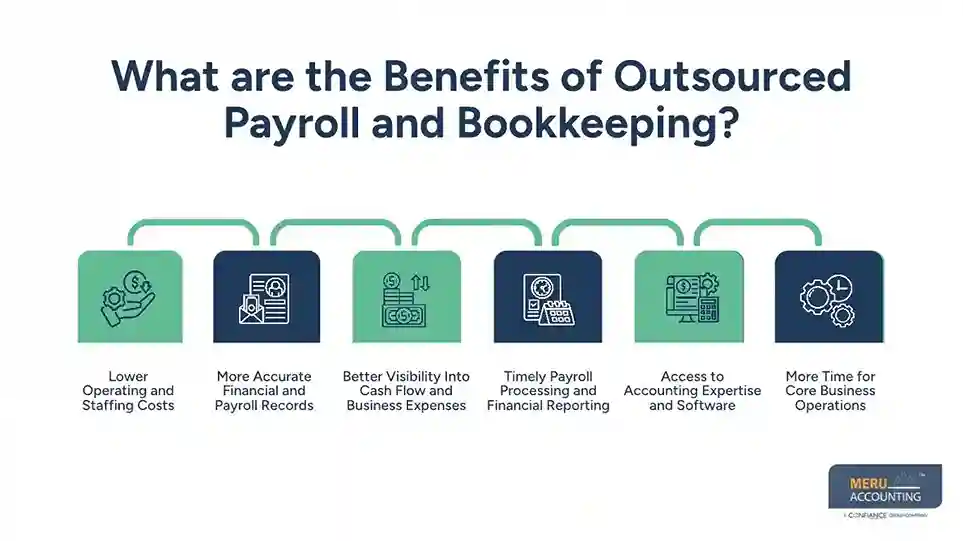
What are the Benefits of Outsourced Payroll and Bookkeeping?
Lower Operating and Staffing Costs
A full-time hire often costs more than a monthly plan once pay, benefits, software, and training are counted. With outsourced payroll and bookkeeping, you pay only for the work you need.
More Accurate Financial and Payroll Records
Trained staff review each entry. Fewer mistakes mean fewer pay disputes and fewer notices from tax agencies.
Better Visibility Into Cash Flow and Business Expenses
Monthly reports show where cash goes. You can spot rising costs early and plan purchases with real figures.
Timely Payroll Processing and Financial Reporting
Pay runs follow a fixed calendar. Reports arrive on the same date each month, so you never wait on a number.
Access to Accounting Expertise and Software
You gain trained accountants and paid software without buying licenses or training new hires. Many payroll and bookkeeping services include online portals for approvals.
More Time for Core Business Operations
Managing payroll and books takes time each month. By assigning these tasks to a service provider, owners can focus more on customers, sales, and daily business needs.
optional anymore
on running the business
What Compliance Requirements Should Businesses Consider?
Federal, State, and Local Payroll Tax Requirements
Employers must withhold and deposit federal income tax, Social Security tax, and Medicare tax. Many states and cities add their own taxes and due dates.
Employee Classification and Payroll Records
Workers must be classified as employees or contractors under the correct tests. A wrong label can bring back taxes and penalties.
Bookkeeping Documentation and Audit Readiness
The IRS advises keeping employment tax records for at least four years. Store receipts, invoices, and bank statements in order, so an audit stays a short task. Good payroll and bookkeeping services make this routine.
Data Security and Employee Information Protection
Payroll files hold Social Security numbers and bank details. Ask any provider about encryption, user access limits, and staff background checks.
Compliance Responsibilities When Outsourcing
You still carry the legal duty, even when a provider files for you. With outsourced payroll and bookkeeping, review each tax filing and keep your approvals in writing.
How Does the Payroll and Bookkeeping Outsourcing Process Work?
Review Current Payroll and Financial Records
List your staff, pay schedules, tax accounts, software, and open books. This gives the provider a clear view of the work involved and the records needed for a smooth handover.
Define Service Requirements and Responsibilities
Agree in writing on who approves pay, who signs tax filings, and how fast questions are answered. Clear roles keep payroll and bookkeeping services on track.
Set Up Accounting Software and Payroll Systems
The provider connects your bank feeds, chart of accounts, and payroll tools. Access levels are set for each person.
Transfer Records and Verify Opening Balances
Past reports, tax IDs, and pay history are moved over. Both sides confirm that opening balances match your last closed books, since this step shapes all outsourced payroll and bookkeeping that follows.
Begin Payroll Processing and Bookkeeping
Payroll and bookkeeping services begin with a test run, followed by live pay runs and monthly entries. Early cycles receive extra review.
Review Reports and Monitor Service Quality
Check reports each month and track pay accuracy, filing dates, and response time. Strong outsourced payroll and bookkeeping shows results you can measure.
Why Choose Meru Accounting for Payroll and Bookkeeping Services?
Trained Team With Clear Processes
Meru Accounting provides payroll and bookkeeping services for small and mid-size businesses and accounting firms. Each client receives a defined workflow and a named contact.
Payroll Handled on Schedule
We prepare pay runs, tax forms, and payroll reports to your calendar. You approve each item before anything is filed.
Books Kept Current
We record transactions, reconcile accounts, and send monthly statements. Your figures are ready when you need them.
Tools You Already Use
We work inside popular accounting and payroll software, so you keep control of your data. Our team follows the agreed setup to keep records in order and make routine reports easier to review.
Easy Start and Clear Pricing
We scope your needs first, then quote a clear fee. Our outsourced payroll and bookkeeping plans come with every charge explained before you commit. Contact Meru Accounting to request a quote.
Our Expert Perspective
In our client work, the leading cause of payroll errors is not math. It is late or missing information, such as a new hire form that arrives after the pay run closes. Owners who set one weekly cutoff for time sheets and changes see far fewer corrections. Small firms also tend to wait too long to clean their books, and starting payroll and bookkeeping services with tidy opening balances saves hours each month. For owners weighing outsourced payroll and bookkeeping, we suggest a one-quarter trial with set targets for accuracy and response time.
Key Takeaways
- Payroll and bookkeeping services cover pay runs, tax filings, records, and reports.
- Costs depend on staff count, transaction volume, and add-ons, so request the full fee list.
- Outsourced payroll and bookkeeping can lower costs and free up owner time.
- The legal duty for filings stays with you, so review each one.
- Choose payroll and bookkeeping services with clear fees, clear roles, and clear reports.
- Follow the six-step process for a clean handover.
FAQs
Payroll and bookkeeping services include pay runs, tax filings, bill payments, invoices, bank reconciliation, and monthly reports. They also cover year-end forms such as W-2 and 1099-NEC.
The price of payroll and bookkeeping services depends on size and workload. Payroll often costs $20 to $50 a month plus $4 to $12 per employee. Bookkeeping often costs $300 to $2,500 or more a month.
It can be, if the provider uses encryption, access limits, and background checks. Ask for their security steps in writing before you share files.
The provider may handle agreed tax tasks, but the employer should confirm its legal duties and check filing and payment proof.
Most moves take two to six weeks, based on how clean your records are. A new provider usually starts at the beginning of a pay period or month.
optional anymore
on running the business