
Managing business finances can feel overwhelming without clear insights into how money moves in and out of your company. A cash flow statement is a critical tool for understanding financial health, planning for growth, and avoiding surprises. This blog explores an example of cash flow statement and explains how outsourcing accounting enhances financial clarity.
With a clear cash flow statement, businesses can identify periods of surplus and shortage, anticipate upcoming expenses, and make informed decisions with confidence.
Coupled with outsourcing accounting, companies gain professional oversight, reduce errors, and obtain timely, actionable insights that make financial management simpler and more reliable.
What You Will Learn From This Blog
- The fundamentals of a cash flow statement and why it matters
- Step-by-step guidance on reading a cash flow statement
- Common mistakes businesses make in cash flow reporting
- How outsourcing accounting contributes to accurate financial management
- A practical example of cash flow statement you can use
- Ways companies gain better cash flow insights through outsourcing
- How Meru Accounting provides outsourced accounting services for clarity and control
What Is a Cash Flow Statement and Why Is It Important?
Definition of Cash Flow Statement
A cash flow statement is a financial report showing how cash enters and leaves a business during a specific period. It tracks operations, investing, and financing activities.
A clear cash flow statement provides a real-time view of liquidity, separate from accounting profits or non-cash adjustments.
Importance for Business Planning
Without a cash flow statement, businesses risk misjudging liquidity, which can lead to missed payments, unplanned debt, or lost growth opportunities.
Forecasting cash needs enables business owners to make informed decisions and maintain smooth operations.
Difference From Profit and Loss Statement
Unlike profit and loss statements, cash flow statements focus purely on cash, not accounting profits or non-cash items like depreciation.
Understanding cash flow through an example of cash flow statement helps evaluate whether the business can meet its short-term obligations.
Key Components
Cash flows are divided into three sections:
- Operating Activities – Cash from day-to-day business operations
- Investing Activities – Cash used for buying or selling assets
- Financing Activities – Cash from loans, equity, or dividends
Helps Track Liquidity
Regular tracking through online bookkeeping services allows companies to forecast shortages, plan expenses, and maintain smooth operations.
Early identification of cash gaps ensures timely corrective action, avoiding financial stress or missed obligations.
How Cash Flow Statements and Outsourced Accounting Improve Clarity
Clear Separation of Cash Sources
Outsourced accounting teams, often using online bookkeeping services, can organize cash inflows and outflows neatly, making it easier to see where money comes from and goes.
Clear categorization of transactions allows management to quickly identify profitable and underperforming areas.
Consistent Reporting
With online bookkeeping services, businesses can generate cash flow statements consistently, avoiding missing or late reports.
Regular reporting ensures financial data is always up-to-date and reliable for decision-making.
Detecting Cash Gaps Early
Professionals monitor patterns in operating, investing, and financing activities, allowing businesses to address shortages before they escalate.
Early detection of cash gaps prevents potential disruptions in daily operations and supports proactive planning.
Reducing Manual Errors
Manual bookkeeping can create errors in cash reporting. Outsourced accountants use tested systems to ensure numbers are precise.
Accurate reporting using online bookkeeping services minimizes the risk of financial misstatements and enhances trust in the data presented to stakeholders.
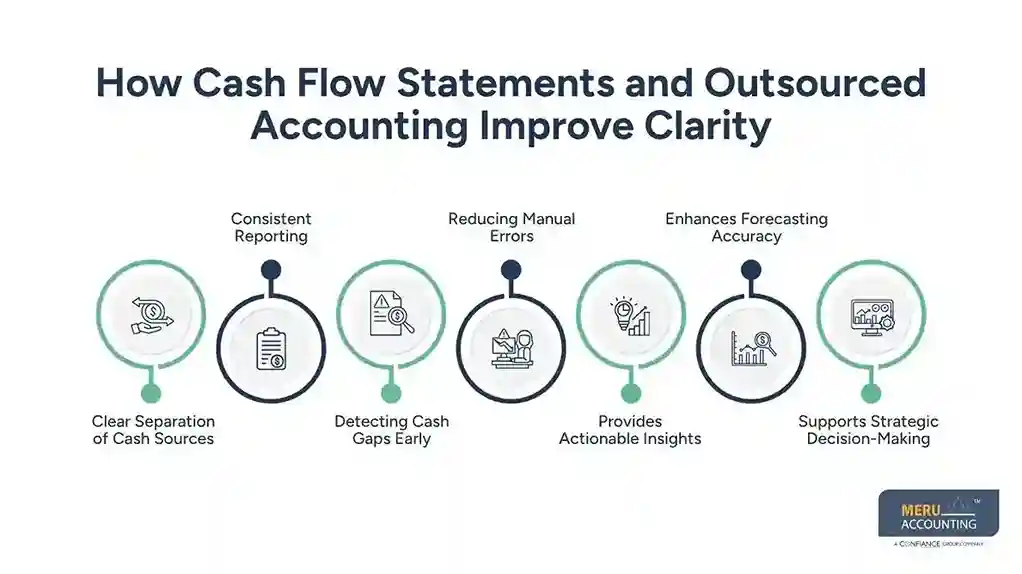
Provides Actionable Insights
When statements are accurate, leadership can make informed decisions about budgets, investments, and cost reductions.
Analysis from outsourced accountants highlights trends and opportunities that drive smarter financial strategies.
Enhances Forecasting Accuracy
Outsourced accounting helps create reliable cash flow forecasts for upcoming months or quarters.
Accurate projections allow businesses to plan for growth, manage working capital, and prepare for seasonal fluctuations.
Supports Strategic Decision-Making
Clear cash flow visibility enables management to make informed strategic choices, such as investments or expansion.
Timely insights derived from online bookkeeping services also help in evaluating cost-saving measures and optimizing overall financial performance.
How to Read a Cash Flow Statement: Step-by-Step Guide
Review Operating Activities
Check net cash from operations first; this shows whether day-to-day activities generate enough cash to run the business.
Strong operating cash flow signals stable core business performance and steady cash inflow quality.
Examine Investing Activities
Analyze cash used or received from buying or selling equipment, property, or long-term investments.
Tracking investing cash flow provides clarity on how asset decisions impact overall financial position.
Evaluate Financing Activities
Look at cash flows from loans, equity funding, or dividend payouts to understand external cash impact.
Understanding financing flow helps assess dependence on borrowed funds or investor contributions.
Compare Cash Changes
Compare the net increase or decrease in cash in an example of cash flow statement with previous periods to spot trends or fluctuations. Consistent comparison across periods highlights seasonal patterns and financial stability levels.
Verify Ending Cash Balance
Ensure the ending cash balance matches bank statements to avoid discrepancies.
Accurate matching builds confidence in financial records and reduces reconciliation issues.
Why Businesses Make Mistakes in Cash Flow Reporting
Incomplete Record Keeping
Small oversights like missed invoices or unrecorded expenses can distort cash flow reports. Accurate and complete record keeping ensures that all cash movements are reflected correctly in the statement.
Mixing Cash and Credit Transactions
Including credit-based revenue as cash inflows misrepresents actual liquidity. Separating cash transactions from credit sales provides a true picture of available cash.
Incorrect Categorization
Misclassifying cash flows between operating, investing, and financing sections can confuse stakeholders. Proper categorization allows management to identify the source and use of cash effectively.
Manual Calculations
Manual bookkeeping is prone to errors, which online bookkeeping services can help eliminate. Using automated accounting systems reduces mistakes and improves confidence in the reported figures.
Delayed Updates
Late recording of transactions can result in outdated cash flow statements that do not reflect the current situation. Timely updates keep statements relevant and useful for day-to-day financial planning and analysis.
Example of Cash Flow Statement
A small business tracks cash for one month to understand its financial position. The following example shows how cash comes in, goes out, and what is left at the end, including the beginning cash balance.
Opening Cash Balance (Beginning of Month): $2,000
Cash Inflows
- Cash received from customers: $5,000
Cash Outflows
- Rent paid: $1,000
- Salary paid: $2,000
- Other expenses: $500
Step-by-Step Calculation
- Total Cash Outflow = 1,000 + 2,000 + 500 = $3,500
- Net Cash Flow = Cash Inflows − Cash Outflows = 5,000 − 3,500 = $1,500
Closing Cash Balance (End of Month)
- Opening Cash Balance: $2,000
- Add: Net Cash Flow: $1,500
- Closing Cash Balance = $3,500
This example of cash flow statement shows the business earned more than it spent, leaving extra cash for future needs.
Why This Example Works
This example clearly separates income, expenses, and final cash. Owners can quickly see how much money is available.
Customizing for Your Business
Categories and amounts can be adjusted to match your operations. Using online bookkeeping services, the format stays simple but reflects real cash flows automatically and accurately.
Using Software Tools
Accounting software can track transactions automatically and create cash flow statements. This reduces errors and saves time.
Forecasting Cash Needs
Past cash flow data, stored and managed through online bookkeeping services, helps predict future shortages or extra cash. This makes it easier to plan payments and expenses.
Decision-Making Aid
Clear cash flow statements show the actual financial situation. Managers can make informed decisions without guessing.
Why Choose Meru Accounting for Outsourced Accounting
Experienced Team
Meru Accounting has certified accounting professionals with extensive experience in managing cash flow statements for global clients. We understand industry-specific challenges and deliver accurate financial insights every time.
Tailored Services
We provide customized outsourced accounting solutions to fit each business’s size, sector, and reporting needs. Our approach ensures every report is relevant and actionable for your unique operations.
Technology Integration
Our team uses reliable accounting software for accurate cash flow statements, reconciliation, and forecasting. This ensures data is up-to-date and easily accessible for decision-making.
Cost-Effective Solution
Outsourcing accounting with Meru Accounting eliminates the need for hiring full-time local staff while ensuring precision. It also reduces overhead costs and frees up resources for growth initiatives.
Transparent Reporting
Clients receive clear, consistent, and actionable financial reports to support decision-making. We make sure numbers are easy to understand, so business owners always stay informed.
Our Expert Perspective
At Meru Accounting, we have seen that businesses across industries that maintain structured cash flow statements and use professional accounting support make better financial decisions. Outsourced accounting is no longer just a luxury. It is a strategic step that brings clarity, accuracy, and sustainable growth. Providing an example of cash flow statement helps businesses connect theory with practical financial management, making it easier to make informed decisions and maintain strong financial control.
Key Takeaways
- A cash flow statement tracks cash movements from operating, investing, and financing activities.
- Reading and understanding cash flow statements helps business owners manage liquidity and make informed decisions.
- Common mistakes include misclassifying cash flows, delayed updates, and poor record-keeping.
- Outsourced accounting enhances accuracy, ensures timely reporting, and provides professional analysis.
- Using an example of cash flow statement allows businesses to apply best practices in their financial management.
- Meru Accounting offers expert outsourced accounting services that bring financial clarity and control to your business.
FAQs
A cash flow statement shows how cash moves in and out of a business, helping owners plan and manage finances effectively.
Yes, outsourcing reduces errors, saves time, and provides expert insights without the need to hire full-time staff.
Monthly or quarterly preparation is ideal to ensure updated financial visibility and better decision-making.
Operating activities include cash received from customers and cash paid to suppliers and employees.
Meru Accounting provides accurate statements, timely reporting, and professional guidance to ensure financial clarity.