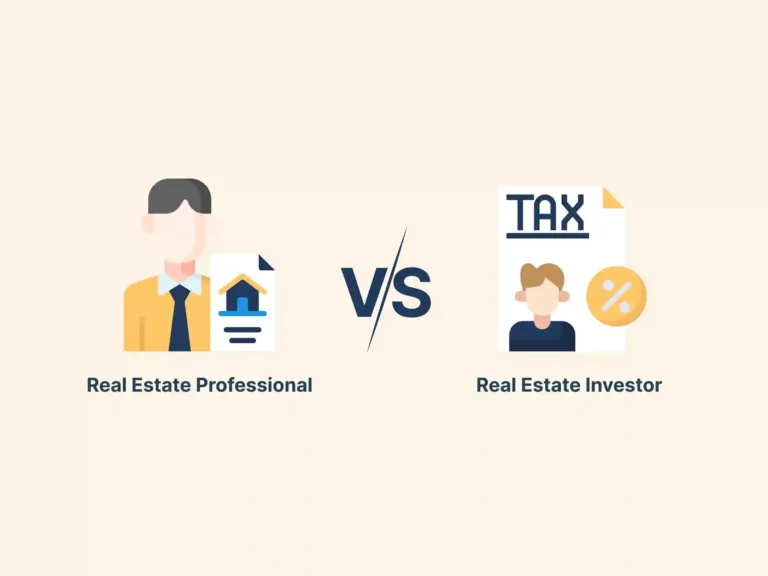
Two people can own the same type of rental property, earn the same rent, and report very different tax results. The reason may not be the property itself. It may come down to IRS real estate professional status, how much work the owner does, and whether that work meets the IRS rules.
This is where many rental owners get confused. Buying several homes does not make someone a real estate professional. Spending a few hours each week collecting rent does not meet the test on its own either. The IRS looks at the work done, the time spent, and the level of participation before a rental loss can receive different tax treatment.
For owners with more than one property, the issue becomes even more important. Rent, repairs, loan costs, insurance, taxes, and other expenses must be tracked with care. Accurate real estate bookkeeping services can keep these records clear while the taxpayer and tax adviser focus on the rules that apply to the owner’s work.
What You Will Learn From This Blog
- What the IRS real estate professional tests require from rental property owners.
- How a real estate professional differs from a regular real estate investor.
- Why rental income and losses are often subject to passive activity rules.
- How material participation affects the tax treatment of rental activity.
- Why work logs and property records matter when claiming professional status.
- How real estate bookkeeping services can keep rental financial records ready for tax review.
IRS Real Estate Professional Requirements For Rental Property Owners
More Than 750 Hours
The first IRS real estate professional test requires more than 750 hours of service in qualifying real property trades or businesses during the tax year.
These hours must relate to businesses in which the taxpayer materially participates, not just time spent owning or watching properties.
More Than Half Of Work
More than half of the taxpayer’s personal service time must be spent in qualifying real property trades or businesses in which they materially participate. This can be hard to meet for an owner who also works many hours in a non-real-estate job.
Qualifying Real Property Work
Qualifying work can include property development, construction, acquisition, rental, leasing, management, operation, and brokerage activities. The IRS looks at the actual services performed, so simply owning rental property does not count as qualifying work.
Employee Work Has A Rule
Services performed as an employee generally do not count toward the professional test unless the taxpayer owns more than 5% of the employer. This rule matters to people who work for real estate firms and also own rental properties.
Spouse Hours Work Differently
For a married couple filing jointly, one spouse must meet the two professional tests without adding the other spouse’s hours. However, a spouse’s participation can count when testing material participation in a rental activity.
Records Matter
Taxpayers should keep records of dates, tasks, hours, property visits, tenant work, leasing work, and management duties. Real estate bookkeeping services can organize financial records, while the taxpayer should retain proof of their own work and participation.
IRS Real Estate Professional Vs Real Estate Investor: What Is The Difference?
Tax Status Is Not The Same
The IRS real estate professional classification is based on IRS tests. “Real estate investor,” by contrast, is a broad term that can describe someone who owns or invests in property without meeting those tests.
That difference matters because the label a person uses for themselves does not decide how the IRS treats the activity.
Property Ownership Is Not Enough
Imagine an owner with ten rental homes who spends little time managing them because a property manager handles most of the work. Ten properties may create a large portfolio, but property count alone does not establish professional status.
The IRS focuses on qualifying services and participation rather than the number of doors an investor owns.
Investor Activity Can Be Passive
Rental activities are generally treated as passive activities under the passive activity rules. There are special rules for taxpayers who qualify as real estate professionals and materially participate in rental activities.
This is why two landlords with similar rental income can face different loss rules when their work and participation are not the same.
Professional Status Needs Participation
Passing the IRS real estate professional tests does not automatically turn every rental activity into a nonpassive activity. Material participation in the rental activity must also be considered.
In simple terms, professional status and material participation are related, but they are not the same test.
Each Property Can Matter
Rental real estate interests are generally treated as separate activities when material participation is tested. A taxpayer may make an election to treat all rental real estate interests as one activity for this purpose.
That choice can affect how participation is measured, so it should not be treated as a casual bookkeeping decision.
Bookkeeping Shows The Difference
A rental owner may have rent coming in from several properties and costs leaving several bank accounts. Real estate bookkeeping services can keep those transactions tied to the right property.
This gives the owner and tax adviser a cleaner record when reviewing income, expenses, property costs, and the financial results of each rental.
How Passive Activity Rules Apply To Real Estate Investors
Passive Loss Limits
Passive activity rules can limit how much passive loss an IRS real estate professional may use against other income in the same tax year. Any loss that cannot be used may generally carry forward under the applicable IRS rules.
Rental Property Is Usually Passive
The IRS generally treats rental activities as passive, unless a specific exception or rule applies to the taxpayer’s situation.
Taking part in rental work does not by itself remove the activity from the passive activity rules.
Active Participation Is Different
Active participation is a lower standard than material participation and may allow an IRS real estate professional to claim a special rental loss allowance. The taxpayer must meet the IRS conditions, so active participation and material participation should not be treated as the same test.
The $25,000 Rule
A qualifying taxpayer may deduct up to $25,000 of rental real estate losses against nonpassive income, subject to income limits and other IRS rules.
The allowance phases out as modified adjusted gross income rises, so the full amount is not available to every taxpayer.
Form 8582 May Apply
Form 8582 is used in certain cases to calculate passive activity loss limits and determine the amount allowed for the current year.
It can also show losses that remain suspended and may be carried forward to a later tax year.
Losses Can Carry Forward
A passive loss that cannot be used in the current year is generally carried forward rather than lost, subject to applicable IRS rules.
This means a rental property can show a tax loss without creating an immediate deduction against other income.
optional anymore
on running the business
How IRS Real Estate Professional Status Can Affect Rental Losses
Nonpassive Rental Losses
The IRS real estate professional rules can change rental loss treatment when the taxpayer qualifies and materially participates in the rental activity.
The rental activity may then be treated as nonpassive, which can affect how the loss is used on the tax return.
Material Participation Still Matters
Professional status alone does not make every rental activity nonpassive because the taxpayer must also meet material participation requirements. This means each relevant rental activity needs to be reviewed under the applicable IRS participation rules.
Losses Need Tax Review
A $40,000 rental loss does not automatically mean the taxpayer can deduct the full amount against salary or other income. Basis limits, at-risk rules, passive activity rules, and other tax provisions may limit the deduction.
Property-Level Records Matter
Rental owners should track rent, mortgage interest, repairs, taxes, insurance, and depreciation for each property to keep financial data clear. Real estate bookkeeping services can organize these records and make the numbers easier to review before tax filing.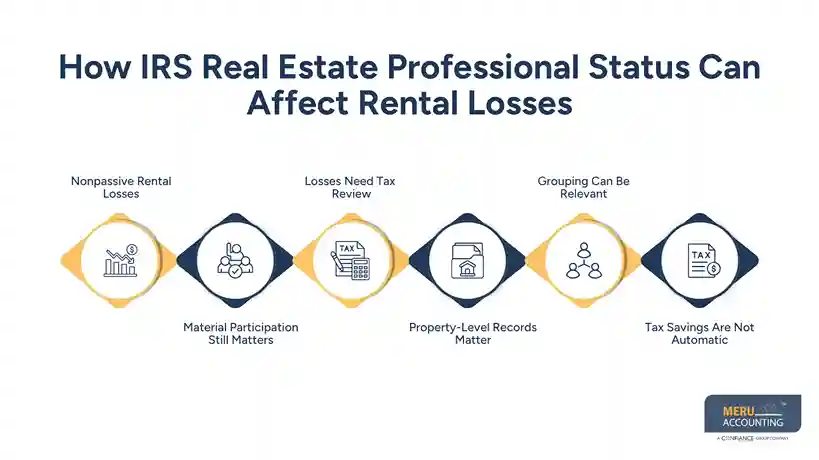
Grouping Can Be Relevant
A qualifying taxpayer may elect to treat all rental real estate interests as one activity when testing material participation under the IRS rules. Because this election can affect later tax years, the choice should be reviewed with a qualified tax professional.
Tax Savings Are Not Automatic
The IRS real estate professional status does not guarantee that every rental loss will be deductible against other income. The final result can depend on participation, income, basis, at-risk limits, and other applicable tax rules.
IRS Real Estate Professional Material Participation Tests
More Than 500 Hours
One material participation test is met when the taxpayer takes part in the activity for more than 500 hours during the tax year. This test can be relevant when an owner spends a large part of the year working on a specific rental activity.
Substantially All Work
A taxpayer may meet another test when their participation is substantially all of the participation by people involved in the activity. An owner who handles nearly every task may have a different result from one who gives most work to outside firms.
More Than 100 Hours
A taxpayer may meet a material participation test by spending more than 100 hours on an activity and participating at least as much as any other individual. The taxpayer’s hours must therefore be viewed alongside the time spent by other people working on the same activity.
Five Of Ten Years
Material participation may be established when the taxpayer materially participated in the activity during any five of the ten tax years before the year being tested. This rule can matter to owners with a long record of active involvement in the same activity.
Three Prior Years
For certain personal service activities, material participation may be established through participation in any three prior tax years. The taxpayer should confirm that the activity meets the IRS conditions before relying on this test.
Keep A Work Log
A work log should record the task, date, property, and time spent instead of showing only one yearly hour total. Real estate bookkeeping services can organize financial data, while the taxpayer should retain records of their own work and participation.
IRS Real Estate Professional Vs Real Estate Investor: Example Scenarios
Investor With A Full-Time Job
An investor works 2,000 hours at a non-real-estate job and spends 300 hours managing two rental homes during the year. Owning both properties does not meet the professional tests by itself, so the investor’s hours and work split must be reviewed.
Full-Time Property Manager
A person spends 1,500 hours managing and leasing rental properties and has no other trade or business work during the year. If the person also meets the material participation rules, the facts may fit the IRS real estate professional requirements.
Investor With Several Rentals
An investor owns five rental homes but hires a property manager for leasing, repairs, tenant calls, and most daily tasks. The number of properties does not replace the IRS participation tests, so the investor’s own work must be reviewed.
Spouse Runs The Rentals
One spouse works outside real estate while the other spends most of the year managing the couple’s rental properties. The spouse seeking professional status must meet the two tests alone, although spouse participation can count for material participation.
Real Estate Broker With Rentals
A real estate broker spends most work hours on qualifying real property activities and also owns rental units. Brokerage can qualify as real property work, but the rental activity still requires a separate material participation review.
Passive Investor
A passive investor owns rental property for income and hires outside firms for leasing, repairs, and daily management. The investor may remain subject to passive activity rules because ownership alone does not establish professional status or material participation.
Partner With Meru Accounting For Real Estate Bookkeeping Services
Property-Level Records
Meru Accounting provides real estate bookkeeping services that organize income and expenses by rental property. This can give owners a clearer view of rent, repairs, taxes, insurance, interest, and other costs.
Rental Income Tracking
Meru Accounting provides real estate bookkeeping services for rental income records and account entries. Clear rental income records can also provide useful financial documentation when an IRS real estate professional reviews real estate activity for tax purposes.
Expense Classification
Rental portfolios often have many types of costs, and a single account may not give an owner enough detail. Meru Accounting provides real estate bookkeeping services that sort transactions so owners can review where funds were spent.
Reconciliation Work
Bank reconciliation can catch missing entries, duplicate transactions, and timing gaps before they affect reports. Meru Accounting provides real estate bookkeeping services that keep account records ready for review.
Reports For Owners
Rental owners may need income statements, expense reports, account details, and property-level results during the year. Meru Accounting provides real estate bookkeeping services to keep these records organized for regular review.
Tax-Ready Records
Bookkeeping does not decide whether someone meets the IRS test for professional status. Meru Accounting provides real estate bookkeeping services that organize financial data so a tax professional can review the numbers with greater clarity.
Our Expert Perspective
The IRS real estate professional rules should be viewed through three separate factors: property ownership, real estate work, and IRS qualification tests. A large rental portfolio does not automatically create professional status, while a taxpayer who meets the required tests may receive different treatment for rental activity.
Keeping time logs throughout the year and clear property-level financial records can make tax review easier, and real estate bookkeeping services can keep income and expenses organized. When rental losses are significant, taxpayers should also review material participation, passive loss limits, basis, and at-risk rules with a qualified tax professional before filing.
Key Takeaways
- IRS real estate professional status is based on specific IRS tests, not on the number of rental properties owned.
- The taxpayer generally must meet both the more-than-750-hour test and the more-than-half personal service test.
- Professional status does not automatically make every rental activity nonpassive.
- Material participation must also be reviewed for the rental activity.
- Rental losses can be limited under passive activity and other tax rules.
- Active participation and material participation are different standards.
- A detailed work log can be useful when a tax position depends on actual hours and services.
- Real estate bookkeeping services can keep rental income and expense records clear and organized.
- Property-level records can make tax review easier when an owner has several rentals.
- Tax rules should be reviewed for the specific tax year because limits and filing rules can change.
FAQs
An IRS real estate professional meets specific IRS tests, while a real estate investor may own rental property without meeting those tests.
An IRS real estate professional may deduct qualifying rental losses against nonpassive income when material participation and other tax rules are met.
You generally need more than 750 hours of qualifying real property services and more than half of your personal service time in qualifying real property businesses.
Rental losses are generally passive for real estate investors unless an exception applies under the IRS passive activity rules.
Yes, an IRS real estate professional must also meet a material participation test for the rental activity to receive nonpassive treatment.
optional anymore
on running the business