
Manufacturing and distribution accounting becomes more complex when a business stores goods at more than one site. A plant may hold raw materials, a second site may hold work in process, and several warehouses may hold finished goods ready for sale. Each site can have its own stock count, cost, transfers, and timing issues.
For this reason, manufacturing and distribution accounting must track not only how much stock a company owns, but also where that stock is held, what stage it is in, and how its cost is recorded. The IRS notes that inventory can include raw materials, work in process, finished goods, and supplies that become part of goods sold.
What You Will Learn From This Blog
- How manufacturing and distribution accounting works across many sites.
- Why raw materials, work in process, and finished goods need different controls.
- Which inventory differences matter most across plants and warehouses.
- How to reduce errors in transfers, counts, costs, and reconciliations.
- What businesses can do to keep inventory data clear and ready for review.
What is Manufacturing and Distribution Accounting?
Manufacturing and distribution accounting covers the financial tracking of goods from the time materials are bought to the time finished products are stored and sold.
For a manufacturer, this can include raw materials, labor, production costs, work in process, finished goods, and the cost of goods sold. For a distributor, the focus is more on purchased goods, storage, freight, stock transfers, sales, and inventory costs.
The process becomes more detailed when a business has several plants or warehouses. Stock may move from a supplier to one warehouse, then to a production site, and later to another warehouse for sale.
Manufacturing and distribution accounting must keep each movement clear so the quantity, cost, and location of inventory match the actual business activity.
This also means that inventory records need regular checks. A business may have the right total stock but still show the wrong balance at one site because of a late transfer, count error, damaged goods, or incorrect cost. Clear records, regular reconciliation, and consistent inventory methods give finance teams a better basis for monthly reports and tax records.
How Multi-Location Inventory Works in Manufacturing and Distribution
Raw Material Sites
A plant may keep steel, plastic, parts, or other inputs at one site. Manufacturing and distribution accounting should show both the quantity on hand and the cost assigned to these items.
Production Sites
Work in process may sit inside a plant while goods move through several production stages. Costs need to move with the product, so the final cost is not understated or overstated.
Finished Goods Warehouses
Once goods are complete, they may move to a warehouse. The accounting record should show the transfer from production to the warehouse without treating the movement as an outside sale.
Regional Storage
A business may store the same product in several states. Distribution accounting software can assign stock to each site and show the total quantity held across all sites.
Customer-Ready Stock
Stock may be held at a warehouse, retail site, or third-party logistics center. The business needs clear records that show whether the goods are owned, sold, reserved, or still available.
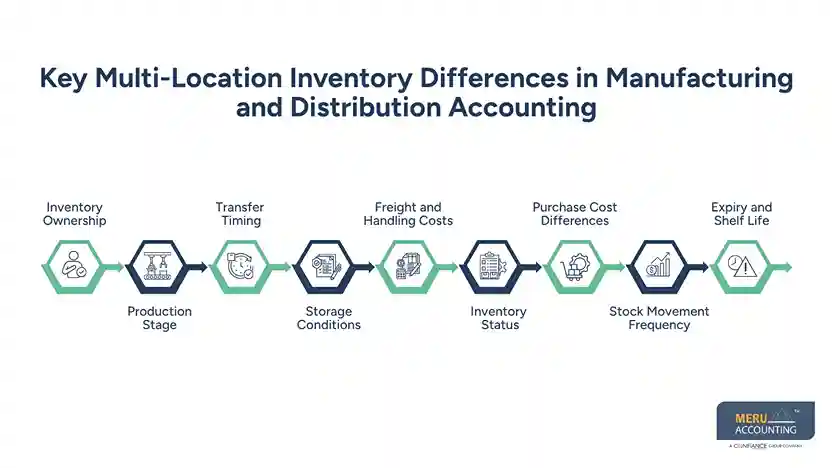
Key Multi-Location Inventory Differences in Manufacturing and Distribution Accounting
Inventory Ownership
Not every item stored at a location is always owned by the business. Some goods may belong to a supplier, customer, or third-party partner, so ownership must be clear before the stock is included in company inventory.
Production Stage
A plant may hold raw materials, partly made goods, and finished products at the same time. Manufacturing and distribution accounting must keep these stages separate because their costs and accounting treatment can differ.
Transfer Timing
Two sites may record the same transfer at different times. Distribution accounting software can show when goods leave one location and when the receiving site records them, which makes timing gaps easier to find.
Storage Conditions
Some products need special storage due to their type, shelf life, or handling needs. A location may therefore hold stock that has a different risk of damage, expiry, or loss than stock at another site.
Freight and Handling Costs
Moving goods between locations can add freight, handling, or other costs. Manufacturing and distribution accounting should track these costs under the right rules rather than adding them to inventory without review.
Inventory Status
Stock can be available, reserved, damaged, on hold, or in transit. Keeping these statuses separate gives the finance team a clearer view of what the business can actually sell or use.
Purchase Cost Differences
The same item may be bought at different prices from different suppliers or at different times. Manufacturing and distribution accounting should keep these cost changes clear when stock is held across several sites.
Stock Movement Frequency
Some locations may receive and ship goods every day, while others may hold stock for longer periods. Frequent movement creates more chances for timing, quantity, and posting errors.
Expiry and Shelf Life
Food, medicine, chemicals, and other dated goods may lose value as they age. Each location should track expiry dates so old stock does not remain in available inventory without review.
How Distribution Accounting Software Handles Multi-Location Inventory
Location-Based Stock Records
Distribution accounting software can give each warehouse or plant its own stock record. This makes it easier to see quantity, item code, and status by site.
Transfer Tracking
A stock transfer should have a source, destination, date, item, and quantity. Distribution accounting systems can link both sides of the transfer so the same goods are not counted twice.
Stock Reconciliation
Reconciliation compares system data with physical counts and other records. This step can show missing stock, duplicate entries, wrong units, or posting errors.
Cost Tracking
Distribution accounting systems can store cost data by item and location. This is useful when purchase costs, freight, or other approved costs differ between sites.
Reporting By Site
Managers can review stock by plant, warehouse, region, or product. This gives the finance team a clearer base for month-end reports and review.
optional anymore
on running the business
Common Accounting Challenges With Multiple Inventory Locations
Duplicate Inventory
A transfer may be posted at the new site before the old site removes the stock. This can make total inventory appear higher than it is.
Late Transfer Entries
Goods may leave one warehouse on Friday but reach another site on Monday. Manufacturing and distribution accounting needs clear cut-off rules for such transfers.
Wrong Location Codes
A simple coding error can place goods in the wrong warehouse. Distribution accounting software may show correct total stock while the site-level data remains wrong.
Physical Count Gaps
A system balance does not prove that physical stock is present. Regular counts are needed to compare actual goods with accounting data.
Costing Errors
A wrong unit cost can affect inventory and cost of goods sold. The issue becomes larger when the same item is held across many sites.
Best Practices For Accurate Manufacturing And Distribution Accounting
Use Clear Location Codes
Give each plant and warehouse a unique code. Manufacturing and distribution accounting becomes easier to review when each stock movement can be tied to one clear location.
Set Transfer Cut-Off Rules
Define when goods are removed from one site and when they are added to another. The same rule should be used each month.
Count High-Value Stock
Not every item needs the same count frequency. High-value or high-risk items can be checked more often, while low-risk items can follow a longer cycle.
Review Inventory Variances
Do not only adjust a difference and move on. Review why the variance happened, such as damage, picking errors, wrong units, or missed transfers.
Keep Cost Methods Consistent
The inventory method should fit the business and be applied consistently. The IRS states that inventory practices should clearly reflect income and remain consistent from year to year.
Partner With Meru Accounting for Manufacturing and Distribution Accounting
Multi-location inventory needs more than software entries. It needs clear checks between stock data, invoices, transfers, costs, and financial reports.
Meru Accounting provides manufacturing and distribution accounting services for businesses that need structured inventory and accounting records across locations. Our team can review inventory postings, reconciliations, cost data, and month-end accounting processes.
We also work with systems such as QuickBooks, Xero, Zoho Books, NetSuite, and Odoo. For businesses using distribution accounting software, our accounting team can review the financial data and check whether the records match the underlying transactions.
Our Expert Perspective
From an accounting review point of view, multi-site inventory issues often start with small process gaps rather than one large error. A transfer may be posted late, a damaged item may stay active, or a count may be done with the wrong unit.
Accurate manufacturing and distribution accounting starts by making each movement easy to trace. When finance teams can follow an item from purchase to production, transfer, storage, and sale, month-end review becomes much clearer.
The IRS also notes that businesses using inventory need a method to identify inventory items and value them for tax reporting. This makes consistent records important beyond internal reporting.
Key Takeaways
- Manufacturing and distribution accounting must track both inventory value and inventory location.
- Raw materials, work in process, and finished goods need different checks.
- Transfers between sites should have clear dates, quantities, and source and destination records.
- Physical counts should be compared with system balances on a set schedule.
- Distribution accounting software can make location-level tracking and reporting easier.
- Cost methods should be selected carefully and applied in a consistent way.
- Variances should be reviewed to find the cause before an adjustment is posted.
- Strong records make month-end reporting and tax work easier to review.
FAQs
Manufacturing and distribution accounting tracks production costs, inventory, stock transfers, sales, and financial data across manufacturing and distribution operations.
Multi-location inventory accounting tracks the quantity, cost, and status of stock held at each plant, warehouse, or storage site.
Businesses track inventory across warehouses by using location codes, stock transfers, physical counts, and regular inventory reconciliations.
Common errors include duplicate stock entries, missed transfers, wrong location codes, incorrect counts, and differences in inventory costs.
Distribution accounting software records stock levels, transfers, costs, purchases, and sales for inventory held across multiple locations.
optional anymore
on running the business