
A real estate virtual assistant can take much more than admin work off a property firm’s plate. When AP and AR are handled with a set process, the team can keep vendor bills, rent, tenant balances, property costs, and bank entries in line. This matters when one firm manages many units, owners, vendors, and rent dates at the same time.
Real estate accounting has a problem that basic bookkeeping advice often misses: one payment can need more than one level of review. A $1,800 repair bill may need the right vendor, property, unit, expense type, approval, and payment date before it is posted.
The same issue can occur with rent. A $2,500 bank receipt must be matched to the right tenant and lease. If the amount is short, late, or paid for more than one item, the difference needs to be found.
A real estate virtual assistant can take care of these repeat checks under a clear process. An outsourced real estate assistant can also keep AP and AR lists current while an accountant or property manager makes the final decisions.
What You Will Learn From This Blog
- How AP and AR work differs in a real estate firm.
- Where a real estate virtual assistant fits into the accounting cycle.
- How vendor bills can be coded by property, unit, and account.
- How rent, fees, and other receipts can be matched to tenant records.
- How an outsourced real estate assistant can keep open items from piling up.
- Which checks can be used to review the work each month.
What is a Real Estate Virtual Assistant?
A real estate virtual assistant provides remote accounting and admin support for property-related work. The role can include recording income and bills against the right property, unit, vendor, or tenant instead of placing all transactions in one general account.
For example, a $900 plumbing bill for Property A should be coded to the correct property and expense account, even if the same plumber also works at other properties. The assistant can also review vendor invoices for dates, amounts, duplicate entries, property details, and required documents before they move to approval.
The role can also cover tenant and rent records. A real estate virtual assistant can match rent receipts with the right tenant and unit, update tenant ledgers, and flag short or missing payments instead of marking every bank deposit simply as rent.
An outsourced real estate assistant can also organize invoices, receipts, lease records, and payment proof so each transaction has the right supporting file.
These tasks may be completed in systems such as QuickBooks, Xero, AppFolio, or RentRedi, based on the firm’s accounting setup. The work should follow the firm’s chart of accounts, property codes, document rules, and approval limits so entries remain consistent and can be reviewed during reconciliation and month-end close.
The Role of AP and AR in Real Estate Accounting
AP Tracks Property Costs
Accounts payable records what the firm owes. In real estate, this can include repairs, utilities, insurance, cleaning, landscaping, management fees, and other property costs.
A real estate virtual assistant can sort these bills by property, vendor, account, due date, and approval status.
AR Tracks Money Due
Accounts receivable records money the firm expects to receive. Rent is the main item for many rental firms, but late fees, parking fees, service charges, and other approved amounts may also appear.
The real estate virtual assistant can compare expected amounts with actual receipts.
Property Coding Matters
The same vendor may work at ten properties. The bill amount alone does not show where the cost belongs.
A clear property code lets the accounting team see the cost of each building and keeps property-level reports more useful.
Cash Timing Matters
AP shows bills that may need cash soon, while AR shows money that is due to the firm. Reviewing both lists gives the manager a better view of near-term cash needs.
An outsourced real estate assistant can keep both lists updated before the close.
Tax Records Need Support
The IRS says rental records should support income and expenses reported on tax returns, and documentary evidence such as bills, receipts, and canceled checks may be needed.
This makes proper AP and AR records part of good tax recordkeeping, not just office admin.
How a Real Estate Virtual Assistant Supports Accounts Payable
Receive and Sort Bills
The first step is to collect bills from email, portals, shared folders, or property managers. A real estate virtual assistant can sort them by property and vendor before entering them.
This prevents a pile of unreviewed invoices from sitting until month-end.
Check the Invoice
The invoice can be checked for vendor name, date, amount, property, service, and supporting approval. An outsourced real estate assistant can flag missing data rather than guessing the correct account.
Code the Expense
A $2,400 roof repair should not be treated in the same way as a $150 cleaning bill simply because both came from vendors. The correct account and property need to be selected under the firm’s accounting rules.
Track Approval
The bill can then move through the firm’s approval path. A real estate virtual assistant can keep a list showing whether a bill is waiting for a manager, owner, or accountant.
The assistant should not approve payments outside the authority given by the firm.
Match Payment to Bill
Once a payment is made, the payment can be matched to the open bill. This closes the AP item and leaves a clear record for bank reconciliation.
How a Real Estate Virtual Assistant Supports Accounts Receivable
Build the Rent Due List
A real estate virtual assistant can start with the rent due list for each property and compare it with the rent expected under the lease records.
This gives the team a clear base for checking receipts.
Match Bank Receipts
Suppose three tenants pay $2,000, $1,850, and $2,000 on the same day. The bank may show three deposits, but the accounting record still needs the right tenant and unit for each amount.
The real estate virtual assistant can match those entries and flag unclear receipts.
Find Short Payments
If rent due is $2,500 and only $2,300 arrives, the account should not be marked as fully paid. The $200 difference should remain visible until it is explained.
An outsourced real estate assistant can list such gaps for manager review.
Track Past-Due Rent
Aging lists can show current, 1–30 day, 31–60 day, and older balances. The real estate virtual assistant can update the list while the property team decides what action to take.
Record Other Receipts
Rent may not be the only receipt. Parking, storage, late fees, or other charges may also need to be posted when allowed by the lease and accounting policy.
The key is to place each receipt in the correct tenant or property account.
optional anymore
on running the business
How an Outsourced Real Estate Assistant Can Streamline Accounting Workflows
Use a Fixed AP Flow
A useful AP flow can be: receive invoice → check details → code property → send for approval → record payment → reconcile.
An outsourced real estate assistant can own the repeat steps while approval stays with the authorized person.
Use a Fixed AR Flow
AR can follow another set path: review rent due → check receipts → match payments → flag short or late amounts → update the tenant ledger.
This gives the real estate virtual assistant a clear work order instead of a loose list of tasks.
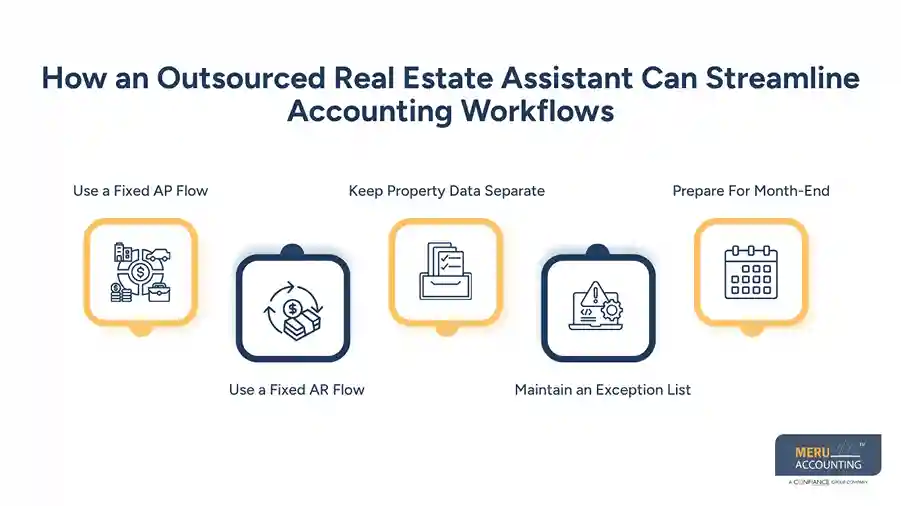
Keep Property Data Separate
If a firm manages 30 properties, the accounting team should be able to tell which bills and receipts belong to each property. The workflow should make property coding a required field.
This can reduce the risk of costs being placed in the wrong property account.
Maintain an Exception List
Not every transaction can be cleared at once. A bill with no property code or a payment with no tenant name should go to an exception list.
An outsourced real estate assistant can keep these items open until the right person gives the missing detail.
Prepare For Month-End
Before close, the assistant can check unpaid bills, unpaid rent, unmatched bank entries, missing invoices, and unresolved tenant balances.
This gives the accountant a cleaner list to review instead of a large group of unknown items.
Best Practices for Managing an Outsourced Real Estate Assistant
Define the Work Scope
Set out which AP and AR tasks the outsourced real estate assistant owns. For example, data entry and matching may be assigned to the assistant, while payment release stays with an authorized manager.
Give Clear Coding Rules
Create rules for property names, units, expense accounts, vendor names, and tenant records. A real estate virtual assistant should not need to guess how a recurring transaction should be coded.
Limit System Access
Access should match the person’s job. Someone who enters bills does not necessarily need rights to create vendors, change bank details, or release payments.
Set Review Points
Managers can review a sample of posted bills and matched receipts each week or month. This gives the real estate virtual assistant clear feedback before small errors become repeat errors.
Keep a Written Exception Log
The log can show the issue, property, amount, date, person responsible, and current status. An outsourced real estate assistant can update it as questions are resolved.
How to Measure the Performance of a Real Estate Virtual Assistant
Invoice Accuracy
Check whether bills have the correct vendor, amount, property, account, and date. A real estate virtual assistant should also flag invoices that lack enough information to post safely.
Payment Matching
Measure how many receipts are matched to the correct tenant and account without later correction. Unmatched items should be tracked rather than hidden.
Open AP Items
Review bills that remain unpaid or unapproved past their due date. A rising count may point to a slow approval step, missing data, or a vendor issue.
AR Aging
Review the value and age of unpaid tenant balances. An outsourced real estate assistant can maintain the report, while the property team decides how to handle each account.
Month-End Rework
Count entries that need correction after review. Fewer repeat corrections can show that the process and review rules are working as intended.
Why Real Estate Firms Choose Meru Accounting For AP and AR
Property-level Expense Tracking
Meru Accounting records vendor bills against the correct property, unit, and expense account. This makes it easier to see how much each property spends on repairs, utilities, maintenance, insurance, and other costs.
Vendor Bill Management
Our team reviews invoice details, checks for missing information or duplicate entries, records approved bills, and tracks invoices that are still pending approval or payment.
Rent and Tenant Records
Meru Accounting matches rent receipts with the correct tenant and property, records the amount received, and flags short or unpaid balances for review by the property management team.
Bank and Ledger Reconciliation
Bank deposits and payments are compared with accounting entries to find unmatched or incorrect transactions. This includes checking rent receipts, vendor payments, and other property-related transactions.
Transaction Documentation
Invoices, receipts, payment records, and other supporting documents are organized with the related accounting entries. This creates a clearer record when transactions need to be reviewed later.
Accounting Software Experience
Meru Accounting works with QuickBooks, Xero, Zoho Books, NetSuite, and Odoo. Our team can follow the existing chart of accounts, property codes, approval rules, and reporting structure used by the real estate firm.
Our Expert Perspective
A real estate virtual assistant should not be measured by how many invoices or receipts are entered in a day. The stronger test is whether the right property, tenant, account, amount, and supporting record are linked to each transaction.
That is where an outsourced real estate assistant can add value: by making repeat checks part of the process and leaving decisions that need management judgment with the right person.
Key Takeaways
- A real estate virtual assistant can manage repeat AP and AR work within a defined accounting process.
- Real estate AP needs property, vendor, account, approval, and payment checks.
- Real estate AR needs tenant, unit, lease, receipt, and balance checks.
- Property-level coding is important when one firm manages more than one building.
- An outsourced real estate assistant can maintain exception lists and month-end checklists.
- Payment release and other high-risk actions should stay with authorized staff.
- IRS guidance stresses keeping records that support rental income and expenses.
FAQs
A real estate virtual assistant can enter vendor bills, track rent due, match payments, update tenant accounts, and maintain AP and AR records.
A real estate virtual assistant can review invoices, code costs to the right property, track approvals, and match payments with outstanding bills.
A real estate virtual assistant can track rent due, match tenant payments, identify unpaid balances, and maintain current AR records.
An outsourced real estate assistant can handle invoice entry, rent posting, payment matching, account updates, and reconciliation preparation.
AP and AR management gives property firms a clear record of bills due, rent received, unpaid balances, vendor payments, and property-level transactions.
optional anymore
on running the business