



A SaaS business can collect thousands of dollars in subscription payments without those payments all being revenue for the same month. Add annual plans, upgrades, refunds, payment fees, and recurring software costs, and the numbers can get hard to track. SaaS bookkeeping keeps these transactions organized so your books show what your business has earned, spent, and still owes.
As your customer base grows, you also need a reliable way to handle monthly close, deferred revenue, financial reports, and day-to-day accounting. The right process gives you cleaner records and makes it easier for your team, CPA, or finance partner to work from the same numbers.
What You Will Learn From This Blog
- What SaaS bookkeeping means and why it differs from basic bookkeeping
- What a SaaS bookkeeping process should cover
- How subscription revenue and deferred revenue are tracked
- How to record common SaaS costs
- Which reports and metrics SaaS companies should watch
- When to use in-house or outsourced SaaS bookkeeping solutions
- How bookkeeping and CPA support can work together
What Is SaaS Bookkeeping?
SaaS bookkeeping is the process of recording, sorting, checking, and reporting the financial activity of a software-as-a-service business. It covers routine books such as bank records, bills, sales, payroll, accounts receivable, and accounts payable, while also taking SaaS billing needs into account.
The main difference is the way SaaS companies earn and collect money. A customer may pay once for a year, while the related service is provided over 12 months. The cash may arrive today, but the full amount may not be income for today.
That is why SaaS bookkeeping often needs clear rules for subscription sales, deferred revenue, refunds, credits, and changes to customer plans.
What Does SaaS Bookkeeping Include?
A sound SaaS bookkeeping process should cover more than data entry. It should create books that can be checked, closed, and used for reports.
Common work includes:
- Recording sales, bills, payroll, and other transactions
- Reconciling bank and credit card accounts
- Tracking accounts receivable and unpaid customer bills
- Recording accounts payable and vendor bills
- Matching payment data with accounting records
- Tracking subscription income and related balances
- Reviewing refunds, credits, and chargebacks
- Keeping the chart of accounts clean and useful
- Preparing monthly financial reports
- Keeping records ready for tax and CPA review
The exact workflow will depend on the business model, billing system, accounting software, and number of transactions. A startup with a few customers may need a much simpler process than a SaaS company with thousands of users and several billing plans.
SaaS Revenue Recognition: What Bookkeepers Need to Track
Revenue is one of the areas where SaaS bookkeeping needs care. The amount a customer pays is not always the same as the amount that should be shown as revenue for that month.
For example, a customer may pay $12,000 for a one-year subscription. If the service is delivered over 12 months, the accounting records may recognize the revenue over that service period rather than treating the full $12,000 as one month’s income.
This creates deferred revenue, also called unearned revenue. The cash has been received, but part of the amount relates to service that has not yet been provided.
Bookkeepers may also need to track:
- Monthly and annual plans
- Multi-year contracts
- New subscriptions
- Upgrades and downgrades
- Cancellations
- Refunds and credits
- Discounts
- Chargebacks
- Contract changes
For companies subject to accrual accounting, revenue recognition should also align with the proper accounting rules. SaaS businesses that have more complex contracts may need CPA input when setting up their revenue process.
The key is to keep billing data and accounting records in sync. A payment platform can show what customers paid, while the books need to show how those amounts should be recorded.
How to Handle SaaS Expenses and Operating Costs
Good SaaS bookkeeping also gives you a clear view of where your money goes. SaaS companies can have a wide mix of costs, and each type should be recorded in the right account.
Common expenses include:
- Cloud hosting and data storage
- Software subscriptions
- Product development
- Sales and marketing
- Payroll and contractor costs
- Customer support
- Office costs
- Legal and professional fees
- Payment processing fees
- Insurance
- Research and development
It is useful to keep expense accounts clear enough to show where funds are being used. For example, combining cloud costs, software tools, and office costs into one broad account may make a basic report harder to read.
The chart of accounts should fit the way the SaaS company works. It should support clean monthly reports without creating dozens of accounts that add work but little value.
optional anymore
on running the business
Key Financial Reports for SaaS Companies
Reliable SaaS bookkeeping gives management a stronger base for financial reports. These reports can help owners, finance teams, CPAs, and investors understand the company’s current position.
Profit and Loss Statement
The P&L shows revenue, expenses, and net income for a set period. SaaS leaders can use it to see changes in sales, payroll, software costs, marketing spend, and other operating costs.
Balance Sheet
The balance sheet shows assets, liabilities, and equity. For SaaS companies, areas such as cash, accounts receivable, deferred revenue, and debt can be important to review.
Cash Flow Statement
A company can show revenue on its P&L and still face cash pressure. The cash flow statement helps show how cash moves through the business.
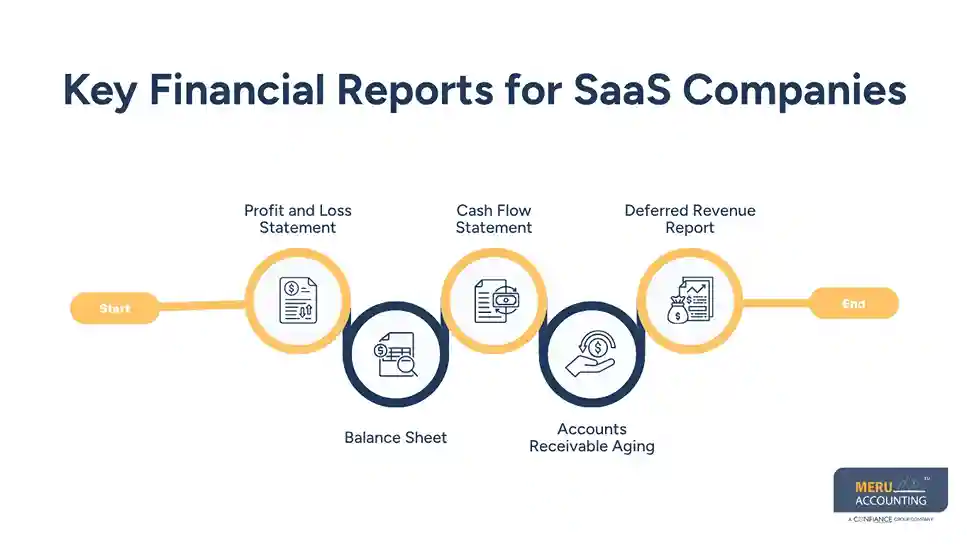
Accounts Receivable Aging
An A/R aging report shows unpaid customer balances and how long they have been open. This can help teams spot late payments before they create a larger cash issue.
Deferred Revenue Report
This report helps track amounts received from customers that relate to future service periods. It can be especially useful when annual or multi-year plans are common.
SaaS businesses may also track metrics such as monthly recurring revenue, annual recurring revenue, churn, customer acquisition cost, customer lifetime value, gross margin, burn rate, and cash runway. These metrics should be based on sound financial data rather than numbers pulled from disconnected systems.
SaaS Bookkeeping Solutions: In-House vs. Outsourced
As a SaaS company grows, the owner may need to decide whether to keep bookkeeping in-house or use outside support. Both models can work, but the right setup depends on transaction volume, staff skills, accounting needs, and the level of reporting required.
An in-house bookkeeper can work well when the company has enough ongoing work to support a dedicated role. It can also make sense when the finance team needs close day-to-day access to the books.
Outsourcing can be useful when a business needs experienced support without building a full finance team. SaaS accounting and bookkeeping solutions may cover routine bookkeeping, reconciliations, A/R and A/P, monthly reports, cleanup work, and support for the close process.
Before choosing a provider, ask:
- Does the provider understand subscription-based businesses?
- Can they work with your accounting software?
- How do they handle billing and payment data?
- What is included in the monthly scope?
- Who reviews the books?
- Can they support your CPA or tax team?
- How are cleanup and catch-up tasks handled?
The goal is not simply to move bookkeeping work outside the company. The goal is to build a process that keeps financial data clean and useful as the business grows.
SaaS Bookkeeping Solutions From Meru Accounting
SaaS businesses need books that keep pace with recurring billing, customer payments, operating costs, and monthly reporting. At Meru Accounting, we set up our SaaS bookkeeping solutions around your existing accounting system and workflow, with a focus on keeping the numbers accurate and month-end close on track.
Our SaaS Bookkeeping Services Include
- Monthly bookkeeping and account reconciliation
- Subscription revenue and expense tracking
- A/R and A/P support
- Bank, credit card, and payment reconciliation
- Monthly financial statements and reports
- Cleanup and catch-up bookkeeping
- Tax-ready financial records
- Support with your existing accounting software
We can also work with your CPA or finance team when bookkeeping and tax work need to stay aligned. The result is a clean set of books that is ready for review and reporting each month.
Our Expert Insight
In SaaS accounting, a big change in revenue deserves a closer look before it is accepted as a normal monthly result. An annual subscription, for example, can create a large cash receipt without the full amount being revenue for that month. We check the billing terms, payment date, and accounting entry to make sure the numbers line up.
We also look for smaller issues that can affect the close, such as payment fees posted to the wrong account, refunds recorded late, or customer balances that do not match the billing system. These checks help keep the books accurate and give the CPA a cleaner set of records at year-end.
Key Takeaways
- SaaS bookkeeping needs to account for subscription billing and the timing of revenue.
- Cash received is not always the same as revenue earned.
- Deferred revenue needs to be tracked when customers pay for future service periods.
- Reconciliations should cover banks, cards, payment platforms, and key customer balances.
- P&L, balance sheet, cash flow, A/R aging, and deferred revenue reports can give SaaS teams a clearer financial view.
- CPA support can be useful for tax, revenue recognition, financial review, and more complex accounting needs.
- SaaS bookkeeping solutions can help growing companies add accounting support without building a large in-house team.
FAQs
SaaS bookkeeping handles standard accounting tasks along with subscription billing, deferred revenue, refunds, and payment data.
Under accrual accounting, revenue is generally recognized over the service period rather than when the full payment is received.
Common metrics include MRR, ARR, churn, CAC, and gross margin. These should be based on reliable financial and customer data.
Many SaaS companies use platforms such as QuickBooks Online or Xero, often alongside billing, payment, payroll, and expense tools.
A monthly close is common because it gives the team timely financial results and helps catch errors before they build up.
optional anymore
on running the business


