
A funding round can change how a startup manages money. A founder who once checked a few bills and bank entries may now have investor funds, new staff, higher costs, more sales, and regular financial reports to manage. This is where startup accounting software needs to do more than record income and expenses.
The key question is not which system has the longest feature list. It is whether the system can handle the firm’s needs today and still work as those needs grow. The right choice can keep records clear, reduce manual work, and give founders better financial data for key decisions.
What You Will Learn From This Blog
- When a funded startup should review, upgrade, or replace its startup accounting software.
- Which features matter as transactions, staff, and costs increase.
- How funding can change reporting and control needs.
- How to compare small business accounting software for startups with advanced systems.
- What to check for cost, security, access, and integrations.
- When a startup should consider moving to a more advanced system.
What is Startup Accounting Software and Why Does It Matter After Funding?
A Central Place for Financial Records
Startup accounting software brings sales, costs, bills, payments, bank entries, and other records into one system. This gives the finance team a clearer view of what the business owns, owes, earns, and spends.
Better Control After Funding
More cash after a funding round can also mean more spending. A startup may hire staff, buy tools, increase marketing, or build new products, so financial records need to stay current and easy to review.
Clear Records for Tax Work
Tax work needs complete and well-kept records. The accounting system should keep income, expenses, payroll data, and other entries in order, while tax treatment should still be reviewed by a qualified tax professional.
Better Data for Founders
A bank balance alone does not show the full financial picture. Startup accounting software can provide profit and loss reports, balance sheet data, cash-flow views, unpaid bills, and amounts due from customers.
Room for More Work
A system that works for a small number of transactions may become hard to use after growth. Small business accounting software for startups can still fit a growing firm, but its limits should be checked before transaction volume rises sharply.
When Should a Funded Startup Upgrade its Accounting Software?
After a Funding Round
Funding is a good time to review the finance setup. If the startup now has more cash, vendors, staff, or reporting needs, the old system may no longer match the way the business operates.
When Transactions Rise
More invoices, bills, card payments, refunds, and bank entries can create extra work. Startup accounting software with better automation and controls can become useful when manual entry starts taking too much time.
When Investors Need More Reports
Investors may ask for monthly or quarterly financial data. If the current system cannot produce clear profit, cash, budget, or balance sheet reports, a new system may be worth considering.
When More Staff Join
New staff bring more payroll, expense claims, benefits, reimbursements, and user access needs. The accounting system should provide clear roles so each person can work only with the records they need.
When New Markets Open
Selling in new states or countries can bring new currencies, payment methods, tax needs, and entities. These changes should be considered before choosing a system that may later become too limited.
Key Features to Look for in Startup Accounting Software
General Ledger and Chart of Accounts
The general ledger records financial activity, while the chart of accounts groups those entries. A growing startup should be able to add useful account groups without making the books hard to manage.
Accounts Payable and Accounts Receivable
The finance team needs to know who the business must pay and who owes money to the business. Startup accounting software should track bills, invoices, due dates, payment status, and outstanding balances.
Bank and Credit Card Reconciliation
Bank feeds can bring transactions into the system, but imported data still needs review. Reconciliation checks whether the book records match bank and card records and can flag missing or incorrect entries.
Invoicing and Expense Management
As sales and costs rise, scattered invoices and receipts become harder to track. Small business accounting software for startups can keep invoices, expenses, bills, and payment status together for easier review.
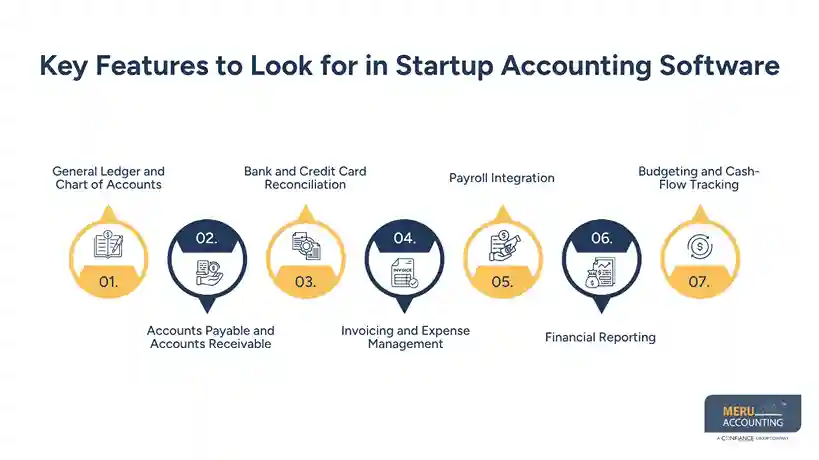
Payroll Integration
Payroll data should connect with the books in a clear way. This can reduce repeat entry and make wage costs, payroll taxes, benefits, and related records easier to review.
Financial Reporting
Reports should give useful answers about the business. Founders may need profit and loss data, investors may need regular reports, and the finance team may need balance sheet and cash-flow information.
Budgeting and Cash-Flow Tracking
Funding can be used quickly when spending is not tracked. Budget and cash-flow tools allow the team to compare planned spending with actual results and review future cash needs.
optional anymore
on running the business
How Funding Changes Your Accounting Software Requirements
More Detailed Cost Tracking
After funding, broad categories may not be enough. A startup may want to track costs by team, product, project, or campaign, so startup accounting software should allow useful cost groups.
More User Access
A founder may manage all finance work at first. Later, a bookkeeper, finance manager, or outside accountant may need access, making role-based permissions more important in small business accounting software for startups.
More Formal Reports
Funding can create a regular reporting cycle. Instead of making reports only when someone asks, the finance team may need monthly results, cash reports, budgets, and other financial data on a set schedule.
More Control Over Cash
A funded startup may have more money but also more plans for that money. Startup accounting software should give the team timely records so spending can be checked against the firm’s financial plan.
More Audit Needs
Financial records may be reviewed by investors, accountants, or other parties. Audit trails can show who changed a record and when, giving the business a clear history of important actions.
How to Choose Startup Accounting Software as Your Funded Startup Scales
Match the Software to Your Current Accounting Needs
Start with the finance work the startup has today. Small business accounting software for startups may be enough when the firm has simple books, one entity, and a small team.
Check Whether it Can Handle Higher Transaction Volumes
Ask how the system will perform when today’s transaction count grows. It should handle more invoices, bills, bank entries, users, and records without forcing another software change too soon.
Evaluate Investor and Financial Reporting Capabilities
Look at the reports before choosing startup accounting software. Check whether it can produce profit and loss, balance sheet, cash flow, budget, and other reports needed by founders and investors.
Look for Integrations With Banking, Payroll, and Payment Tools
The accounting system should fit the tools the startup already uses. Bank feeds, payroll systems, payment tools, billing platforms, and expense apps can reduce repeat entry when data moves between systems correctly.
Review Automation, User Roles, and Approval Workflows
Automation can reduce routine work, but control is also important. Check whether the startup accounting software allows different user permissions, approval steps, and review of sensitive financial actions.
Consider Multi-Entity and Multi-Currency Support
A startup may add another legal entity or begin selling in another currency. If growth plans include these changes, small business accounting software for startups should be checked for suitable entity and currency features.
Compare Pricing With Your Expected Growth
Do not compare only the starting price. Review user fees, add-ons, payroll costs, support charges, and other expenses that may appear as the startup grows.
Check Data Security, Audit Trails, and Access Controls
Financial data needs strong protection. Review user permissions, login controls, audit records, backups, and the vendor’s approach to storing and protecting business data.
Check the Quality of Customer Support and Accounting Assistance
Reliable accounting software still needs reliable customer support. Check response times, support hours, training options, and whether accounting assistance is available when the finance team faces a complex issue.
How Accounting Software Should Support Startup Financial Reporting
Monthly Profit and Loss
A profit and loss report shows revenue and costs for a set period. It allows the startup to compare actual results with its plan and review whether growth is producing better financial results.
Balance Sheet Review
Startup accounting software shows assets, liabilities, and equity through the balance sheet at a point in time. It can reveal changes in cash, unpaid bills, loans, and other key balances.
Cash-Flow Reports
Profit does not always mean cash is available. Cash-flow reports show money coming in and going out, which is important when a startup is using funding to expand.
Budget Versus Actual
A budget sets expected income and spending. Small business accounting software for startups can compare it with actual results to show where costs are higher or revenue is lower than planned.
Investor Reporting
Investors may need reports on a regular basis. Startup accounting software should make it easier to pull accurate figures instead of rebuilding financial data each time a report is due.
When Should a Startup Move From Basic Accounting Software to a More Advanced System?
When Manual Work Takes Too Much Time
If the finance team spends too much time entering, moving, and checking data, small business accounting software for startups may no longer meet the firm’s needs. This can be a stronger reason to upgrade than simply wanting more features.
When the Chart of Accounts Gets Complex
New products, teams, locations, or revenue streams can make the chart of accounts harder to manage. A more flexible system may then provide better control.
When More Users Need Access
As more people work with financial records, shared logins can create access and control issues. Different users should have permissions based on their duties.
When Reports Need More Detail
Early-stage firms may need only basic reports. Later, they may need data by product, team, project, region, or entity, which can make advanced reporting more important.
When the Firm Adds New Entities
New entities can bring separate books, bank accounts, currencies, tax work, and reports. Startup accounting software should be reviewed to ensure it can handle this added structure.
Common Mistakes to Avoid When Choosing Startup Accounting Software
Choosing Only on Price
The lowest plan may not have the lowest total cost. Check user fees, add-ons, setup work, support, and future costs before making the choice.
Buying More Than You Need
A large feature list does not always mean a better fit. Choose startup accounting software that meets current needs while covering the next realistic stage of growth.
Ignoring Data Migration
Moving records requires planning. Check which data can move, how old entries will be handled, and whether the new books can be tested before the old system is closed.
Failing to Check User Controls
Not every user needs full access to financial data. Set permissions based on job duties and keep approval rights with the right people.
Forgetting the Finance Team
A system may look simple during a demo but feel hard to use each day. Let the people managing the books test tasks such as reconciliation, billing, reporting, and month-end work.
How Meru Accounting Supports Funded Startups
Accounting Services for Growing Startups
Meru Accounting provides accounting services for startups that need structured bookkeeping and financial records as they grow.
Services include bookkeeping, accounts payable and receivable, payroll, and financial reporting.
Support for Growing Transaction Volumes
More sales, bills, expenses, and payments can make daily accounting work harder to manage.
Meru Accounting provides services that keep these records organized as transaction volumes increase.
Financial Reporting and Bookkeeping
Funded startups often need current books and clear reports for internal review and investor reporting.
Meru Accounting provides bookkeeping and financial reporting services based on the startup’s accounting needs.
Payroll and Accounts Payable
Hiring staff can increase payroll work, while growth can also bring more vendor bills and payments.
Meru Accounting provides payroll and accounts payable services to manage these regular accounting tasks.
Accounting Software and Finance Processes
Accounting software records financial data, but correct setup and regular review are still important.
Meru Accounting provides accounting services alongside the software selected by the startup.
Our Expert Perspective
The right startup accounting software should meet current finance needs without becoming a limit as the startup grows. Review transaction volume, users, reports, integrations, security, cost, and future expansion instead of choosing a system only for its feature list. The system should also fit the finance team’s daily work and reporting needs. This can make future growth easier to manage without an early software change.
Key Takeaways
- Choose startup accounting software based on current finance needs and expected growth.
- Funding can create greater needs for reporting, cash tracking, user controls, and audit records.
- Check the general ledger, reconciliation, invoicing, expenses, payroll, reports, and cash-flow tools.
- Review integrations with banking, payroll, payments, and expense systems.
- Compare the full cost rather than only the starting plan.
- Check security, access controls, audit trails, and data migration before switching.
- Consider an upgrade when manual work or complex reporting makes the current system hard to manage.
- Keep financial records current and have key tax and finance matters reviewed by a qualified professional.
FAQs
Choose a system based on transaction volume, reporting needs, integrations, user controls, security, pricing, and expected growth.
Startup accounting software should include a general ledger, bank reconciliation, invoicing, expense tracking, payroll integration, financial reports, and cash-flow tools.
A startup should upgrade when higher transaction volume, more users, complex reports, new entities, or manual work exceed the current system’s limits.
Small business accounting software for startups can work when the books remain simple, and the system can handle expected growth.
Startups should check features, transaction limits, integrations, pricing, security, user access, reporting, support, and data migration before choosing startup accounting software.
optional anymore
on running the business