Small business accounts payable can seem simple: a bill comes in, someone checks it, and the firm pays it. But think of a firm with 400 bills a month. One bill sits in an inbox, one has the wrong tax amount, three wait for sign-off, and a vendor says a bill is still unpaid even though the team thinks it was paid.
Now the true cost of AP starts to show. The firm is not just paying the bills. It is also paying for the time spent finding, checking, fixing, signing off, and tracking them. That is why the cost of small business accounts payable should be checked before a firm picks new software or compares outsourced accounts payable services.
What You Will Learn From This Blog
- How small business accounts payable moves from bill receipt to final payment.
- What a firm’s AP work can cost each month.
- How to work out the cost of each invoice with a simple case.
- How to compare manual AP, AP software, and outsourced accounts payable services.
- Which software tools matter as bill volume grows.
- How to check if a new AP process is saving money.
- What to check before making a software or outsourcing choice.
What is Small Business Accounts Payable?
Bills a Business Needs to Pay
Imagine a small firm buys $8,000 of stock from a vendor and gets 30 days to pay. Until that bill is paid, the $8,000 sits in small business accounts payable.
The same can apply to rent, software, repairs, freight, ads, office goods, and other costs bought on credit.
The AP Process
A bill does not go from an inbox to a bank account at once. It may need a data check, account code, manager sign-off, due-date check, and payment review first.
When that chain is not clear, bills can sit for days with no clear owner.
Vendor Records
A vendor record may seem like a small task, but one wrong bank number can cause a costly payment error. The same is true for a wrong vendor name, tax detail, or payment term.
For small business accounts payable, vendor data should stay up to date, and changes should be checked.
Due Dates and Terms
A vendor may give 30 days to pay, while another may ask for payment in 15 days. Some may give a discount when a bill is paid early.
A good AP process makes these dates easy to see rather than leaving them buried in emails or paper files.
AP as a Liability
An unpaid bill is not just a task on someone’s list. It is a liability in the accounts. Once the bill is paid, the AP balance falls, and cash falls too.
That is why wrong AP data can affect more than the AP team. It can also affect cash plans and financial reports.
optional anymore
on running the business
How Much Does Accounts Payable Cost for a Small Business?
Labor Cost
Take a firm where one bookkeeper spends 35 hours a month on small business accounts payable. At a full labor cost of $28 an hour, that is $980 a month.
At first, $980 may seem like the full AP cost. It is not.
Data Entry Cost
The bookkeeper may also spend time typing invoice numbers, vendor names, tax amounts, due dates, and account codes. If a bill takes six minutes to enter and the firm gets 400 bills, that is 40 hours just for entry.
This is where bill volume starts to change the cost of small business accounts payable.
Review and Approval Cost
The person who enters the data is not always the person who signs off on the bill. Managers may spend time checking the bill, asking for more details, or finding proof that the goods or work were received.
That time has a cost too, even if it does not show as an AP wage.
Error and Rework Cost
Here is a common case: a $2,500 bill is entered as $25,000. Someone later finds the error, checks the source bill, fixes the entry, and runs the sign-off step again.
The extra work may take only an hour, but repeat errors across hundreds of bills can add a high cost.
Late and Payment Costs
A late bill may lead to a fee or a lost early-pay discount. A firm may also pay bank, card, check, or wire fees.
These costs can turn a low-cost AP process into a costly one without the owner seeing the full cost.
How to Calculate Small Business Accounts Payable Costs
Step 1: Count Monthly Invoices
Start with the bill count. Say a firm gets 400 invoices in one month. Do not use an estimate if the real count is easy to find. Pull the last three months and use the average.
This gives a better base for the small business accounts payable cost test.
Step 2: Calculate Staff Cost
Next, count the hours spent on AP by bookkeepers, clerks, managers, and owners.
Suppose the total is 55 hours a month at $25 per hour. The AP labor cost is:
55 × $25 = $1,375
Step 3: Add Other AP Costs
Now add costs that sit outside staff pay.
For example:
- Software: $150
- Bank and payment fees: $75
- Scan and paper costs: $40
- Late fees: $60
That adds $325 to the $1,375 labor cost.
Total monthly AP cost = $1,700
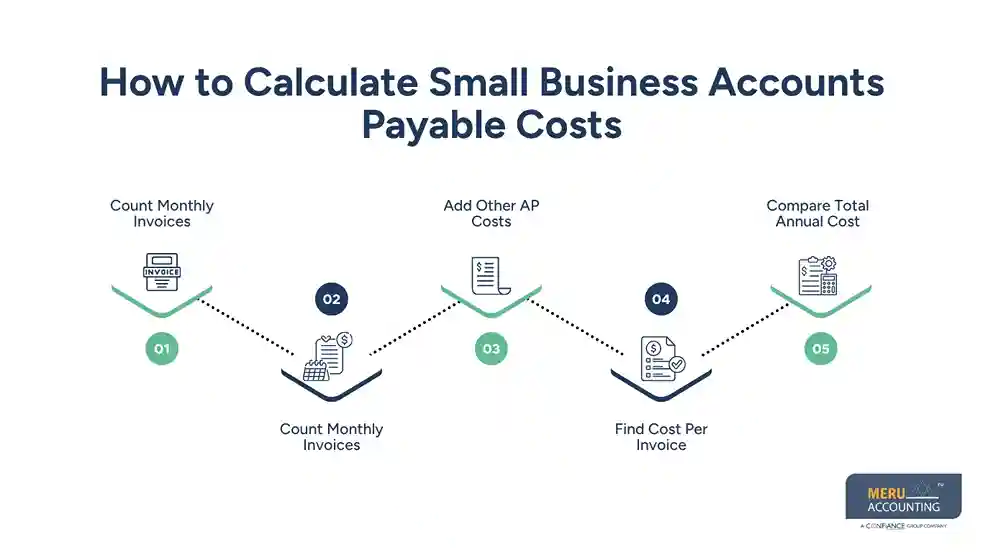
Step 4: Find Cost Per Invoice
The useful number is not just the $1,700 total. It is the cost of handling each bill.
Cost per invoice = Total monthly AP cost ÷ Monthly invoices
So:
$1,700 ÷ 400 = $4.25 per invoice
This number gives the firm a clear base for comparing small business accounts payable work, software, or outsourced accounts payable services.
Step 5: Compare Total Annual Cost
The $1,700 monthly cost becomes:
$1,700 × 12 = $20,400 per year
Now imagine an outside AP service costs $14,000 a year. The $6,400 gap looks good at first, but the firm still needs to check what the outside team will do.
If the service leaves payment work, bill checks, or manager review with the firm, the real gap may be much smaller.
What is Accounts Payable Software?
Invoice Capture
Imagine getting 80 bills by email in one week. Without a clear system, someone may need to open each file, read it, and type the data into the books.
AP software can pull key bill data into the small business accounts payable system. This cuts the need for repeat entry.
Approval Rules
Not every bill should need the same sign-off.
A $150 office bill may need one sign-off, while a $15,000 vendor bill may need two. Good AP software can send bills based on set rules.
Payment Tracking
A good AP screen should answer simple questions fast:
Which bills are due this week? Which are waiting for sign-off? Which are paid? Which are late?
That view can make daily small business accounts payable work much easier to track.
Vendor Data
Vendor data needs care because payment errors can be costly. The system should show who changed payment data and when the change was made.
Access should also be limited to staff who need it.
Accounting Integration
AP software should fit the accounting system already in use. If staff must download a report, fix the data, and type it all again, the new tool may add work rather than cut it.
Before buying, test the full path from invoice entry to the final accounting record.
How to Choose the Best Accounts Payable Software for a Small Business
Match the Bill Volume
A firm with 80 bills a month has a very different need from one with 2,000.
Do not pay for a large set of tools that the team will not use. At the same time, do not pick a low-cost plan that gets costly when the bill count rises.
Check the Total Price
A $100 monthly plan may not really cost $100.
Check bill limits, user fees, payment charges, setup fees, storage costs, and other charges. Then compare that total with the current cost of small business accounts payable.
Review Approval Controls
Ask how the software handles a bill from start to finish.
Can the system send a bill to the right person? Can it stop payment until sign-off? Can it show who approved it?
These checks matter more than a long list of extra tools.
Check Security Controls
AP teams deal with vendor and payment data, so security should be part of the buying test.
Look for user roles, access rules, audit logs, safe login methods, and controls for changes to payment data.
Test Accounting Fit
Do not buy based on a sales demo alone. Test a real bill.
Enter it, send it for sign-off, post it to the books, and check the final record. This small test can show issues that a feature list may hide.
How to Measure Accounts Payable Efficiency and ROI
Cost Per Invoice
Track the cost per bill before and after a change to see if your small business accounts payable process is more efficient.
For example, if the cost drops from $5.50 to $3.75 and the firm handles 400 bills each month, the monthly saving is:
($5.50 − $3.75) × 400 = $700
That gives the owner a clear number to use.
Invoice Processing Time
Time is another useful measure. If bills once took five days to reach sign-off and now take two, the process has changed in a way that can be measured.
Do not judge AP by speed alone. A fast process that creates wrong entries is not a good result.
Error Rate
In small business accounts payable, count duplicate bills, wrong amounts, wrong account codes, missed bills, and wrong payments.
If a new system cuts errors from 12 a month to three, that is useful data when judging the value of the new process.
Late Payment Rate
Track how many bills miss their due date.
If late bills fall after the firm changes its AP process, it may point to better bill tracking and sign-off. It can also cut late fees and help keep vendor terms on track.
Return on Investment
Say a new AP tool costs $300 a month and cuts labor and error costs by $600.
The monthly gain is $300.
When comparing outsourced accounts payable services, use the same test. Compare the outside fee with the AP work, staff time, error costs, and payment work that the service takes on.
How Meru Accounting Provides Accounts Payable Services
Invoice and Bill Entry
Meru Accounting provides outsourced accounts payable services that can cover small business accounts payable bill entry into the accounting system. Bill data can be checked for key fields such as vendor name, amount, date, and account code.
Bill Review and Coding
Bills need the right account code before they reach the books. Meru Accounting provides services for bill review and coding based on the accounting rules and process set by the business.
Payment Due Date Tracking
A bill can be correct but still cause trouble if it is paid late. AP work can include tracking due dates and keeping unpaid bills clear so the business can plan its cash needs.
Vendor Account Checks
Vendor accounts need regular checks to find unpaid bills, repeat entries, or other gaps. These checks can give the business a clear view of what it owes at a given time.
AP Records and Reconciliation
AP records should match the related accounting data. Meru Accounting provides accounting and bookkeeping services that can include account checks and reconciliation as part of the agreed work scope.
Fit For Growing Firms
As bill volume grows, manual small business accounts payable work can take more staff time. Outsourced accounts payable services can give a firm another way to handle this work without adding the full cost of an in-house AP team.
Our Expert Perspective
Many firms judge small business accounts payable by the software fee or bookkeeper’s pay, but the real cost often sits in bill checks, sign-off delays, payment errors, late fees, and manager time.
Before changing the AP process, add up these costs and compare them with the full price and scope of outsourced accounts payable services or new software.
A real bill should also be tested from receipt to entry, sign-off, posting, and payment to see where manual work remains. Keep review steps for vendor and payment data, then track cost per invoice, errors, late bills, and processing time to confirm that the new setup gives a real gain.
Key Takeaways
- Small business accounts payable includes bill entry, review, sign-off, payment, vendor data, and AP checks.
- The true AP cost includes staff time, software, payment fees, bank fees, late costs, and error work.
- Use the total AP cost divided by the bill count to find the cost per invoice.
- A cost-per-invoice figure makes it easier to compare small business accounts payable handled in-house with software and outsourced accounts payable services.
- Pick AP software based on bill count, total price, sign-off rules, security, and fit with the accounting system.
- Test a real bill before you buy software instead of judging the tool from a sales demo alone.
- Track cost, time, errors, and late bills after a new small business accounts payable process starts.
- Outsourced accounts payable services should be judged by total value and work scope, not the service fee alone.
- Keep vendor payment data under tight control and check any change to payment details before money is sent.
FAQs
The cost depends on bill volume, staff time, software, payment fees, errors, and late fees. You can find the cost per bill by dividing the total AP cost by the number of bills processed.
Calculate the cost per invoice by adding all monthly AP costs and dividing the total by the number of invoices processed that month.
The best AP software for small business accounts payable should match the firm’s bill volume, budget, approval needs, security needs, payment process, and accounting system.
A small business should think about AP software when manual bill work takes too much time, errors rise, bills are hard to track, or approval and payment delays become common.
Outsourced accounts payable services can cost less than managing small business accounts payable in-house when the service fee is lower than the full cost of staff time, software, errors, payment work, and other AP costs.
optional anymore
on running the business