
A SaaS startup can have strong sales and plenty of cash coming in, yet still have unclear books. Accounting for early stage SaaS startup companies can get tricky when customers pay for annual plans, subscriptions change, refunds are issued, or payment platforms take fees before sending a payout. Without the right process, it can be hard to tell how much revenue the business has earned and how much cash it can actually use.
Early-stage SaaS companies also have to track costs that can grow fast, from cloud hosting and software tools to payroll, contractors, and sales costs. Good books should show where the money goes and give founders a clear view of cash, revenue, expenses, and profit.
The good news is that you do not need a large finance team to keep your books in shape. With the right accounting setup and a steady monthly process, you can keep records clean as the business grows. This blog covers what to track, common mistakes to avoid, and when outsourced startup accounting may make sense.
What You Will Learn From This Blog
This guide covers:
- What accounting for early stage SaaS startup companies should include
- How to set up your books from the start
- How to track SaaS revenue and deferred revenue
- How to manage costs and cash
- How to match bank, card, and payment data
- Common mistakes that can hurt SaaS books
- When outsourced startup accounting can help
What Accounting for an Early Stage SaaS Startup Should Cover
Early stage SaaS accounting should give you a clean view of sales, costs, cash, and what you owe. It should also help you track key data as the firm grows.
A basic setup should cover:
- Chart of accounts
- Bank and card accounts
- SaaS sales
- Payment fees
- Refunds and chargebacks
- Payroll and contractor costs
- Software and cloud costs
- Accounts payable
- Accounts receivable
- Deferred revenue
- Fixed assets, if any
- Monthly financial reports
The right setup for accounting for early stage SaaS startup firms will depend on how they bill users, how much they sell, and how fast they grow.
Set Up the Right Accounting System From the Start
The first step is to pick an accounting system that fits the firm. Many early SaaS firms use tools such as QuickBooks Online, Xero, or another cloud accounting system.
Do not make the chart of accounts too broad. You need enough detail to see key costs, but too many accounts can make the books hard to run.
For example, a SaaS firm may need clear lines for cloud hosting, software tools, sales costs, ad spend, payroll, contractor costs, and payment fees.
Set rules for how each type of sale and cost is booked. This helps keep the books the same each month.
This is one reason accounting for early stage SaaS startup firms should be set up early. Fixing a poor setup later can take much more time than doing it right at the start.
Track SaaS Revenue Correctly
Revenue is one of the most key areas in SaaS books.
A SaaS firm may get cash today for a plan that lasts six or 12 months. But that does not mean all of that cash is revenue for the month.
For example, say a user pays $12,000 for a 12-month plan in January. The firm may earn $1,000 of revenue each month over the term. The rest is held as deferred revenue until it is earned.
This matters when you look at profit, growth, and monthly results.
Accounting for early stage SaaS startup firms should also track refunds, credits, plan changes, failed payments, and chargebacks. If these items are not booked well, sales and cash reports may not match.
It is also useful to keep a clear line between operating data and accounting data. MRR and ARR can help show sales trends, but they are not the same as GAAP revenue.
Manage SaaS Expenses and Operating Costs
SaaS firms can have many small costs. A few tools may turn into dozens of tools as the team grows.
Common costs may include:
- Cloud hosting
- Software tools
- Payment fees
- Payroll
- Contractor fees
- Sales and marketing
- Legal and tax work
- Office costs
- Customer support tools
- Product and development costs
A good system should show where cash is going each month.
For example, if cloud costs rise faster than sales, the founder should be able to see that trend in the books. The same is true for sales costs or contractor spend.
For accounting for early stage SaaS startup companies, cost review should not stop at data entry. The books should help the team spot large changes and ask why they happened.
optional anymore
on running the business
Reconcile Payments, Bank Accounts, and SaaS Platforms
SaaS firms often use payment tools such as Stripe or other payment gateways. The amount shown in the payment tool may not match the amount that reaches the bank.
For example, a customer may pay $100. The payment tool may take a $3 fee and send $97 to the bank.
The sale is $100. The fee is a cost. The bank deposit is $97.
If you book only the $97 deposit as sales, your books can be wrong.
A good monthly process should match:
- SaaS sales
- Payment fees
- Refunds
- Payouts
- Bank deposits
- Customer balances
This step is a core part of accounting for early stage SaaS startup companies because payment data can get large very fast.
Common Accounting Mistakes Early Stage SaaS Startups Make
1. Mixing business and personal costs
Founders may pay for tools or other costs from a personal card. This can make the books hard to track and may lead to missed records.
2. Booking cash as revenue
Cash received is not always the same as revenue earned. Annual plans are a common case.
3. Ignoring payment fees
Payment fees can add up fast. They should be tracked instead of being hidden inside net deposits.
4. Waiting too long to reconcile
Small errors can become large when they are left for months. Monthly checks are much easier.
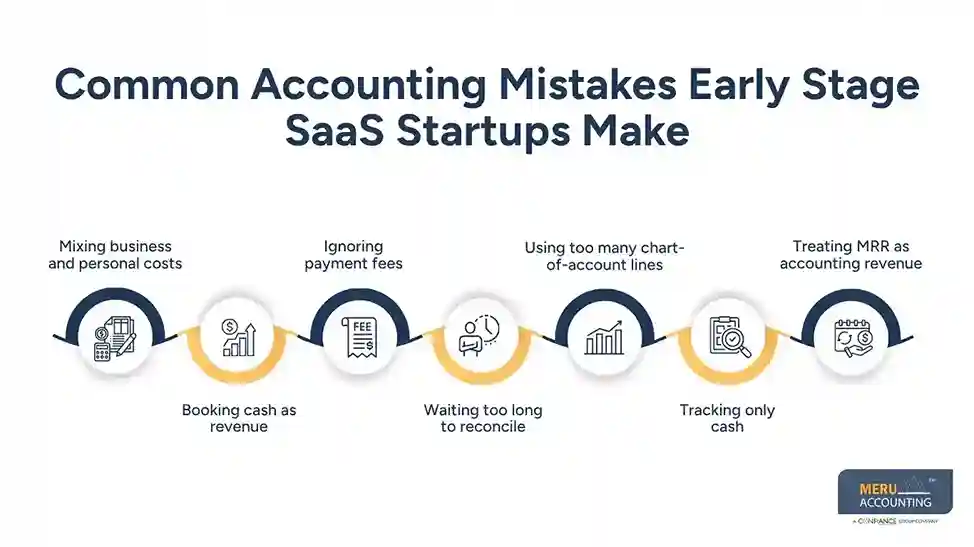
5. Using too many chart-of-account lines
Too much detail can make reports hard to read. Keep the chart clear and useful.
6. Tracking only cash
Cash matters, but it does not tell the whole story. A SaaS firm should also watch receivables, deferred revenue, payables, and key costs.
7. Treating MRR as accounting revenue
MRR is a useful business metric. It should not replace proper revenue records.
Meru Accounting’s Accounting for Early Stage SaaS Startup Services
Early SaaS firms often need solid books without the cost of a large in-house finance team. Meru Accounting can support accounting for early stage SaaS startup companies with day-to-day bookkeeping and month-end accounting work.
Our work can include:
- Chart of accounts setup and review
- Monthly bookkeeping
- Bank and card reconciliation
- SaaS payment reconciliation
- Sales and fee checks
- Accounts receivable tracking
- Accounts payable support
- Deferred revenue tracking
- Expense review
- Monthly financial reports
- Cleanup and catch-up work
- Tax-ready books
We can also work with the accounting system already used by the business. That can include QuickBooks, Xero, or Zoho Books.
The aim is to keep the books clear as sales, users, and costs grow.
Why Early SaaS Firms Use Outsourced Startup Accounting
Hiring a full finance team may not make sense when a SaaS firm is still small. At the same time, leaving the books to a founder can take time away from product and sales work.
That is where outsourced startup accounting can be useful.
An outside accounting team can handle routine work, check the books each month, and help keep key records up to date. This can give founders better data without the cost of hiring a full accounting team.
For SaaS firms, outsourced startup accounting can also help with tasks that need steady care, such as payment matching, deferred revenue, bank checks, and month-end close.
The right level of support can change as the company grows. A small firm may need basic bookkeeping at first. Later, it may need more reporting, cash planning, or support for investor needs.
Our Expert Insight
In our work with growing SaaS businesses, one of the first things we look at is whether the accounting process can keep up with the way the company sells. A startup may begin with a few customers and simple invoices, but billing plans, payment tools, refunds, and new software can add more moving parts within a few months.
A useful monthly close should do more than mark accounts as reconciled. It should help explain changes in the business. If MRR is up but cash is down, for example, the team should be able to trace the gap to items such as annual billing, unpaid invoices, payment timing, or higher operating costs. That link between the books and the business is where accounting becomes useful to a founder.
We also recommend keeping the close process consistent as transaction volume grows. The same key accounts, reports, and checks should be reviewed each month. This makes it easier to spot unusual changes early and gives founders more confidence in the numbers they use for hiring, spending, and growth decisions.
Key Takeaways
- Set up the accounting system before transaction volume gets high.
- Keep the chart of accounts clear and useful.
- Track SaaS revenue based on when it is earned.
- Keep deferred revenue in view for annual and prepaid plans.
- Record payment fees instead of booking only net payouts.
- Reconcile banks, cards, and payment tools each month.
- Do not treat MRR or ARR as the same as accounting revenue.
- Review cloud, payroll, software, and sales costs on a regular basis.
- Use outsourced startup accounting when an in-house team is not yet needed.
- Good accounting for early stage SaaS startup firms should support growth, not just record past activity.
FAQs
Yes. QuickBooks can handle many early-stage needs, such as income, expenses, bank feeds, bills, and financial reports. More complex subscription and revenue needs may require a careful setup and review.
MRR is useful to track, but it should not be treated as an accounting revenue account. Many startups track MRR in their billing or reporting tools and use their accounting system for financial records.
Keep these transactions separate from normal business costs. Record valid business expenses with the right support and track any founder-paid amounts so they can be settled or recorded correctly.
Keep clean bank records, financial statements, revenue records, expense details, and supporting documents. Investors may also want to see trends in revenue, cash use, and other key business metrics.
Warning signs include rising transaction volume, frequent billing changes, messy reconciliations, delayed month-end reports, or a founder spending too much time fixing the books. These are often signs that the accounting process needs more structure.
optional anymore
on running the business