Your SaaS business may be adding customers, but do your books tell the full story? A SaaS accountant can help you make sense of recurring revenue, customer payments, refunds, expenses, and cash flow without leaving gaps in your financial records. But the right fit is about more than knowing accounting basics.
As your software business grows, you need someone who understands the way SaaS companies bill customers and track revenue. They should also know how to work with your accounting and billing tools, keep your monthly close on track, and give you reports you can rely on. This blog will show you what to look for when choosing the right accountant for your growing SaaS business.
What You Will Learn From This Blog
In this guide, you will learn:
- What a SaaS accountant does
- When a growing SaaS firm may need one
- Which tasks an accountant should handle
- When to hire a SaaS accounting consultant
- What SaaS skills to check before you hire
What Is a SaaS Accountant?
A SaaS accountant is an accounting pro who works with software firms that sell access to a product on a set plan. These firms may bill users each month or year. They may also have free plans, paid add-ons, refunds, or plan changes.
SaaS books can have needs that are not seen in a basic firm. For example, a SaaS accountant may need to review sales from a billing tool and match them with bank data. They may also need to track unpaid bills, fees, refunds, and costs tied to the firm.
The goal is not just to post data. Good books should help the owner see what came in, what went out, and what the firm owes or is due.
Your accountant should also know how your billing and payment tools work. This helps cut the risk of gaps between your sales data, bank data, and books.
When Should a Growing SaaS Business Hire an Accountant?
There is no set size at which a SaaS firm must hire an accountant. The right time often comes when the books start to take too much time or need more skill than the owner has.
You may want to hire a SaaS accountant when:
- Your number of users or plans is growing
- You have both monthly and yearly plans
- You use more than one sales or payment tool
- Bank and billing data take more time to match
- Your books need clean month-end close work
- You need more useful monthly reports
- You are getting ready for a tax or audit need
- You plan to seek funds or grow into new markets
A growing firm may also need help when the owner can no longer tell if the books are up to date. Late entries and poor bank matches can make cash flow hard to track.
The right SaaS accountant can take these tasks off the owner’s plate. This gives the team more time to focus on the product, sales, and users.
What Should a SaaS Accountant Handle?
The scope can vary by firm. Still, a good SaaS accountant should be able to handle core bookkeeping tasks and understand the needs of a software firm.
Bookkeeping and Reconciliation
Your books should be kept up to date. This can include bank, card, and other account checks. Each month, the books should be checked against the source data.
Revenue and Billing Records
SaaS sales can come from many plans and payment paths. Your accountant should know how to review billing data and post it to the books in a clear way.
If users get refunds, credits, or plan changes, these items also need to be tracked with care.
Accounts Receivable and Accounts Payable
Some SaaS firms bill firms on terms. Others pay for tools, cloud use, ads, and other services each month. Your accountant should track what is due and what needs to be paid.
Monthly Reports
A growing SaaS firm needs more than a list of bank entries. A SaaS accountant should help keep key reports clean and on time. These may include the profit and loss statement, balance sheet, and cash flow data.
Cleanup and Catch-Up Work
If past books have gaps, the accountant should be able to find and fix them. This may include old bank items, missed entries, wrong account codes, or records that do not match.
A strong cleanup process can give the firm a better base for future reporting.
optional anymore
on running the business
Does Your SaaS Business Need a SaaS Accounting Consultant?
An accountant and a consultant can play different roles. A SaaS accountant often focuses on the day-to-day books, close work, and reports. A SaaS accounting consultant may help with a more complex accounting need, process review, or a change in the way the firm manages its books.
For example, a consultant may help review a new billing setup. They may also help set up a better chart of accounts or improve the flow from a billing tool to the accounting system.
You may need a SaaS accounting consultant when:
- Your accounting process is not easy to scale
- You are changing billing or finance tools
- Your books need a process review
- You need help with a complex accounting issue
- You want to improve your month-end close
- You need a plan for better financial reporting
In some cases, one firm can offer both accounting and consulting support. This can make it easier to keep the same data and workflow across the process.
Key SaaS Accounting Experience to Look For
Industry skill should be one of the first things you check when you choose a SaaS accountant. A person may be good at general accounting but have little experience with subscription-based firms.
Here are key areas to review.
Experience With SaaS Firms
Ask how many SaaS firms the accountant has worked with. Look for work with firms that have a business model like yours.
Knowledge of Recurring Revenue
Your accountant should know how to work with monthly and yearly plans. They should also know how plan changes, refunds, credits, and other sales events can affect the books.
Revenue Recognition Knowledge
Revenue may not always be recorded in the books at the same point that cash hits the bank. Ask the accountant how they handle revenue timing for your type of SaaS model.
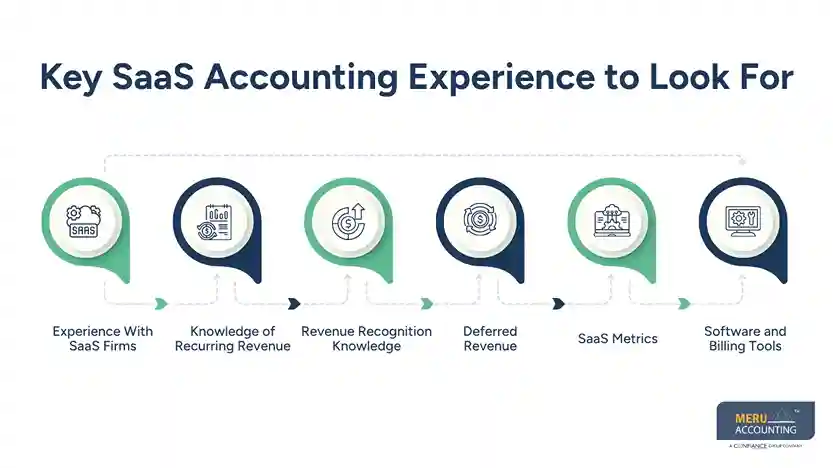
Deferred Revenue
If customers pay before the service period is complete, the books may need deferred revenue records. Your accountant should know how to track these amounts and update them as the service period runs.
SaaS Metrics
A good SaaS accountant should understand terms such as MRR and ARR. They should know how these metrics relate to the firm’s sales data and financial records.
Software and Billing Tools
Ask which accounting systems, payment tools, and billing platforms they know. The best choice is not based on one tool alone. It is based on how well the full flow can be checked and matched.
Meru Accounting's SaaS Accounting Services
A growing SaaS company needs accounting support that fits the way it already does business. At Meru Accounting, we work with SaaS businesses on their day-to-day books, reporting, and accounting needs while staying flexible with their existing tools and workflows.
Our SaaS accounting services include:
Accounting & Reconciliation
- Monthly bookkeeping and account reconciliation
- Bank and credit card reconciliation
- Accounts payable and accounts receivable
- Month-end review
Financial Reporting
- Revenue and expense tracking
- Sales and payment reconciliation
- Monthly financial statements
- Tax-ready financial records
Cleanup & Ongoing Support
- Catch-up and cleanup bookkeeping
- Account and transaction review
- Support with existing accounting software
- Help improving accounting workflows
We work with platforms such as QuickBooks, Xero, and Zoho Books. This lets us fit into your current setup instead of making you change tools just to get accounting support.
Our Expert Insight
When choosing a SaaS accountant, look beyond the software they know. Ask how they would handle a real issue in your business.
For example, if MRR is rising but cash is not, a skilled accountant should know what to check. Annual plans, refunds, unpaid invoices, payment timing, and churn can all affect the numbers.
We also suggest asking for a sample month-end report or close checklist. It can show you whether the accountant simply records transactions or actually reviews the numbers and flags issues.
Key Takeaways
- A SaaS accountant should know more than basic bookkeeping.
- SaaS firms may have complex billing, payment, and revenue needs.
- Look for direct experience with software and subscription firms.
- Ask how the accountant handles billing data, refunds, fees, and bank matches.
- Review their skills with recurring revenue and deferred revenue.
- A SaaS accounting consultant can help with process design and more complex accounting needs.
- Make sure the accountant can support your current tools and future growth.
- Clean monthly books can help you make better business and cash flow decisions.
FAQs
Yes. A good accountant should be able to work with your current accounting setup and understand how it connects with your billing and payment tools.
It depends on your workload and budget. Outsourcing can be a good fit when you need skilled accounting support without adding a full-time employee.
Ask about their SaaS experience, month-end process, reporting, software skills, communication, and how they handle issues that are specific to subscription businesses.
Yes. Clean, well-organized financial records can make it easier to prepare financial reports and respond to requests during fundraising or due diligence.
Often, yes. Setting up good accounting practices early can help prevent messy records and make it easier to track financial performance as the company grows.
optional anymore
on running the business