A shop owner checks the bank and sees $42,000. The profit and loss report shows a $16,000 gain. Then three bills come in, one key client asks for more time to pay, and payday is due in three days. So, which number shows the real state of the firm? That is where small business financial accounting has real value. It is not just about putting sales and costs into a book or app. The books must show what the cash means.
A client payment is not the same as a new sale. A loan pay is not the same as a cost. Cash taken by the owner is not firm sales.
When these items are put in the right place, the books tell a clear tale. When they are not, even a firm with good sales can make poor calls due to bad data.
What You Will Learn From This Blog
- How small business financial accounting goes past basic book work.
- Which key tasks need to be done each month.
- How to find and fix old errors in the books.
- How book data links with tax and tax rule work.
- What can raise or lower the cost of book work.
- How firms can use financial analysis for small business.
- What to check prior to use of the data in an app or report.
What is Small Business Financial Accounting?
More Than Recording Transactions
Say a firm pays $6,000 for a plan that runs for six months. If all $6,000 is put in one month’s cost, that month may look far worse than it is. Small business financial accounting looks at what a deal is and when it took place. It does not just copy the bank data. This is key when a firm uses each month’s report to judge its gains and costs.
Income and Expense Records
A sale may take place now, the bill may go out now, but the cash may come in 45 days later. These are linked, but they are not the same event.
The books must show when the sale was made and when the cash came in, based on the firm’s book method. The same care is due when costs are put in the books.
Assets and Liabilities
A $30,000 tool or truck does not work like a $30,000 day-to-day cost. The asset may stay on the books and be charged off over time, based on the right rules.
A loan is also not a day-to-day cost. Small business financial accounting keeps the loan due, the loan pay, and the loan cost apart so the firm does not show the wrong gain.
Owner Transactions
Owners may move cash to or from the firm. That does not mean each move is a firm cost or firm sale.
For case, an owner draw of $5,000 is not the same as a $5,000 pay to a trade firm. If the two are mixed, the gain and owner stake can both be wrong.
Records That Can Be Checked
A good book should let you ask one key thing: Where did this sum come from?
A bill, sale slip, deal, bank line, pay file, or loan note can show the source. Small business financial accounting is much more sound when key sums can be traced back to the proof that made them.
optional anymore
on running the business
Core Small Business Financial Accounting Services
Monthly Bookkeeping
Monthly bookkeeping is the base task. Sales are put in, bills are logged, cash is tied to the right sale, and costs are put in the right place.
The workload can vary a lot. A small firm with 60 deals a month has a very new set of needs from a web shop with 4,000 sales.
Bank and Credit Card Reconciliation
The books may show $18,750 in a bank. The bank may show $17,920. That gap needs a check.
It may be a bank fee, a check not yet cleared, a cash payment not yet in the books, a double post, or a line put in the wrong place. The goal is to find the cause, not just force the two sums to match.
Accounts Receivable Review
An open bill is not always a good asset. Its age has to be considered.
If a client owes $12,000 and the bill is ten days old, that may be fine. If the same $12,000 has been due for 14 months, the risk is much higher. A review by age gives the owner a more accurate view of cash that may come in.
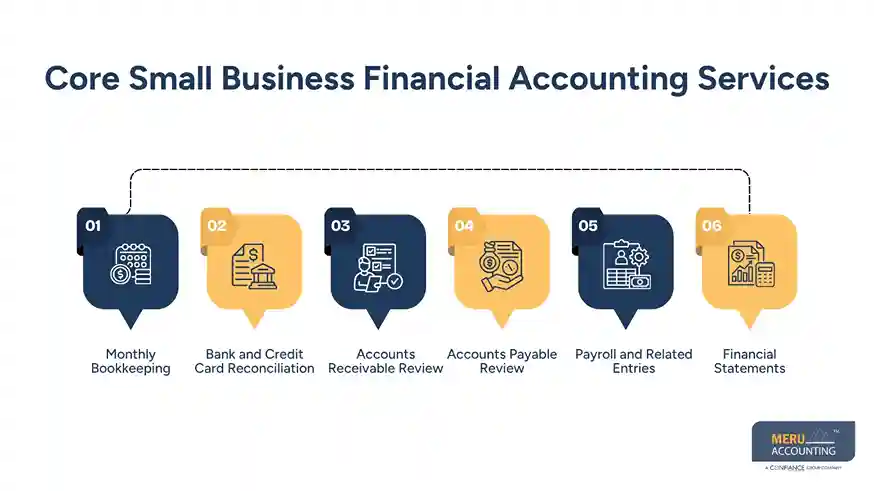
Accounts Payable Review
The same rule fits trade bills. A $9,000 bill may be due next week. It may also be an old bill that was paid, or a bill that was put in twice.
A pay file must be checked, not just cleared, when an old sum looks odd.
Payroll and Related Entries
Pay work can make many book lines at once. These may be wage cost, staff tax, firm tax, pay due, and the bank pay.
If the pay file and bank do not match the books, the wage cost may be wrong. A tax sum may also stay open even when it has been paid.
Financial Statements
A gain and loss report, a balance sheet, and a cash flow view each tell a part of the tale.
The gain and loss report shows how the firm did. The balance sheet shows what it has and what it owes. The cash view shows cash in and cash out. Small business financial accounting is more useful when all three are read as one set.
How to Clean Up Small Business Financial Records
Identify Missing or Duplicate Transactions
Start with proof, not guesswork. Match bank and card lines to the book and flag each line that does not match.
A $3,500 cost put in twice can cut the gain by $3,500 on paper. A $3,500 client payment left out can make open bills seem too high.
Reconcile Bank and Credit Card Accounts
Do not take the bank’s live sum as proof that the books are right. Check each open line and find out why it is still open.
Some gaps are due to time. Others are due to old errors. Small business financial accounting clean-up must tell these two cases apart.
Correct Account Classifications
A bank line tells you that cash moved. It does not tell you what that cash move was for.
Taking a $20,000 loan payment is an easy case. The full payment is not, in most cases, a cost. Part may cut the loan due, while the part for loan cost is shown as a cost.
Review Accounts Receivable and Payable
Old sums often have a tale to tell. A client may not agree with a bill. A trade firm may have sent a credit note. A payment may have been put on the wrong bill.
Before an old sum is cut, find the first line and check what took place. A neat book is not a good book if the fix is not right.
Fix Prior-Period Errors
A wrong entry from last month may be easy to fix. An error from two years ago may be far more key if it hit old tax data or old reports.
The fix must look at the date, type of error, and tax effect. Small business financial accounting should not treat each old sum as a line that can just be cut out.
Document the Cleanup
When a fix is made, leave a short note of what was done and why. Note the old sum, new sum, date, book code, and proof used.
This can save time when a new book lead, tax pro, or firm owner asks why an old sum was changed.
Small Business Tax Accounting and Compliance
Keep Tax and Book Records Connected
Tax work often starts with the books, but tax rules and book rules do not always work in the same way.
A firm may need one view of cost for its own use and a new view for tax. Small business financial accounting should keep the base data clear while tax work is done under the rules that fit the firm.
Separate Taxable and Non-Taxable Items
Not each cash receipt is a sale. Not each cash pay is a tax cost.
The right tax view can depend on the type of deal, firm type, tax rule, and place of the firm. Good books give the tax pro the facts needed to make that call.
Keep Supporting Documents
A bank line can show that cash moved, but it may not show why it moved.
A bill, sale slip, deal, pay file, loan note, or other proof can fill that gap. When key proof is kept with the book data, it is far less hard to check a sum at a later date.
Track Tax Payments
Tax pay can get mixed up with day-to-day costs if it is put in the wrong book code.
Payroll tax, sales tax, gain tax, and other tax payments may each need a new book line. Small business financial accounting should show the tax due and then show the tax paid in the right way.
Review Before Filing
Do not send the tax data out just as it sits in the app. Give the books one last check.
Look at odd costs, large shifts from past months, old client bills, old trade bills, fixed items, loans, owner draws, and tax due. This can catch a bad line prior to tax filing.
Keep Current With Tax Rules
Tax rules can shift. Due dates, rates, forms, limits, and tax breaks may not stay the same each year.
For that reason, use the latest tax rules for the firm. If the tax point is not clear, ask a tax pro who can check the rule that fits the case.
How Much Does Small Business Financial Accounting Cost?
Number of Transactions
The count of book lines is a key cost point. A firm with 60 book lines a month has less work than one with 4,000 sales and pay lines.
More lines also mean more match work, more bank checks, and more time spent on odd or hard-to-read items.
Number of Accounts
One bank account is easy to check. Add two cards, a loan, a Cash App, a sales app, and a new bank, and the work goes up.
Small business financial accounting costs can rise as each new account needs a full check each month.
Cleanup Requirements
New book work and old book clean-up are not the same task.
If the past 18 months have bad bank checks, double lines, wrong book codes, and old client bills, the first clean-up may cost more than the later month-to-month work.
Payroll and Tax Work
Payroll, payroll tax, sales tax, tax prep, and other tax work may sit outside the base book fee.
When you check a quote, see what is in it. A low fee may look good until key tasks turn out to be extra.
Reporting Needs
Some owners need just a gain and loss report and a balance sheet. Others need data by job, site, team, item, or client.
More detail means more work must be done in the books first. If the book codes are not right, a neat report can still give the wrong view.
Pricing Structure
A book firm may bill by the month, hour, job, or plan.
Do not ask only, “What is the fee?” Ask what the fee has in it, how many bank and card files are in the plan, if clean-up is extra, and what takes place if book lines rise.
Small Business Financial Reporting And Financial Analysis
Profit and Loss Review
More sales do not always mean more gain.
Say sales rise from $100,000 to $125,000, but direct cost goes from $55,000 to $80,000. Sales rose by $25,000, yet gross gain rose by just $5,000. Financial analysis for small business should spot that gap.
Balance Sheet Review
A gain and loss report can look good while the balance sheet shows stress.
Client bills may rise, debt may grow, or cash may fall. Small business financial accounting brings these parts side by side so the owner can see what the gain report does not show.
Cash Flow Review
Cash is often the first pain point in a firm that is still growing.
A firm may bill $70,000 in one month but get just $35,000 in cash. Staff and trade bills still need to be paid. Financial analysis for small business should thus track cash in and cash out, not sales on their own.
Margin Analysis
Sales show what was sold. Margin shows what was left after key costs.
If a $200 item had a $110 cost last year and now has a $150 cost, the firm keeps much less per sale. Financial analysis for small businesses can show this change even when sales count stays the same.
Receivable and Payable Trends
A rise in client bills due may mean sales are up. It may also mean clients now take more time to pay.
A rise in trade bills due can mean the firm is using more cash to fund its work, or it may mean bills are being held back. Financial analysis for small business should look at the cause, not just the sum.
Budget and Actual Results
A budget says what the firm thought would take place. The actual report says what did take place.
If the plan set $15,000 for ads but the firm spent $27,000, there is a gap of $12,000. The next step is to ask why. Sales may have gone up, or the ad spend may have run off plan.
Why Choose Meru Accounting For Small Business Financial Accounting?
Bookkeeping and Reconciliation
Meru Accounting provides bookkeeping and bank checks for firms that need a set way to keep their books in line.
The work can cover bank and card files, sales, costs, client bills, trade bills, and other core book data.
Tax and Payroll Accounting
Meru Accounting provides tax and payroll work along with book work.
When these records stay in one flow, it is much easier to trace a pay, tax sum, sale, or cost back to the source book data.
Accounting Software
Meru Accounting works with QuickBooks, Xero, Zoho Books, NetSuite, and Odoo.
The right app can vary by firm. The key points can be sales count, bank links, pay flow, report needs, and the type of work the firm does.
Cleanup and Financial Reports
Meru Accounting provides book clean-up and report work for firms with old, bad, or mixed book data.
The goal is not to make an old sum vanish from the report. The aim is to find the cause, make the right fix, and then build the report from the clean data.
Our Expert Perspective
One issue we see in small business books is not a lack of data. It is a lack of checks.
A book can have many rows and still give a poor view if bank lines are not matched, old client bills are left open, or loan payments are put in as one cost. That is why small business financial accounting should first aim for clean data, then turn that data into clear reports.
Financial analysis for small business is far more useful when the data has been checked first. A nice chart or report cannot fix a bad source.
Key Takeaways
- Small business financial accounting should show what each key sum means, not just record cash flow.
- Bank and card checks can find gaps, double lines, and wrong book codes.
- Old client and trade bills should be checked before they are cut or changed.
- Loan pay, owner cash, assets, and tax pay need the right book code.
- Old book clean-up should use proof and keep a note of each key fix.
- Book cost can vary by book lines, bank files, clean-up work, payroll, tax work, and report needs.
- A firm can show a gain and still have a cash gap.
- Financial analysis for small business should look at gain, cash, margin, debt, costs, and bills due.
- Tax calls should be made from the latest tax rules that fit the firm.
- Clean books give an owner a far sounder base for key money calls.
FAQs
Small business financial accounting includes bookkeeping, account cleanup, bank reconciliation, tax records, payroll records, financial reports, and review of income and expenses.
Financial accounting gives a clear view of sales, costs, cash flow, debts, and profit, which can help business owners make sound money decisions.
A small business should usually reconcile its bank and credit card accounts each month to find missing, duplicate, or wrong entries before they affect financial reports.
Financial analysis for small business means reviewing sales, costs, profit, cash flow, margins, debts, and other figures to see how the business is doing.
The cost depends on the number of transactions, type of accounting work, business size, software used, and whether the business needs basic bookkeeping or full accounting services.
optional anymore
on running the business