
A startup’s payroll needs can change fast as it adds new hires, offers employee benefits, or expands into new states. Payroll software for startups can make it easier to manage these changes, but choosing the right tool takes more than comparing monthly fees. The software must fit your current team and support your needs as the business grows.
Some tools focus on basic payroll, while others offer tax filing, time tracking, benefits management, and detailed reports. Knowing which features matter can help you avoid paying for tools you don’t need or switching systems too soon.
In this blog, we’ll cover the key features to look for, common pricing models, and payroll mistakes to avoid. We’ll also look at when payroll management services for startups may be a better fit than handling every task in-house.
What You Will Learn From This Blog
- How payroll software works and what tasks it can handle.
- Which key features matter most when you choose a payroll tool.
- How to pick a tool based on your startup’s size and stage.
- What costs to check before you sign up for a plan.
- Which common payroll errors you should avoid.
- When payroll management services for startups may be a better fit.
What Is Payroll Software for Startups and How Does It Work?
Payroll software is a tool that helps a firm manage staff pay. It can store staff data, track work hours, work out gross pay, apply tax cuts, and create pay slips. Some tools can also send pay to staff bank accounts and file payroll tax forms.
For a startup, payroll software for startups can help bring key pay tasks into one system. Rather than using spreadsheets to track each pay run, you can use one tool to store data and check each step.
Here is how a basic pay run works:
- Add staff details: Enter each worker’s name, home address, tax forms, pay rate, and bank data.
- Track work hours: Add hours worked, paid time off, and any extra hours.
- Work out gross pay: The tool uses pay rates and hours to find each worker’s gross pay.
- Apply tax and other cuts: It works out tax withholdings and any set cuts for health plans or other benefits.
- Pay your team: The system can send funds by direct deposit or help you make paychecks.
- Keep pay records: It saves pay slips, tax data, and reports for later use.
The steps may vary by tool and plan. Some tools also offer tax filing, while others need you to file forms or use an outside service. Founders should check what each plan covers before they sign up.
optional anymore
on running the business
Key Features to Look for in Payroll Software for Startups
The best payroll software for startups is not always the one with the most tools. It is the one that fits your team size, pay needs, and budget. Here are the key features to look for.
1. Auto Pay Runs
Look for a tool that can work out pay based on set rates and hours. It should help you cut down on manual math and let you set pay dates. Check if it can handle hourly, fixed, and extra pay with ease.
2. Tax Withholding and Filing
Payroll tax rules can be hard to track, especially when your team works in more than one state. Check if the tool can calculate tax cuts and file the right forms. Also, ask who is in charge if a tax form is late or has an error.
3. Staff Self-Service
A staff portal lets team members view pay slips, tax forms, and pay data on their own. They may also be able to change bank data or update their home address. This can cut down on routine queries sent to the founder or HR team.
4. Benefits and Pay Cuts
If your startup offers health plans, paid leave, or other staff benefits, check if the tool can track them. It should also let you set up the right pay cuts and show them on pay slips.
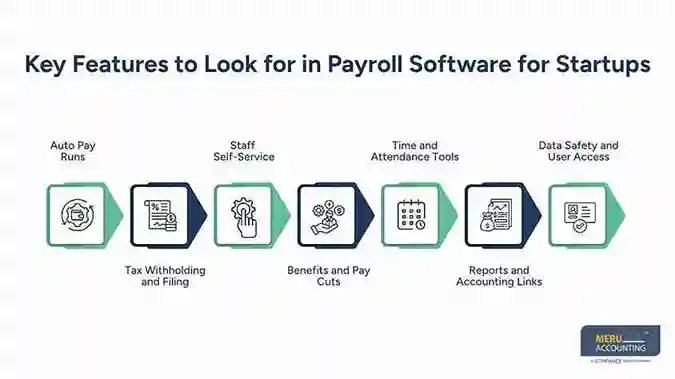
5. Time and Attendance Tools
For teams paid by the hour, time tracking is key. Check if the tool can track work hours, leave, and overtime. If you use a separate time clock tool, make sure it can link with your payroll system.
6. Reports and Accounting Links
Good payroll reports can help you track staff costs, tax cuts, and total pay. Look for links to your books so that pay data can flow into your records with less manual work. This can also help you match pay runs with bank data.
7. Data Safety and User Access
Payroll data holds private staff and bank details. Pick a tool with data encryption, secure logins, and role-based access. It should let you give staff access only to the data they need to see.
How to Choose Payroll Software Based on Your Startup's Stage
Your pay needs will change as your firm grows. So, the right payroll software for startups should fit your stage, not just your current staff count.
Pre-Revenue Stage
At this stage, you may have only a few staff or founders on the team. A basic plan may be enough if it can run payroll, track taxes, and keep clear records. Avoid paying for HR tools you do not need yet.
First Few Hires
Once you hire your first staff, pay runs become a set task. You need a tool that can store tax forms, track hours, and send pay on time. Check if it can also handle paid leave and staff records.
Growing Team
When your team grows to 15 or 20 staff, manual work can take up more time. You may need set pay rules, staff portals, tax filing, and clear reports. A tool that can handle more staff without a hard shift in cost is worth a look.
Remote and Multi-State Teams
If you hire staff who work in other states, you may face more tax and pay rules. Check if the tool can track each work site and handle state tax needs. Do not assume that all plans offer full multi-state support.
How Much Does Payroll Software Cost for Startups?
The cost of payroll software for startups can vary based on the plan, staff counts, and tools you need. Most firms charge a base fee each month, plus a set fee for each staff member.
Here are the main costs to check:
Cost Type | What to Check |
Base plan fee | The fixed cost you pay each month |
Per-staff fee | The extra cost for each worker on payroll |
Tax filing | Whether tax forms and filing are part of the plan |
Direct deposit | Whether bank pay has an extra fee |
Add-on tools | Costs for time tracking, benefits, or HR tools |
Setup fee | Any cost to set up staff data or move past records |
Do not pick a tool based on its base fee alone. A low-cost plan may not cover tax filing or key tools. Once you add these costs, the total may be much higher.
Ask each provider for the full cost based on your staff count. Also, check if the price will rise as your team grows. A clear cost plan can help you avoid a switch to a new tool too soon.
Common Payroll Mistakes Startups Should Avoid
Even with payroll software for startups, founders still need to check pay data and tax rules. A tool can help cut errors, but it cannot fix wrong data or poor work steps.
Here are some common errors to avoid:
- Wrong worker type: Treating an employee as a contractor can lead to tax and legal issues. Check the work setup before you add a worker to the system.
- Late tax filing: Missing tax dates can lead to fees and added work. Set alerts and check who will file each form.
- Wrong pay rates: A rate change may not show in the next pay run if staff data is not up to date. Review all pay changes before you run payroll.
- Missed overtime: Staff who meet the legal rules for overtime must get the right rate. Check work hours and pay rules for each role.
- Poor record keeping: Keep pay slips, tax forms, and time logs in a safe place. Do not rely on old emails or loose sheets.
- No pay review: Do not send each pay run without a check. Review hours, pay rates, tax cuts, and net pay first.
A clear review process can help you spot errors before staff gets paid. It can also help you keep sound records if a tax body asks for proof.
Payroll Management Services for Startups: How Meru Accounting Can Help
Payroll is not just about sending pay to staff. It also calls for clean records, sound checks, and the right data for your books. As your team grows, these tasks can take time away from core work.
Meru Accounting offers payroll management services for startups that need support with key payroll and accounting tasks. With the right support, founders can spend less time on routine pay work and more time on sales, hiring, and growth.
Our payroll support can help with:
- Payroll record upkeep: Keep staff pay data and key payroll records in order.
- Pay review support: Check pay data and key figures as part of the payroll workflow.
- Payroll accounting: Keep payroll costs in line with your books and help track pay entries.
- Account checks: Match payroll entries with bank data and help spot gaps.
- Payroll reports: Keep clear records of pay costs and related entries for review.
- Ongoing support: Get help as your team grows and your pay needs change.
If you already use payroll software, our team can work with the records and data you share. You do not need to view software and outside support as two separate choices. The right mix can help you keep pay work on track while you scale.
If your startup needs help with payroll records and related accounting work, payroll management services for startups from Meru Accounting can add skilled support without building a full in-house team.
Our Expert Insight
One issue we often see in growing startups is payroll falling into the wrong accounting period. For example, employees may work during the last few days of September but receive their pay in October. If the wages are recorded only when paid, September’s expenses may appear lower than they really are.
The correct approach is to record wages in the period employees earn them, even if payment happens later. This helps keep monthly profit reports accurate and gives founders a clearer view of labor costs.
We also recommend reviewing payroll accruals, employer taxes, bonuses, and unpaid leave balances during month-end close. These amounts can affect both reported expenses and liabilities. A consistent review helps prevent payroll costs from being missed or recorded twice.
Key Takeaways
- Pick payroll software for startups based on your team size, pay needs, and budget.
- Check auto pay runs, tax filing, staff portals, and time tracking before you sign up.
- Look at the full cost, not just the base plan fee.
- Keep staff data, pay rates, and tax forms up to date.
- Review each pay run before you send funds.
- Consider payroll management services for startups when pay tasks take too much time or need skilled support.
- Match payroll reports with your books to keep a clear view of staff costs.
FAQs
Yes. Founders can manage payroll with suitable software or outsource routine payroll tasks until the business needs a dedicated team.
In the U.S., employers generally need an EIN and must meet applicable federal and state employer tax registration rules before running payroll. State and local requirements depend on where employees work.
Startups may need to register as employers in each state where their employees work, withhold the right state and local taxes, and follow local wage and leave laws. Remote work can create tax obligations outside the company’s home state.
Keep payroll registers, employee Forms W-4, Forms W-2, time records, tax deposits, quarterly filings, and proof of wage payments. Federal recordkeeping rules generally require employers to retain employment tax records for at least four years.
Consider outside support when payroll reviews, tax filings, reconciliations, and employee pay records take too much time or require expertise your team lacks. You can retain your existing software while outsourcing selected payroll and accounting tasks.
optional anymore
on running the business