Meru Accounting

Nearshore vs Offshore Accounting Services: Which Model Offers Better Value?

Contents
Want to learn more?

Subscribe for business tips, tax updates, financial fundamental and more


    Nearshore vs Offshore Accounting Services: Which Model Offers Better Value?

    A lower hourly rate may look like a good deal until extra review time, missed deadlines, or poor communication add to the cost. That’s why comparing nearshore vs offshore accounting services takes more than looking at price quotes. The right choice should give your business skilled accounting support without adding more work for your in-house team.

    Nearshore and offshore firms offer different benefits in terms of cost, time zone overlap, talent, and day-to-day support. Understanding these differences can help you decide which model offers better value for your business.

    What You Will Learn From This Blog

    • How nearshore and offshore accounting teams work.
    • The key differences in cost, time zones, skills, and data safety.
    • When nearshore or offshore support makes more sense.
    • How a hybrid model can help manage costs and daily work.
    • What to check before hiring an accounting outsourcing firm.

    What Are Nearshore Accounting Services?

    Nearshore accounting services mean hiring an outside team in a nearby country. For a US business, this often means working with an accounting team in Latin America or the Caribbean.

    The main draw is time zone overlap. Your team can share more work hours with the outside staff. This can make it easier to set up calls, ask for updates, and clear up issues during the workday.

    Nearshore teams can help with many daily tasks, such as:

    • Recording sales, costs, and other entries.
    • Bank and credit card checks.
    • Accounts payable and accounts receivable.
    • Payroll records and support.
    • Month-end close and reports.
    • Account cleanup and catch-up work.

    This model can work well for firms that need close team contact or have tasks that call for quick input. It can also help when your staff needs to review work in real time.

    Still, a nearby location does not always mean a better fit. Rates, staff skills, data safety, and review steps can vary from one firm to the next. You should judge the full offer, not just the location.

    What Are Offshore Accounting Services?

    Offshore accounting services mean hiring an outside team in a far-off country. US firms often work with teams in India, the Philippines, and other parts of Asia.

    This model can give a business access to a large pool of skilled staff at a lower cost than many local hires. It can also help firms handle a high volume of work without adding a large in-house team.

    Offshore teams can take on tasks such as:

    • Daily bookkeeping and data entry.
    • Bank, card, and account checks.
    • A/P and A/R tasks.
    • Payroll accounting support.
    • Month-end close work.
    • Financial reports and account review.
    • Cleanup and catch-up bookkeeping.

    The time gap can be a plus when work is planned well. Your team can send files at the end of its day, and the offshore team can work on them during its own day. The results can then be ready for review when your staff starts work.

    However, this setup needs clear task rules, set review times, and safe ways to share data. Without these steps, time zone gaps can slow down work rather than speed it up.

    Good financial management isn't
    optional anymore
    Meru Accounting handles the accuracy, so you can focus
    on running the business

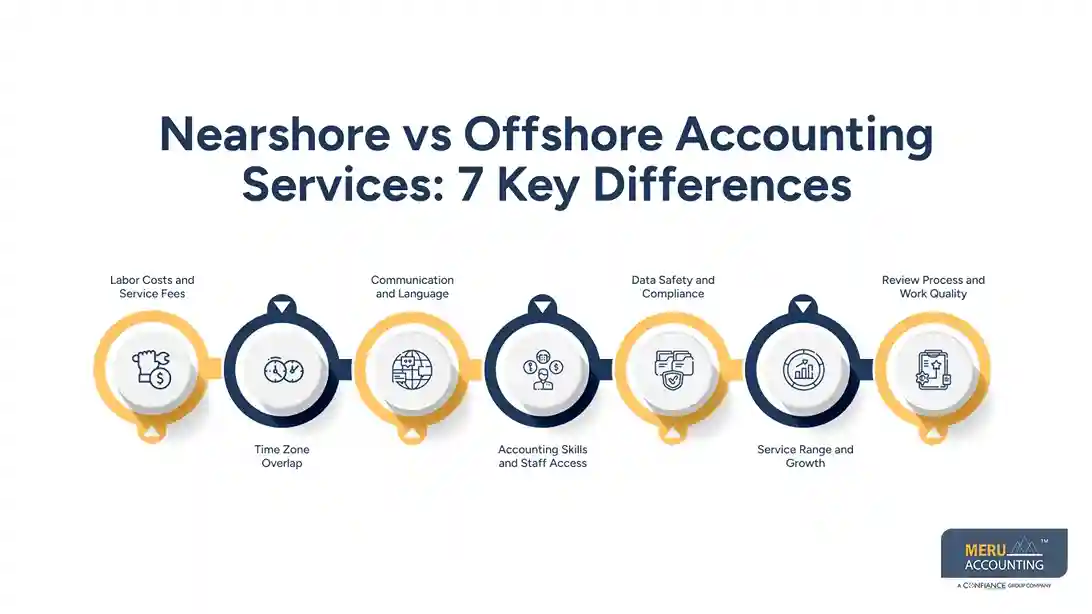
    Nearshore vs Offshore Accounting Services: 7 Key Differences

    When you compare nearshore vs offshore accounting services, look beyond hourly rates. The right choice should fit your work, team size, and need for support.

    1. Labor Costs and Service Fees

    Cost is often the first point firms look at. Nearshore teams may charge more than some offshore teams due to local pay rates and market costs. Offshore teams in places such as India may offer lower rates for the same type of work.

    But the hourly rate does not show the full cost. You should also check setup fees, software costs, team lead fees, and the cost of any extra review work.

    A low rate may not save much if the work needs many edits. Compare the cost of the full service, not just the rate per hour.

    2. Time Zone Overlap

    Nearshore teams often work closer to US time zones. This makes it easier to hold live calls, ask for quick changes, and work on tasks that need input from both teams.

    Offshore teams may have a large time gap. But this can also support work across the full day. A task sent at the end of your workday may be ready the next morning.

    The best choice depends on how much live contact your work needs. Daily reviews may call for more overlap, while routine tasks can work well with set handoff times.

    3. Communication and Language

    Nearshore teams may offer more shared work hours, which can help with calls and team chats. This can be useful when your staff needs to talk through new tasks or fix an issue right away.

    Offshore firms may use set channels, shared task lists, and written work steps to keep work clear. Many also have staff with strong English skills.

    Do not assume that location alone tells you how well a team will work with yours. Ask who will handle your account, how often you will get updates, and how the firm deals with open issues.
    Nearshore vs Offshore Accounting Services: 7 Key Differences

    4. Accounting Skills and Staff Access

    Both models can give you access to trained accounting staff. The skill level depends on the firm’s hiring process, staff training, and review rules.

    Nearshore teams may be a good fit when you want staff who can join live calls and work with your in-house team. Offshore firms can offer a wider range of staff and skill sets, based on their size and hiring reach.

    Check the team’s past work, accounting knowledge, and grasp of US rules. Ask who will review the books and how the firm checks work before it is sent to you.

    5. Data Safety and Compliance

    Your accounting team may need access to bank data, payroll records, vendor files, and client details. This makes data safety a key part of any deal.

    Both nearshore and offshore firms should have clear rules for data access, file sharing, staff access, and data storage.

    Before you sign, ask about:

    • Role-based access to files and systems.
    • Multi-factor login and safe file sharing.
    • Staff privacy rules and training.
    • Data backup and breach response plans.
    • Access removal when staff leave a project.

    Also, check which laws and rules apply to your data. Do not treat a firm’s location as proof that it meets your legal duties.

    6. Service Range and Growth

    Nearshore teams can be a good fit for firms that need close support and regular team contact. Offshore firms may offer more room to add staff as the work grows.

    For example, a firm may start with bank checks and monthly books. Later, it may need help with A/P, A/R, payroll records, and month-end close.

    Before you hire, ask how the provider will add staff, train new team members, and keep work steady as the task list grows. A good growth plan should not lead to gaps in service or poor work quality.

    7. Review Process and Work Quality

    No matter where your team works, you need a clear way to check the work.

    A sound review plan may include bank checks, account tie-outs, open item lists, and month-end review steps. It should also set out who fixes errors and how fast they must be fixed.

    Ask for a sample report or work plan before you sign. You can also start with a small task to see how the team handles deadlines, questions, and edits.

    When Should a Business Choose Nearshore Accounting Services?

    Nearshore support may be the better fit when your work needs close contact with your outside team. It can suit firms that:

    • Need daily calls or quick team input.
    • Have tasks that change often.
    • Need live help during the US workday.
    • Work with complex tasks that call for regular talks.
    • Prefer more overlap with their in-house staff.

    For example, a firm that needs its outside team to join daily close calls may find a nearshore setup easier to manage.

    Still, do not choose this model just because the team is close by. Check the rate, skills, service range, and review plan before you make a choice.

    Can a Hybrid Nearshore and Offshore Accounting Model Offer Better Value?

    Yes. A hybrid model can bring together the strengths of both options. A firm can use nearshore staff for tasks that need live contact and offshore staff for work that can follow a set process.

    For example, nearshore staff may help with daily calls, urgent account issues, and work that needs input from the US team. Offshore staff may handle bank checks, data entry, A/P, A/R, and monthly reports.

    This setup can help lower costs while keeping key tasks close to your team. But it needs clear roles and one shared work plan.

    To make it work:

    1. Set out which team owns each task.
    2. Use one system to track work and open issues.
    3. Set clear due dates and review steps.
    4. Keep file access limited to each team’s needs.
    5. Check work quality across both teams.

    A hybrid setup is not right for every firm. It may add more steps if the work is small or the teams do not share the same process. Start with a clear task split and check the results before you add more staff.

    Get Reliable Offshore Accounting Support With Meru Accounting

    Outsourcing accounting takes more than assigning someone to enter transactions. Your books need consistent records, accurate reconciliations, proper account reviews, and reports that reflect your business activity. Meru Accounting brings experience across multiple industries to help businesses manage these tasks through dedicated offshore accounting support.

    Our services cover the key stages of your accounting cycle:

    • Bookkeeping and transaction recording: Maintain daily and monthly records of income, expenses, and business transactions.
    • Bank and credit card reconciliation: Match transactions with statements and investigate missing or unusual entries.
    • Accounts payable and receivable: Manage vendor bills, customer invoices, payment records, and outstanding balances.
    • Payroll accounting support: Record payroll expenses and keep related accounts up to date.
    • Month-end accounting and reporting: Review account balances, complete reconciliations, and prepare financial reports.
    • Bookkeeping cleanup and catch-up: Review past records, correct errors, and bring overdue books up to date.

    We work with businesses across industries and adapt our accounting processes to their reporting needs and existing workflows. Our team also supports different accounting software and can work within the systems your business already uses.

    Whether you need help with routine bookkeeping or a wider range of accounting tasks, Meru Accounting provides the people and processes to keep your financial records organized and ready for review.

    Our Expert Insight

    One area businesses should check when hiring an accounting partner is how the team handles month-end adjustments. For example, a vendor may send an invoice in July for services used in June. If the expense is recorded only in July, June expenses and profits will be overstated.

    A good accounting team should know when to record accruals, prepaid expenses, unpaid invoices, and other adjustments so each month’s reports show the right figures.

    Before hiring a provider, ask how its team handles month-end close, reviews account balances, and corrects errors. These steps reveal more about its accounting expertise than hourly rates or team location alone.

    Key Takeaways

    • Nearshore teams offer more time zone overlap and may suit firms that need live contact.
    • Offshore teams can offer lower rates and access to a large pool of accounting staff.
    • The best model depends on cost, skills, data safety, and the type of work.
    • A hybrid setup can split tasks based on the need for live contact and task volume.
    • Review steps and work quality matter as much as the hourly rate.
    • Check the full cost and service terms before you hire an outside team.

    FAQs

    Many offshore accounting firms support US GAAP-based bookkeeping and reporting. However, check the team’s knowledge of accrual accounting, revenue recognition, and financial reporting before hiring.

    Responsibility depends on the service agreement. It should clearly state who reviews entries, corrects errors, approves reports, and handles missed deadlines.

    Yes. An outsourced team can maintain books, prepare reconciliations, and organize financial records for your CPA. Your CPA can then use these records for tax returns, reviews, and financial advice.

    It depends on the state of your books, task volume, and software access. The process often includes reviewing past records, setting up access, defining workflows, and checking opening balances before regular work begins.

    It can help maintain consistency between transaction records, reconciliations, and reports. However, businesses should still have proper review and approval controls, especially for payments and financial statements.

    Good financial management isn't
    optional anymore
    Meru Accounting handles the accuracy, so you can focus
    on running the business