Multi State payroll tax compliance is a key duty for US businesses that employ workers in different states. Each state may set its own rules for income tax, unemployment tax, taxable wages, registrations, and filing dates. When a worker moves, starts remote work, or travels between offices, the employer may need to review its payroll tax setup. A small mistake can lead to unpaid tax, late fees, or state tax notices.
Businesses need clear employee records, accurate payroll data, and regular checks to meet these duties. Payroll tax compliance outsourcing gives companies another option when their internal teams lack the time or skills to manage different state rules. With the right process, businesses can reduce errors, keep tax records in order, and meet their payroll duties on time.
What You Will Learn From This Blog
- How multi state payroll tax compliance works and why state rules differ.
- Common payroll tax problems that affect remote and relocating employees.
- Ways to find payroll errors and correct tax returns.
- How payroll software and Payroll tax compliance outsourcing can reduce manual work.
- What to check before choosing an outside payroll tax service.
What is Multi State Payroll Tax Compliance?
Multi State payroll tax compliance means following the payroll tax rules of each US state where a business employs workers. These duties include state income tax withholding, state unemployment insurance (SUI), tax registration, wage reports, tax returns, and timely payments. Each state has its own tax rates, wage limits, and filing dates.
Remote work, employee moves, and work across state lines can also change tax duties. Employers must keep employee records current and check state rules, including reciprocal tax agreements where applicable.
Businesses can maintain multi state payroll tax compliance by checking tax rates, tracking deadlines, saving payment records, and reviewing payroll reports. Payroll software can manage tax data and flag due dates, while Payroll tax compliance outsourcing can provide expert help with tax calculations, registrations, filings, and notices. Employers should confirm the provider’s service scope and review all payroll data to reduce errors and avoid penalties.
Common Multi State Payroll Tax Compliance Problems and How to Resolve Them
Incorrect State Tax Withholding For Remote and Relocating Employees
Problem: Payroll may keep withholding tax for an employee’s former state after a move. It may also use the home address without checking where the employee performs work.
Solution: Ask workers to report address and work-location changes promptly. Check the rules of each state, update payroll from the correct date, and review any past withholding errors. Accurate records are central to multi state payroll tax compliance.
Missing Payroll Tax Registrations in New States
Problem: Hiring a remote employee can create tax duties in a state where the company has no tax account. Delayed registration may lead to late returns and extra fees.
Solution: Check registration rules before the employee starts work. Open the required state accounts, confirm account numbers, and add filing dates to the payroll calendar. Payroll tax compliance outsourcing can include registration checks when the service agreement covers this work.
Miscalculating State Unemployment Insurance Taxes
Problem: SUI rates and taxable wage limits vary by state. An old rate or incorrect wage limit can cause an employer to pay too much or too little tax.
Solution: Confirm the assigned employer rate and annual wage limit for each state. Review taxable wages during the year and check state notices for rate changes. Keep the records used to calculate each payment.
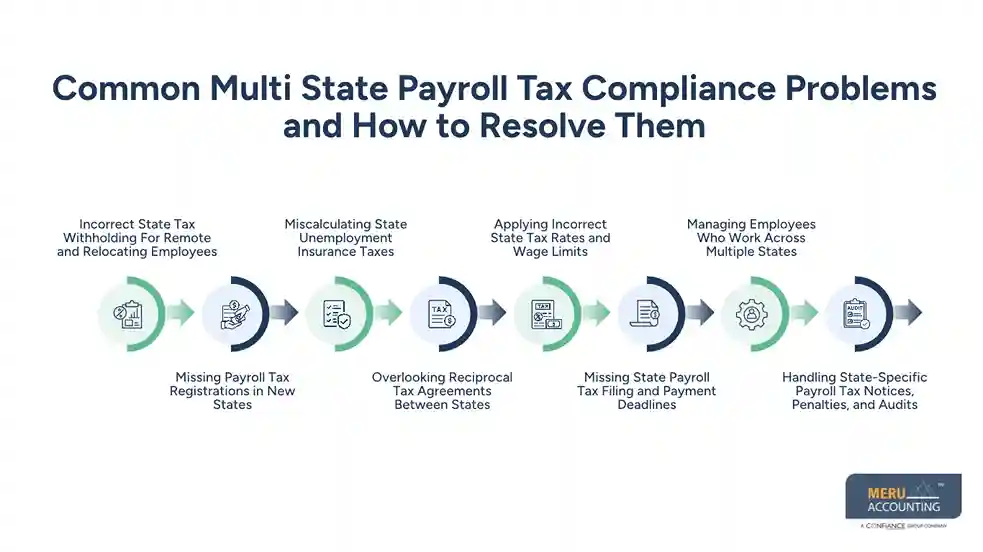
Overlooking Reciprocal Tax Agreements Between States
Problem: Some states have agreements that let eligible workers pay income tax to their state of residence rather than their work state. Missing these rules can lead to incorrect withholding.
Solution: Check the agreement and confirm that the employee meets its terms. Collect the required exemption form and retain it with payroll records. Never assume that all states offer the same tax relief.
Applying Incorrect State Tax Rates and Wage Limits
Problem: Payroll may use an old rate, the wrong wage limit, or a tax rule that applies to another state. This can affect employee deductions and employer costs.
Solution: Check official state tax agency guidance before each tax year and after announced changes. Test updated payroll settings and compare sample calculations with the relevant rules. Effective multi state payroll tax compliance requires separate checks for each tax type.
Missing State Payroll Tax Filing and Payment Deadlines
Problem: Different states may have different filing schedules and payment dates. Tracking only federal deadlines can cause a business to miss state obligations.
Solution: Keep a calendar for each state, with return dates, payment dates, and wage report deadlines. Assign a person to check completion and save proof of filing. Payroll tax compliance outsourcing can take on agreed filing tasks and report missing data before a due date.
Managing Employees Who Work Across Multiple States
Problem: Workers may perform duties in several states during one pay period. Assigning all wages to a single state without checking local rules can cause errors.
Solution: Track workdays by state and keep approved time and travel records. Review wage allocation rules before calculating withholding. Seek qualified tax advice when two states claim taxing rights or the correct treatment remains unclear.
Handling State-Specific Payroll Tax Notices, Penalties, and Audits
Problem: A state agency may flag unpaid tax, a missing return, or a mismatch between reported wages and its records. Delayed replies can affect multi state payroll tax compliance and lead to more fees or further review
Solution: Record the notice date, response deadline, tax period, and amount in question. Compare the notice with filed returns and payment records, then reply with clear evidence. Payroll tax compliance outsourcing may include notice handling, but confirm the provider’s role before assigning this duty.
optional anymore
on running the business
How to Identify and Correct Multi State Payroll Tax Errors
Review Payroll Reports
Compare payroll registers, state returns, and payment receipts. Differences in wages or tax amounts can show where an error needs review.
Check Employee Records
Review work locations, home addresses, move dates, and travel records. Use these details to confirm which state rules applied during each pay period for multi state payroll tax compliance.
Verify Tax Calculations
Check the tax rates, wage limits, and employee details used by the payroll system. Correct any wrong settings before the next payroll run.
Trace the First Error
Find the first pay period affected by the mistake. Calculate the full difference so that the correction covers every affected period.
Amend Returns When Required
Follow the relevant state agency’s process for corrected returns, extra payments, or refund claims. Keep proof of each change and the reason for it.
Record the Final Fix
Document who reviewed the error, who approved the correction, and what changed. These steps make future multi state payroll tax compliance checks more reliable.
Best Practices For Maintaining Multi State Payroll Tax Compliance
Keep Employee Details Current
Ask workers to report moves and changes in work location. Update payroll records before the next pay run and retain the effective date.
Maintain a State Tax Register
List state registrations, tax account details, filing dates, and assigned staff to manage multi state payroll tax compliance. Review the register at regular intervals and whenever the business hires in a new state.
Use a Payroll Review Checklist
Check employee locations, wages, deductions, and tax settings for multi state payroll tax compliance before approving payroll. A second review can catch errors before returns and payments are sent.
Follow Official Tax Updates
Use state agency websites for current rates, forms, wage limits, and deadlines. Record each change and confirm that the payroll system reflects it.
Save Filing and Payment Proof
Keep returns, payment receipts, agency notices, and employee tax forms in a secure place. These records can be vital during an audit or tax dispute.
Set Clear Staff Duties
Assign ownership for payroll checks, tax payments, and notices. Payroll tax compliance outsourcing can cover agreed tasks, while the employer retains oversight of the full process.
How Payroll Software Can Simplify Multi State Payroll Tax Management
Apply State Tax Settings
Payroll software can use employee work locations to apply configured tax rules. Staff must still confirm that the data and settings are correct.
Track Rates and Wage Limits
Some systems provide tax table updates and alerts. Check what the vendor updates automatically and what needs manual review.
Manage Due Dates
Software can flag filing dates and incomplete tasks. Assign an owner to confirm that each return was filed and each payment cleared.
Connect HR and Time Records
Links with HR and time systems can reduce repeated data entry. Review changes in employee location before the next pay run.
Create State-Level Reports
Reports can show wages, tax withheld, and employer tax by state. Compare these figures with returns and bank records to find differences.
Know the Limits of Software
Software cannot resolve every tax dispute or replace expert judgment. Strong multi state payroll tax compliance still requires current records and regular reviews.
How to Choose Payroll Tax Compliance Outsourcing Services
Check State Tax Experience
Choose a provider with experience in the states where your staff work. Ask how it handles remote hires, employee moves, SUI, and reciprocal agreements.
Confirm the Service Scope
Check whether the provider manages registration, tax calculations, returns, payments, or state notices for multi state payroll tax compliance. Put each party’s duties in writing.
Review Data Security
Ask how the provider protects tax IDs, wage records, and bank details. Confirm who can access records and how sensitive files are shared.
Check Filing Controls
Find out who reviews returns before filing and how payments are confirmed. Agree on deadlines for data sharing, approval, and urgent issues.
Ask About Error Resolution
Check whether the provider handles amended returns, penalties, and state audits. Confirm how it reports errors and what extra fees may apply.
Compare Fees and Terms
Review service limits, extra charges, and exit terms before signing. Payroll tax compliance outsourcing should match the number of states, employees, and tasks involved.
How Meru Accounting Handles Payroll and Accounting Needs
Meru Accounting provides payroll, bookkeeping, accounting, accounts payable and receivable, and financial reporting services for businesses. Companies can discuss their payroll record needs, review steps, and accounting processes with our team to define a service scope that fits their operations.
Review Payroll Records
We review agreed payroll records and related account entries to find gaps or differences that need attention. Clear records make it easier to check wage costs and account balances.
Organize Payroll Tasks
A defined process can set out who tracks due dates, checks employee changes, and saves filing proof. We recommend confirming the exact state tax services included in our scope before assigning registration or filing duties.
Match Payroll With Accounts
Payroll costs affect wages, employer taxes, and cash flow. Matching payroll reports with accounting records gives owners a clearer view of staff costs and unpaid liabilities. Our accounting services can include this review within the agreed scope.
Set Review Procedures
Meru Accounting can work with businesses to define records, review steps, and reporting needs within the agreed service scope. We also recommend confirming who remains responsible for each legal duty.
Choose the Right Service Scope
Businesses with staff in many states may need more review than those with one small remote team. Discuss the states involved, employee count, and current payroll process with our team before selecting multi state payroll tax compliance services.
Our Expert Perspective
Multi state payroll tax compliance starts with accurate employee location records and a clear process for each state. A new hire, a move, or a change in workdays can affect tax duties, so businesses should review these changes before running payroll rather than wait for a state notice.
Payroll tax compliance outsourcing can reduce the workload for internal teams, but it works best when the employer checks the provider’s work, keeps full records, and assigns clear duties. Current state guidance and timely reviews remain key to sound payroll tax management.
Key Takeaways
- Multi state payroll tax compliance requires businesses to follow the state rules that apply to their workers.
- Remote work and employee moves can change tax withholding and registration duties.
- SUI rates, wage limits, and filing dates need regular review.
- Correct errors by tracing them to the first affected pay period and following state procedures.
- Payroll software can reduce manual work, but staff must review data and tax settings.
- Payroll tax compliance outsourcing can cover agreed tasks when the provider has the right skills and clear service terms.
- Keep tax returns, payment proof, and state notices in a secure record system.
FAQs
Review employee work locations, tax withholding, state returns, and payment records, then correct errors through the relevant state tax agency.
Common problems include wrong state tax withholding, missing tax registrations, incorrect unemployment tax, missed filing dates, and errors with employees who work across state lines.
Remote employees may create state tax withholding, registration, and reporting duties based on their work location and the tax laws of the states involved.
Businesses should consider payroll tax compliance outsourcing when they lack the staff, time, or state tax knowledge needed to manage payroll tax filings and deadlines across multiple states.
Businesses can reduce penalties by tracking state filing deadlines, using current tax rates, keeping employee records accurate, and reviewing payroll tax payments before they are due.
optional anymore
on running the business