Inventory accounting records the cost of goods a business buys, makes, and sells. It also shows when stock loses value due to damage, age, low demand, or a fall in market prices. When the value of stock falls below the amount shown in the books, a business may need to record an inventory write-down. This step keeps stock values and profit reports in line with the facts.
A clear stock valuation process gives business owners an accurate view of inventory costs, gross profit, and current assets. It also allows finance teams to spot losses before they grow. Businesses with large stock levels may use outsourced inventory accounting services to review stock records, check values, and post the right entries at the end of each period.
What You Will Learn From This Blog
- What inventory accounting means and why stock write-downs matter.
- Which events can cause a loss in stock value.
- How U.S. GAAP and IFRS guide inventory write-downs.
- How to calculate a write-down with a clear example.
- How to record write-downs and report their effect on profit.
- When outsourced inventory accounting services may be useful.
Introduction to Inventory Accounting and Inventory Write-Downs
What is Inventory Accounting?
Inventory accounting tracks the cost and value of goods held for sale or used to make products. It covers raw materials, work in progress, and finished goods, based on the nature of the business.
What is an Inventory Write-Down?
An inventory write-down reduces the book value of stock when its recorded cost is higher than the amount the business can recover from its sale or use. The loss is recorded in the accounts for the period in which it is found.
Write-Down vs. Write-Off
A write-down reduces inventory value but leaves some value in the financial records. A write-off removes all or part of the inventory value when the goods have no recoverable value, such as items that are fully damaged or no longer fit for sale.
Cost and Net Realizable Value
Inventory cost can include the purchase price, direct labor, and suitable production costs. Net realizable value (NRV) is the expected selling price less the costs needed to finish and sell the goods.
When Should a Business Review Stock?
A business should review stock at each reporting date and when it finds damage, slow sales, expired goods, or a sharp drop in selling prices. Regular checks make inventory accounting more accurate and reduce the risk of overstated assets.
Why Inventory Write-Downs Matter in Inventory Accounting
Accurate Stock Values
A write-down prevents the balance sheet from showing stock at a value the business cannot recover. This gives owners, lenders, and investors a more reliable view of current assets.
Reliable Profit Reports
When stock loses value, the loss must be reflected in the right period. Without a write-down, expenses may be too low and reported profit may be too high.
Better Buying Decisions
Stock reviews show which items sell slowly or lose value over time. Buyers can use this data to change order sizes, clear old goods, or reduce future purchases.
Stronger Stock Controls
A review may reveal poor storage, damaged goods, weak demand forecasts, or errors in stock records. These findings give managers a clear basis for changes in stock handling and buying rules.
Clear Records for Audit
Stock counts, price records, sales data, and write-down entries form a record of how the business set its stock value. Outsourced inventory accounting services can review these records and flag gaps before the year-end close.
What Causes an Inventory Write-Down?
Damage During Storage or Transit
Water, heat, poor packing, or mishandling can make goods unsafe or unfit for sale. The write-down depends on whether the goods can still be sold and how much value remains.
Slow-Moving or Old Stock
Goods may lose value when demand falls, or newer models take their place. Inventory accounting reviews, including those provided through outsourced inventory accounting services, can compare expected sales with current stock levels to identify items that may need a lower value.
Expiry and Obsolete Goods
Food, medicine, dated supplies, and old electronic parts may lose value after expiry or a product change. Items that cannot be sold or used may need a full write-off rather than a partial reduction.
Falling Selling Prices
A drop in market prices can reduce the amount a business expects to earn from its stock. If NRV falls below cost, the business may need to record a write-down.
Higher Costs to Finish or Sell
Extra repair, packing, transport, or selling costs can reduce the net amount a business expects to recover. Inventory accounting must include relevant costs when the rules require an NRV test.
What Accounting Rules Govern Inventory Write-Downs?
Lower of Cost and Net Realizable Value (NRV)
Under U.S. GAAP, most inventory is measured at the lower of cost and NRV. If NRV falls below recorded cost, the business reduces inventory to NRV and records the loss in the period it occurs.
Inventory Write-Down Requirements Under U.S. GAAP and IFRS
IAS 2, the IFRS standard for inventories, requires stock to be measured at the lower of cost and NRV. U.S. GAAP also uses the lower-of-cost-and-NRV rule for most inventory, though certain inventory measured using the LIFO method or the retail inventory method follows different guidance.
What NRV Includes
NRV is the expected selling price in the normal course of business, less estimated costs to complete the goods and costs needed to make the sale. It is not always the same as market price, since selling and finishing costs can change the final amount.
How Often Should Stock be Tested?
Businesses should assess inventory value at each reporting date. A major drop in demand, damage report, or change in selling price may also call for a review before the next close.
Can a Write-Down be Reversed?
Under IFRS, a later rise in NRV can allow a reversal of an earlier write-down, limited to the original write-down amount. Under U.S. GAAP, a write-down generally establishes a new cost basis and is not reversed if value later recovers.
Why the Accounting Framework Matters
The correct treatment under outsourced inventory accounting services depends on the reporting rules used by the business, its inventory method, and the facts behind the loss. Finance teams should check the applicable standard before posting a material adjustment.
optional anymore
on running the business
How to Calculate Inventory Write-Downs
Confirm the Recorded Cost
Inventory accounting starts with verifying stock costs against purchase bills, production records, and the inventory ledger. Check that the amount follows the business’s stated cost method, such as FIFO or weighted average.
Estimate the Selling Price
Use current sales prices, recent orders, and reliable market data to estimate the amount the business expects to earn from the goods. Avoid using an old list price when actual sales show a lower value.
Deduct Costs to Finish and Sell
Subtract the costs still needed to complete the goods and make the sale. These may include final production work, packing, or other costs that qualify under the applicable accounting rules.
Compare Cost With NRV
Use this formula:
NRV = Expected Selling Price − Costs to Complete − Costs to Sell
Then compare the result with the recorded cost. When cost exceeds NRV under the applicable rule, the difference is the write-down.
Check the Stock Quantity
Confirm the number of units on hand and identify the items affected. Apply the calculation to the relevant stock items or groups as permitted by the accounting framework, and keep the working papers.
Inventory Write-Down Calculation Example With Journal Entries
Stock Cost Before the Review
A business holds 100 units of a product at a recorded cost of $20 per unit. The total stock cost is $2,000, based on the inventory accounting records.
Expected Selling Price
The business now expects to sell each unit for $18. The expected selling value for 100 units is $1,800.
Costs to Complete and Sell
The business expects to spend $1 per unit on costs needed to finish and sell the stock. Total costs are $100, so NRV equals $1,800 minus $100, or $1,700.
Calculate the Write-Down
The recorded cost is $2,000, while NRV is $1,700. The write-down is $300, which reduces the stock value to $1,700.
Write-down = Recorded Cost − NRV
Write-down = $2,000 − $1,700 = $300
Journal Entry
The business can record the adjustment as follows, subject to its chart of accounts and reporting rules:
Account | Debit | Credit |
Inventory write-down expense | $300 | — |
Inventory | — | $300 |
This entry records the loss as an expense and lowers the inventory balance. Some businesses use a separate allowance account instead of crediting inventory directly, based on their accounting policy.
How to Record Inventory Write-Downs in Books
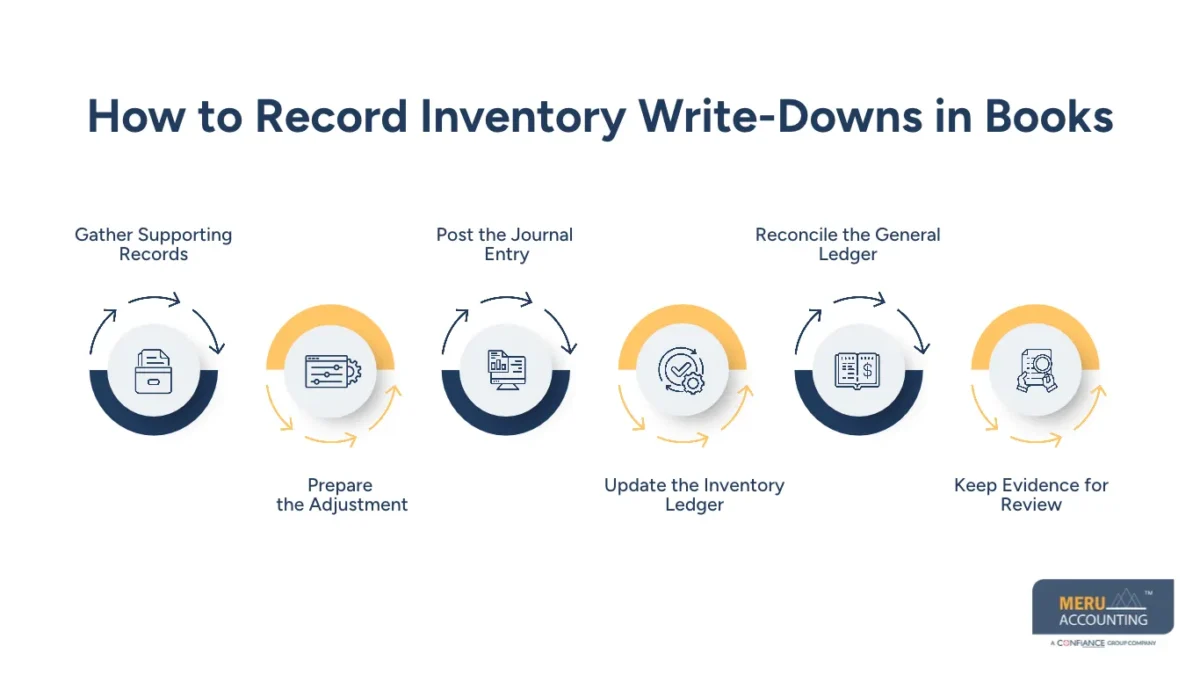
Gather Supporting Records
Keep stock count sheets, purchase bills, recent selling prices, damage reports, and cost estimates. These records help outsourced inventory accounting services document why the business reduced the value and how it reached the amount.
Prepare the Adjustment
Calculate the write-down and check the figures against the stock ledger. A second review can reduce the risk of errors in quantities, prices, or cost estimates.
Post the Journal Entry
Debit the inventory write-down expense and credit inventory or the related allowance account. Use the correct reporting period so the loss appears when the reduction in value is identified.
Update the Inventory Ledger
Revise the stock records to show the reduced value and retain the original cost data where the system allows it. This keeps the audit trail clear for outsourced inventory accounting services and avoids confusion during later stock reviews.
Reconcile the General Ledger
Compare the inventory subledger with the general ledger after posting the entry. Resolve any differences before the accounts close.
Keep Evidence for Review
Store the calculation, approval, and source records with the journal entry. Outsourced inventory accounting services can maintain these working papers and check that each adjustment follows the agreed accounting policy.
How Inventory Write-Downs Affect Financial Statements and Profitability
Effect on the Balance Sheet
A write-down lowers inventory, which is part of current assets. The lower amount reflects the value the business expects to recover from its stock.
Effect on the Income Statement
The write-down creates an expense or forms part of the cost of goods sold, depending on the accounting policy and presentation. As a result, profit for the period falls by the amount recorded, before any related tax effect.
Effect on Gross Profit
If the loss is included in cost of goods sold, gross profit falls. If it appears as a separate expense, the impact may be shown below gross profit, so readers should review the financial statement notes.
Effect on Working Capital
Lower inventory reduces current assets and may reduce working capital. The change does not itself mean cash has left the business during the period, since the write-down is a non-cash accounting adjustment.
Effect on Tax and Reporting
Tax treatment may differ from the financial reporting treatment and from one country to another. A business should check local tax rules with a qualified tax professional rather than assume the accounting loss is deductible at once.
Why Choose Meru Accounting For Inventory Accounting Services?
Meru Accounting provides bookkeeping, accounting, accounts payable and receivable, financial reporting, and related services for businesses that need clear financial records. Its inventory accounting work can include stock ledger checks, cost reviews, reconciliation, and the recording of approved adjustments.
- Stock Record Review: Compare stock reports with purchase bills, sales data, and ledger balances.
- Write-Down Calculations: Review cost, NRV estimates, and the supporting records for stock value changes.
- Journal Entries: Record approved adjustments in line with the client’s accounting policy and reporting framework.
- Period-End Reconciliation: Match inventory records with the general ledger and flag differences for review.
- Ongoing Accounting Support: Outsourced inventory accounting services can give growing businesses added capacity during monthly and year-end close without requiring them to build every task into an in-house team.
Businesses should share their accounting framework, stock method, reporting needs, and approval process before assigning this work. Meru Accounting can then define the scope of the review and the records needed for each reporting period.
Our Expert Perspective
Inventory write-downs should follow clear evidence, not guesswork. A lower sales forecast alone may not be enough; the finance team should check current prices, stock condition, costs to complete, and the likely cost of sale.
A sound inventory accounting review also separates a one-time loss from a repeated stock issue. If the same items lose value each quarter, managers should review order levels, product demand, storage practices, and stock age. Outsourced inventory accounting services can provide a consistent review process, but management remains responsible for estimates, approvals, and the final financial statements.
Key Takeaways
- Inventory accounting records stock cost and shows when stock loses value.
- A write-down is needed when the applicable accounting rules require inventory to be reduced below its recorded cost.
- NRV equals expected selling price minus costs to complete and sell.
- In the example, $2,000 of stock with an NRV of $1,700 requires a $300 write-down.
- The journal entry lowers inventory and records an expense or other appropriate loss account.
- U.S. GAAP and IFRS share the lower-of-cost-and-NRV rule for most inventory, but reversal rules differ.
- Stock counts, price data, cost estimates, and approved entries provide an audit trail.
- Outsourced inventory accounting services can handle reviews and reconciliations, while management retains responsibility for accounting judgments.
FAQs
Calculate net realizable value by subtracting costs to complete and sell goods from their expected selling price, then compare it with inventory cost.
Debit inventory write-down expense and credit inventory or an inventory allowance account for the amount of the loss.
A business should record an inventory write-down when stock cost exceeds its net realizable value under the applicable accounting rules.
Both generally require inventory to be measured at the lower of cost and net realizable value, but their rules for reversing write-downs differ.
Inventory write-downs reduce the reported value of stock and lower profit for the period in which the loss is recognized.
optional anymore
on running the business