A company can have a great product, loyal customers, and a steady stream of sales, but none of that guarantees good financial management. Someone still needs to decide how much to spend on growth, when to cut costs, how to fund new projects, and what the numbers say about the company’s future. That’s where the CFO for dummies topic gets interesting. It isn’t just about accounting or spreadsheets; it’s about the financial decisions that keep a business moving in the right direction.
A Chief Financial Officer (CFO) brings those decisions together. They help business owners understand their financial position, plan ahead, and make better use of company resources. In this blog, we’ll look at what a CFO actually does, the reports they rely on, and how their work supports businesses at different stages of growth.
What You Will Learn From This Blog
- What a CFO is and how the role fits into a business.
- The main financial duties handled by a CFO.
- How CFOs use financial reports to track business health.
- How financial planning helps owners make better decisions.
- When a small business should consider hiring a CFO.
- How virtual CFO services support financial planning and growth.
What Is a CFO? Understanding the Role of a CFO
A Chief Financial Officer, or CFO, is the senior executive who oversees a company’s financial health. They manage financial planning, review business performance, assess risks, and help leaders decide how to use company funds.
Think of a CFO as the person who helps answer three key questions:
- Where does the business stand financially? They review revenue, expenses, cash flow, debt, and profit to understand the company’s current position.
- Where is the business heading? They use budgets, forecasts, and past results to estimate future financial needs.
- What should the business do next? They assess the financial impact of plans such as hiring, expansion, new products, or large purchases.
For example, a company may want to open a second location. Its sales may be growing, but that doesn’t mean it has enough cash to cover rent, payroll, equipment, and other startup costs. A CFO reviews the expected costs, cash needs, and likely returns before advising the owner.
Understanding the Role of a CFO in a Business
When understanding the role of a CFO, it’s helpful to know that the job goes beyond preparing reports or checking expenses. A CFO connects financial data with business goals.
An accountant may record a sale, while a CFO looks at how sales trends affect profit, cash flow, and future plans. Both roles matter, but they serve different needs.
A CFO also works with other leaders to set financial goals, track results, and address problems before they affect the business. Their work helps owners make decisions based on actual financial data rather than guesswork.
optional anymore
on running the business
CFO for Dummies: Understanding the Core Responsibilities of a CFO
A CFO handles several areas of business finance. The exact duties depend on the company’s size, industry, and stage of growth, but most CFOs focus on the following responsibilities.
1. Financial Planning and Analysis
A CFO reviews past results and current trends to help plan the company’s next steps. They look at sales, costs, profit margins, and cash needs to see what is working and where the business may face trouble.
For example, if a company’s sales rise by 15% but its profit stays flat, the CFO may review labor costs, supplier rates, and other expenses to find the reason.
2. Budgeting and Financial Forecasting
A budget sets out how much the business plans to earn and spend over a set period. A financial forecast uses current data and expected changes to estimate what may happen next.
A CFO helps create both and checks actual results against the plan. If spending is higher than expected, they can help find the cause and adjust future budgets.
3. Cash Flow and Working Capital Management
Profit and cash are not the same. A business can show a profit on paper but still lack enough cash to pay bills on time.
A CFO tracks when money comes in and when payments are due. They may review customer payment terms, supplier bills, stock levels, and short-term debt to keep enough cash on hand.
4. Financial Reporting and Performance Monitoring
A CFO reviews financial reports to understand the company’s results. They track key figures such as gross profit margin, operating costs, cash flow, and debt.
They also explain these figures to business owners and other leaders. This helps the team understand whether the company is meeting its financial goals.
5. Risk Management and Financial Compliance
Every business faces financial risks. These may include late customer payments, rising costs, debt, fraud, tax issues, or changes in market demand.
A CFO helps spot these risks and set up ways to manage them. They also work with accounting and tax teams to support accurate records and meet reporting rules.
Understanding the Financial Reports Every CFO Uses
Financial reports help a CFO see how a business earns, spends, and holds money. Each report shows a different part of the company’s financial health.
Financial report | What it shows | Why a CFO uses it |
Income statement | Revenue, expenses, and profit or loss over a period | To check whether the business is earning a profit |
Balance sheet | Assets, liabilities, and owner’s equity at a set date | To assess the company’s financial position |
Cash flow statement | Cash received and cash paid during a period | To track liquidity and cash needs |
1. Income Statement
The income statement shows whether a company made a profit or loss during a set period.
For example, if a business earns $100,000 in revenue and has $75,000 in total expenses, its profit before any applicable taxes is $25,000.
A CFO uses this report to review profit margins, compare results with past periods, and find costs that need attention.
2. Balance Sheet
The balance sheet shows what a company owns, what it owes, and the value left for its owners.
For example:
Item | Amount |
Total assets | $150,000 |
Total liabilities | $60,000 |
Owner’s equity | $90,000 |
This report helps a CFO assess debt, available resources, and the company’s ability to meet its financial duties.
3. Cash Flow Statement
The cash flow statement tracks cash moving into and out of the business. It groups cash activity into operating, investing, and financing activities.
A company may report $25,000 in profit but have only $8,000 in cash available because customers have not paid their invoices. The CFO uses the cash flow statement to spot this gap and plan for upcoming payments.
How Does a CFO Help Make Better Business Decisions?
Business owners make financial choices every day. Some affect short-term costs, while others can shape the company for years. A CFO helps assess these choices before money is committed.
Here are four ways they support better decisions.
1. Evaluating Business Investments
Before buying equipment, opening a new office, or launching a product, a CFO reviews the cost and expected return. They may compare different options and estimate how long it could take to recover the investment.
2. Setting Financial Goals
A CFO helps set clear goals for revenue, profit, cash reserves, and spending. These targets give the business a way to track progress and see when results fall short.
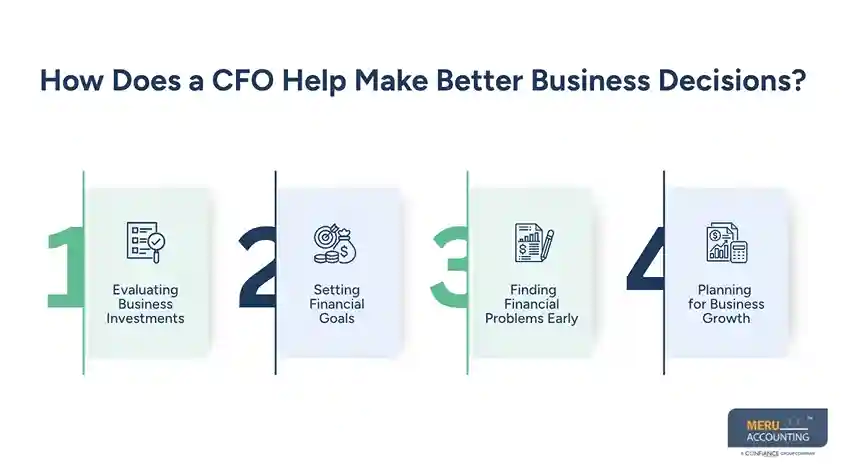
3. Finding Financial Problems Early
A steady rise in expenses or a drop in gross profit margin may point to a problem. A CFO reviews these trends and helps find the cause before the issue grows.
4. Planning for Business Growth
Growth often requires more staff, stock, equipment, or working capital. A CFO estimates these needs and helps decide whether the business can fund them through existing cash, loans, or other sources.
For instance, a retailer planning for a busy holiday season may need to buy more stock months in advance. A CFO can estimate the cash needed and check whether expected sales will cover the cost.
When Does a Small Business Need a CFO?
Not every small business needs a full-time CFO from the start. Many owners can manage early financial needs with a bookkeeper or accountant. However, as a company grows, basic accounting support may no longer be enough.
Here are some signs that it may be time to seek CFO-level support:
- Cash flow is hard to predict: The business earns revenue but often struggles to pay bills on time.
- Costs are rising: Expenses keep growing, but the owner cannot see which areas are reducing profit.
- Growth plans need funding: The company wants to hire, expand, or buy equipment but needs a clear financial plan.
- Reports don’t guide decisions: The business has financial statements but lacks useful insight into what the numbers mean.
- Financial risks are harder to manage: Debt, customer payments, and high costs need closer review.
A small business can choose from three common options:
CFO arrangement | Best suited for |
Full-time CFO | Larger businesses with ongoing and complex financial needs |
Part-time CFO | Companies that need regular financial guidance but not a full-time executive |
Virtual or outsourced CFO | Businesses that want expert financial support through a remote service |
The right choice depends on the company’s needs, budget, and growth plans.
Get Expert Financial Guidance With Meru Accounting's Virtual CFO Services
A business owner shouldn’t have to figure out financial forecasts, profit margins, cash needs, and growth plans alone. These decisions need more than accurate books; they need someone who can interpret the numbers and turn them into a workable financial plan.
At Meru Accounting, our virtual CFO services help businesses get that financial direction without the expense of hiring a full-time CFO. Our support covers the key areas of financial management:
- Financial Planning and Analysis: Review business performance, track profit margins, and identify areas that need attention.
- Budgeting and Forecasting: Build budgets, project future revenue and expenses, and plan for upcoming financial needs.
- Cash Flow Management: Monitor cash movement, identify potential shortfalls, and improve working capital planning.
- Financial Reporting: Prepare and review financial statements to give business owners a clearer picture of their company’s performance.
- Profitability Analysis: Examine costs, margins, and business performance to help identify ways to improve returns.
- Strategic Financial Support: Assess expansion plans, major purchases, funding needs, and other important business decisions.
Want to make your business numbers work harder? Explore Meru Accounting’s virtual CFO services and get financial support that helps you plan, measure, and move forward with confidence.
Our Expert Insight
One thing business owners should consider before expanding is whether their current operations can support that growth. Higher sales don’t always mean a business is ready to open another location, hire more staff, or take on larger orders. These moves can increase fixed costs and put pressure on available capital.
In our experience, a sound expansion plan should account for the break-even point, expected sales, operating costs, and the time needed to recover the initial investment. We also recommend testing a few scenarios, including lower-than-expected sales and higher operating costs, before committing funds. Growth is a good sign, but sustainable growth starts with knowing what your business can afford.
Key Takeaways
- A CFO oversees a company’s financial health and helps guide its financial plans.
- CFO responsibilities include budgeting, forecasting, cash flow management, reporting, and risk control.
- Income statements, balance sheets, and cash flow statements help CFOs assess business performance.
- CFOs use financial data to guide investment, hiring, and growth decisions.
- Small businesses may need CFO support when finances become more complex.
- Virtual CFO services offer access to financial guidance without the cost of a full-time executive.
FAQs
A CFO manages a company’s finances, oversees financial planning, reviews reports, and helps leaders make sound business decisions.
Most CFOs have a degree in finance, accounting, or business. Many also hold a CPA or CMA certification and have years of financial management experience.
Yes. Small businesses can hire a part-time or virtual CFO to get financial guidance without the cost of a full-time executive.
A business should consider hiring a CFO when financial planning, cash flow, budgeting, and growth decisions become too complex to manage with basic accounting support.
A virtual CFO typically provides financial services remotely, while an outsourced CFO is an external professional hired to handle financial leadership. The terms often overlap.
optional anymore
on running the business