A construction estimate is only as good as the numbers behind it. A bid that looks profitable can turn into a poor deal if material orders are too high, equipment sits idle, or crews spend more hours on a task than planned. That’s why construction accounting needs to start well before the first invoice arrives. It helps contractors make sense of project costs, set realistic budgets, and keep financial records tied to the work being done.
The real challenge is not just knowing how much a project costs, but knowing where the money is going and whether the job is still on track to make a profit. From the first purchase order to the final client payment, each financial detail matters. Let’s look at how contractors can manage project costs, control spending, and make better financial decisions throughout a job.
What You Will Learn From This Blog
- How to set a clear budget for each construction project.
- How job costing helps track labor, materials, and other costs.
- Ways to manage cash flow, progress bills, and retainage.
- Which accounting methods and reports matter in construction.
- How accounting tools can help control costs and improve profit.
How to Build an Accurate Construction Project Budget
A sound budget gives a project a clear cost plan before work starts. It sets out how much the firm expects to spend on labor, raw materials, tools, permits, and other needs. A good budget also gives the team a base to check costs as work moves ahead.
Start with the scope of work, plans, and bid details. Break the job into clear tasks, such as site prep, framing, wiring, plumbing, and final work. Then add the cost of each task.
Key costs to include are:
- Labor: Wages, payroll taxes, benefits, and overtime.
- Materials: Cement, steel, wood, pipes, wiring, and other supplies.
- Equipment: Rental fees, fuel, repairs, and upkeep.
- Subcontractors: Fees for trade work and outside crews.
- Site costs: Permits, insurance, waste removal, and site safety.
- Overhead: Office costs, admin pay, and other shared expenses.
It is also wise to set aside a reserve for price hikes, delays, or changes in the work plan. The amount will depend on the job’s size, risk, and scope.
Cost item | Planned cost |
Labor | $45,000 |
Materials | $60,000 |
Equipment | $15,000 |
Subcontractors | $25,000 |
Site and other costs | $10,000 |
Total budget | $155,000 |
This sample budget gives the team a clear cost target. As work moves ahead, compare actual costs with these planned amounts. Any gap should be checked before it grows.
optional anymore
on running the business
How to Track and Control Construction Project Costs
Once work begins, the budget must be checked on a regular basis. A budget alone cannot stop cost overruns. The team needs clear records of what each job spends and why.
Job costing is one of the key parts of construction accounting. It tracks income and costs by job, task, or cost type. This helps owners see how much each project costs and whether it is on track to earn a profit.
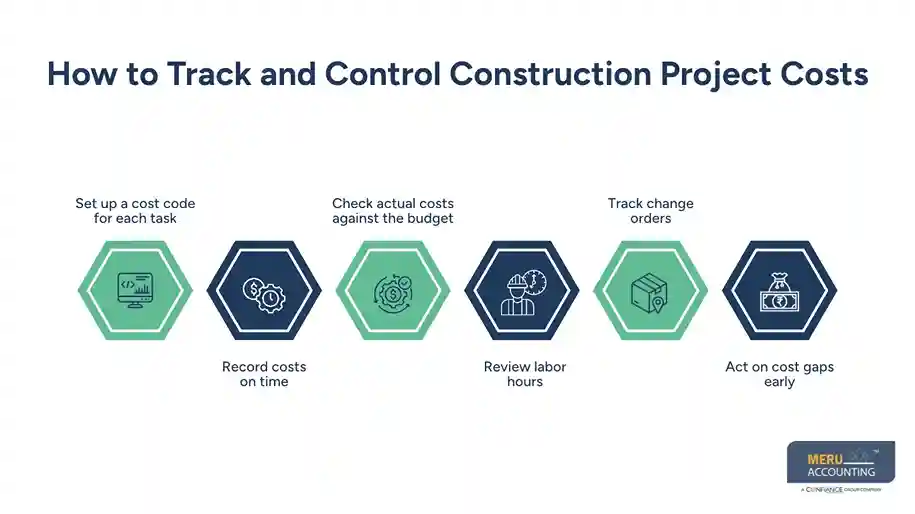
For better cost control, follow these steps:
- Set up a cost code for each task: Use clear codes for labor, materials, tools, and subcontractors.
- Record costs on time: Log bills, time sheets, purchase orders, and tool use as they come in.
- Check actual costs against the budget: Review the gap between planned and actual spend.
- Review labor hours: Check if crews are using more hours than planned.
- Track change orders: Record any change in the work scope, price, or time frame.
- Act on cost gaps early: Find the cause and adjust the plan before the loss grows.
For example, if a firm sets aside $20,000 for labor but spends $24,000, it has a $4,000 cost overrun. The project lead should check if the gap came from overtime, low output, rework, or poor labor planning.
Good job costing helps firms spot such issues early. It also makes it easier to price new bids based on past job data.
How to Manage Construction Cash Flow and Working Capital
Profit and cash flow are not the same. A firm may show a profit on its books but still lack cash to pay workers, vendors, or trade partners. This often happens when clients pay late or hold back part of the bill until the job is done.
Strong cash flow planning is a key part of accounting for construction companies. It helps firms plan when cash will come in and when bills must be paid.
Here are some ways to keep cash flow on track:
- Plan cash needs by job stage: Map out when you need funds for labor, supplies, and other costs.
- Send progress bills on time: Bill clients as work is done, based on the terms of the contract.
- Follow up on unpaid bills: Review past-due accounts and contact clients before delays grow.
- Track retainage: Keep a record of the amount held back by clients and its due date.
- Plan vendor payments: Set pay dates based on cash needs and agreed terms.
- Keep a cash reserve: Hold enough funds to cover key costs during slow payment cycles.
Retainage needs close care. For example, if a client holds back 10% of a $100,000 bill, the firm gets $90,000 at first. The other $10,000 may not come in until the work meets the terms of the contract.
A cash flow report can help owners see shortfalls before they become a problem. It also helps them plan when to seek a credit line or adjust the timing of costs.
Construction Accounting Methods for Accurate Financial Reporting
Construction jobs may last for months or years. This makes it hard to report income and costs in the same way as a firm that sells goods each day. The right accounting method helps show how a job is doing over time.
Two key methods used in construction are:
Percentage-of-Completion Method
This method records income and costs as work moves ahead. The firm reports a share of the contract value based on the work done to date. It can give a better view of long jobs when the firm can make sound cost estimates and meets the rules for using this method.
Completed-Contract Method
This method records income and related costs when the job is done, subject to the rules that apply. It may suit some short-term jobs or firms that meet the right tax and reporting rules.
Firms also need to know the difference between cash and accrual accounting.
Method | How it works |
Cash basis | Records income and costs when cash is received or paid. |
Accrual basis | Records income when earned and costs when incurred. |
Percentage of completion | Reports income and costs as work is done. |
Completed contract | Reports income and costs when the job is complete. |
These methods do not all serve the same purpose. Cash and accrual basis relate to when items are recorded, while the other two relate to how long-term contract income is reported.
The choice can affect tax, profit reports, and the way owners view job results. Firms should work with a qualified CPA to select a method that fits their contracts and meets the rules set by the IRS and other bodies.
How to Use Work-in-Progress (WIP) Reports to Monitor Project Financial Health
A Work-in-Progress (WIP) report shows how much work a firm has done, how much it has billed, and how much it has earned on open jobs. It is a useful tool for firms that handle long-term contracts.
A WIP report often tracks:
- Total contract value.
- Approved change orders.
- Estimated total job costs.
- Costs incurred to date.
- Billings to date.
- Revenue earned to date.
- Expected profit or loss.
One key use of a WIP report is to spot overbilling and underbilling.
Overbilling occurs when the firm has billed more than the revenue earned based on work done. It can help cash flow in the short term, but the firm still has work to finish.
Underbilling occurs when the firm has earned more revenue than it has billed. This can put pressure on cash flow because the firm has done the work but has not yet billed for it.
For example, a firm has earned $60,000 in revenue on a job but has billed only $50,000. It has $10,000 in underbilling. The team should check why the bill is behind and send it if the contract allows.
WIP reports also help owners spot jobs with low margins, rising costs, or poor billing plans. They should be checked each month, not just at year-end.
How Construction Accounting Software Improves Project Cost Management
When a firm runs many jobs, manual records can lead to errors, delays, and missed costs. Construction accounting software can help bring job costs, bills, payroll, and reports into one system.
Key features to look for include:
- Job costing: Track costs by job and cost code.
- Budget tracking: Compare planned costs with actual spend.
- Bill and payment tracking: Keep vendor bills and client payments in one place.
- Payroll links: Assign labor costs to the right jobs.
- WIP reports: Review job progress and billing gaps.
- Financial reports: Build reports to check profit and cash flow.
The right tool depends on the firm’s size, job type, and workflow. Some firms may need a full construction system, while others may use an accounting platform with job cost tools.
Software can make records easier to manage, but it cannot replace sound review. Teams still need to check data, match bills to jobs, and review cost estimates as work changes.
Construction Accounting Services by Meru Accounting
A construction job can have dozens of cost entries, from material orders and crew wages to equipment rentals and subcontractor bills. The challenge is making sure every expense reaches the right job and that the numbers in your reports reflect the actual progress of the work. At Meru Accounting, we help construction businesses bring these financial details together through reliable construction accounting and bookkeeping support.
Our services are designed to help contractors maintain accurate project records, review costs, and make informed financial decisions. Depending on your business needs, our team can assist with:
- Job Costing and Budget Tracking: Record labor, material, equipment, and subcontractor costs by project. Compare actual spending with budget estimates to help identify cost gaps.
- Accounts Payable and Receivable: Track vendor bills, subcontractor payments, client invoices, and outstanding balances.
- Payroll and Labor Cost Accounting: Maintain payroll records and assign labor costs to the right projects.
- WIP Reporting and Financial Statements: Prepare work-in-progress reports and monthly financial reports to help assess job performance and financial position.
- Bank Reconciliation and Account Review: Match transactions, check account balances, and help keep financial records accurate.
- Bookkeeping Cleanup and Catch-Up: Organize incomplete records, correct posting errors, and bring overdue accounts up to date.
Whether you need help tracking costs across active jobs, preparing monthly WIP reports, or managing your complete accounting function, Meru Accounting provides dedicated support at a fraction of the cost of an in-house US team. This gives you better financial visibility without the added cost of building a large internal accounting department.
Our Expert Insight
One detail contractors should never overlook is the cost of work that has been completed but not yet billed. For example, a subcontractor may have finished a major part of a job, but the invoice may not arrive until the following month. If that cost is missing from the current records, the project may appear more profitable than it really is. The same issue can arise with pending material bills, equipment charges, and other expenses.
We recommend reviewing open purchase orders, subcontractor commitments, and pending invoices as part of each month-end close. These costs should be considered when updating the estimated cost to complete each job. This gives contractors a more realistic view of expected profit and helps prevent unexpected losses when the final bills come in.
Key Takeaways
- Build a clear budget before work starts and include all direct and shared costs.
- Use job costing to track labor, materials, tools, and trade partner fees.
- Compare actual costs with planned costs on a set basis.
- Plan cash flow around progress bills, retainage, and vendor payments.
- Use the right accounting method for long-term jobs and reporting needs.
- Review WIP reports to spot billing gaps and job losses early.
- Use monthly reports to check both job-level and firm-wide results.
- Use accounting tools and skilled support to keep records clear and costs in check.
FAQs
Construction accounting covers job costing, payroll, progress billing, retainage, accounts payable, and financial reporting for construction projects.
They add labor, materials, equipment, subcontractor fees, and overhead to determine the total cost of a project.
Accrual accounting is often preferred because it records income when earned and expenses when incurred. The right method also depends on tax rules and contract type.
A WIP schedule tracks project costs, earned revenue, and billings. It helps contractors identify underbilling, overbilling, and potential losses.
It helps contractors monitor job costs, review profit margins, track contract changes, and identify financial problems before they grow.
optional anymore
on running the business