A vendor sends an invoice for $3,500. The goods have arrived, the invoice is approved, but the payment isn’t due for another 30 days. For the accounting team, this is more than an unpaid bill. It’s an example of accounts payable that needs to be recorded, tracked, and cleared at the right time.
Not all payables come from buying goods. A business may also owe money for software, repairs, legal work, shipping, or office rent. Each transaction has its own accounting treatment, and knowing where these amounts belong helps keep financial records accurate. Let’s look at 15 common accounts payable transactions, along with their journal entries and balance sheet treatment.
What You Will Learn From This Blog
- What accounts payable means and how it works in business.
- How to identify and record an accounts payable transaction.
- 15 common examples of accounts payable across business activities.
- How journal entries show purchases and vendor payments.
- How accounts payable appears on a balance sheet.
- How to calculate and review accounts payable balances.
- How proper AP management helps prevent errors and late payments.
What Is Accounts Payable in Accounting?
Accounts payable (AP) is the money a business owes to vendors and suppliers for goods or services bought on credit. It is a short-term liability because most vendor bills are due within one year, often within 30, 60, or 90 days.
For example, a company buys $5,000 worth of raw materials from a supplier and gets an invoice due in 30 days. The company records $5,000 in accounts payable until it pays the supplier.
Accounts payable are listed under current liabilities on the balance sheet. It is not the same as an expense. The expense or asset records what the business bought, while accounts payable records the unpaid amount owed to the vendor.
For example, when a company buys office supplies on credit, it records an office supplies expense and a matching AP liability. When it pays the bill, the AP balance goes down.
optional anymore
on running the business
How to Identify an Accounts Payable Transaction
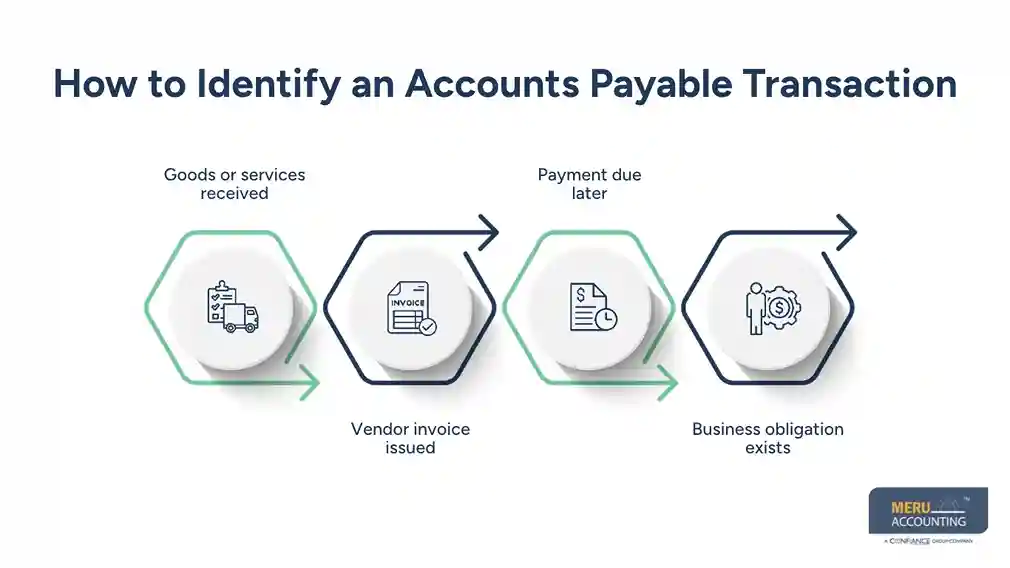
Not every business expense is an account payable. A transaction becomes accounts payable when a business receives goods or services on credit and has an obligation to pay a vendor.
Here are the main signs of an AP transaction:
- Goods or services received: The business has received the items or services it ordered.
- Vendor invoice issued: The supplier sends a bill with the amount due and payment terms.
- Payment due later: The business does not pay at the time of purchase.
- Business obligation exists: The company must pay the vendor under the agreed terms.
A purchase paid for at once with cash or a debit card does not create an AP balance. It is recorded as a cash payment instead.
15 Common Examples of Accounts Payable in Business
Businesses can have many types of unpaid bills. The following examples of accounts payable show how common purchases and services create short-term liabilities.
No. | Transaction | Example amount | Why it is accounts payable |
1 | Office supplies | $800 | Supplies bought on credit |
2 | Inventory purchases | $6,000 | Goods bought for resale |
3 | Office rent | $2,500 | Rent billed for later payment |
4 | Utility bills | $450 | Electricity or water bill due |
5 | Internet and phone bills | $180 | Monthly service invoice |
6 | Contractor payments | $1,200 | Work completed but not yet paid |
7 | Shipping charges | $650 | Delivery service billed later |
8 | Equipment purchases | $4,000 | Equipment bought on credit |
9 | Marketing services | $1,500 | Agency invoice due later |
10 | Software licenses | $300 | Software bill with deferred payment |
11 | Raw materials | $8,000 | Production materials bought on credit |
12 | Repairs and maintenance | $700 | Repair work completed but unpaid |
13 | Legal and accounting fees | $2,000 | Professional services billed later |
14 | Insurance premiums | $900 | Premium billed for later payment |
15 | Travel and lodging | $1,100 | Business travel costs billed later |
Note: These are illustrative amounts. Actual AP treatment depends on the invoice, contract, payment terms, and accounting policy.
1. Office Supplies Purchased on Credit
A business orders $800 worth of paper, ink, and other office supplies from a vendor. The vendor sends an invoice due in 30 days. The business records an $800 supplies expense and an $800 AP liability.
2. Inventory Purchased From Suppliers
A retailer buys $6,000 worth of goods for resale and agrees to pay the supplier within 45 days. The inventory is recorded as an asset, while the unpaid amount is added to accounts payable.
3. Unpaid Office Rent
A company receives a $2,500 rent invoice for its office space. If the amount is due later, the business records the rent cost and the related AP balance.
4. Electricity and Water Bills
A company receives a $450 utility bill for electricity and water used during the month. Since the payment is due next month, the amount is recorded as a utility expense and an AP liability.
5. Internet and Telephone Bills
A business gets a monthly invoice of $180 from its internet and phone provider. If the company has not paid the bill yet, it records the amount as a payable.
6. Outstanding Contractor Payments
A business hires a contractor to complete a project for $1,200. The work is done, and the contractor sends an invoice with 15-day payment terms. The unpaid invoice is recorded as an AP liability.
7. Transportation and Shipping Charges
A retailer receives a $650 invoice from a shipping company for product deliveries. The delivery service has been used, but payment is due later. The amount is recorded as a shipping cost and accounts payable.
8. Equipment Purchased on Credit
A company buys office equipment worth $4,000 and agrees to pay the vendor in 30 days. The equipment is recorded as a fixed asset, while the unpaid amount is recorded under AP.
9. Marketing and Advertising Services
A business hires a marketing agency for a $1,500 campaign. After the work is completed, the agency sends an invoice. Until the business pays it, the amount remains payable.
10. Software Subscriptions and Licenses
A company receives a $300 invoice for its monthly software licenses. If the provider allows payment at a later date, the unpaid invoice is recorded as accounts payable.
11. Raw Material Purchases
A manufacturer buys $8,000 worth of raw materials from a supplier on credit. The materials are added to inventory, and the amount owed is recorded as a liability.
12. Maintenance and Repair Services
A business hires a service provider to repair its office equipment for $700. The provider completes the work and sends an invoice due in 30 days. The business records the repair cost and AP balance.
13. Legal and Accounting Fees
A company receives a $2,000 invoice from its legal or accounting firm for professional services. Since the payment is due later, the unpaid amount is recorded as accounts payable.
14. Unpaid Insurance Premiums
A business receives an insurance premium invoice for $900. If the premium is due but has not been paid, the business records the amount as payable, subject to the terms and coverage period.
15. Business Travel and Accommodation Invoices
A company books $1,100 in hotel stays and travel services through a corporate vendor account. The vendor sends an invoice for later payment. The amount becomes an AP liability once the service has been received and the obligation is due.
How to Record Accounts Payable: Journal Entry Examples
Recording AP involves two main steps: entering the vendor bill and recording the payment. The debit and credit entries depend on what the business buys.
Example 1: Recording a Vendor Invoice
A company buys $2,000 in office supplies on credit.
Account | Debit | Credit |
Office Supplies Expense | $2,000 | — |
Accounts Payable | — | $2,000 |
The expense increases with a debit, while accounts payable increases with a credit.
Example 2: Paying the Vendor
The company pays the $2,000 invoice by bank transfer.
Account | Debit | Credit |
Accounts Payable | $2,000 | — |
Cash/Bank | — | $2,000 |
The debit reduces the amount owed, and the credit reduces the cash balance.
Example 3: Recording a Vendor Credit
A supplier issues a $300 credit for damaged goods previously purchased on credit.
Account | Debit | Credit |
Accounts Payable | $300 | — |
Inventory or Purchase Returns | — | $300 |
The credit reduces the amount owed to the supplier. The other account depends on how the original purchase was recorded.
How to Calculate Accounts Payable: Practical Examples
Businesses can use a simple formula to find their ending AP balance:
Ending Accounts Payable = Beginning AP + Credit Purchases − Payments − Vendor Credits
For example, assume a business has:
- Beginning AP: $10,000
- Credit purchases: $15,000
- Payments to vendors: $12,000
- Vendor credits: $1,000
Ending AP = $10,000 + $15,000 − $12,000 − $1,000
Ending accounts payable
$12,000
The amount the business still owes its vendors.
Accounts Payable Balance Sheet Examples
Here is a simple example of how AP appears on a balance sheet when a business has $12,000 in unpaid vendor bills.
Balance sheet item | Amount |
Current Assets | |
Cash and cash equivalents | $20,000 |
Accounts receivable | $15,000 |
Inventory | $25,000 |
Total Assets | $60,000 |
Current Liabilities | |
Accounts payable | $12,000 |
Short-term loans | $8,000 |
Accrued expenses | $5,000 |
Total Liabilities | $25,000 |
Equity | $35,000 |
Total Liabilities and Equity | $60,000 |
These accounts payable balance sheet examples show that AP is part of current liabilities, not assets. The business has $12,000 in unpaid bills that it must settle with vendors.
Accounts Payable Services by Meru Accounting
A $500 utility bill and a $15,000 inventory invoice shouldn’t follow the same accounting treatment. One may be recorded as an operating expense, while the other affects inventory and the cost of goods sold when items are sold. Getting these details right is part of managing accounts payable, not just entering bills into accounting software.
At Meru Accounting, our outsourced accounts payable services cover the accounting work behind vendor transactions, including:
- Invoice Review and Entry: Check vendor invoices against purchase orders, receipts, and agreed terms before entering bills into the books.
- AP Coding and Classification: Assign expenses, inventory purchases, equipment, and service costs to the right accounts.
- Vendor Account Reconciliation: Compare supplier statements with recorded invoices, credits, and payments to find missing bills or duplicate entries.
- Payment Due Date Tracking: Maintain payment schedules and outstanding invoice records so businesses can plan upcoming cash needs.
- AP Aging and Reporting: Prepare aging reports that show current, overdue, and upcoming vendor balances.
- Month-End AP Reconciliation: Review AP balances and supporting records to help ensure liabilities are reported in the correct accounting period.
Our team brings hands-on experience across different industries and accounting systems. We focus on the details behind each transaction, from the initial invoice entry to the final payment record, with review checks to support accurate books and reliable financial reports.
Our Expert Insight
One detail that often gets missed is how vendor credits affect the true cost of a purchase. For example, a retailer buys $10,000 in inventory but later receives a $1,500 credit for damaged goods. If that credit isn’t recorded, both the inventory cost and the amount owed to the supplier may be overstated.
We advise looking beyond the original invoice when reviewing purchase records. Discounts, returns, credit memos, and pricing adjustments can all change the final amount a business owes. This level of detail makes a real difference in keeping financial statements accurate.
Key Takeaways
- Accounts payable is the money a business owes vendors for purchases made on credit.
- A common example of accounts payable is an unpaid supplier invoice.
- AP can include inventory, rent, utilities, equipment, and professional service bills.
- Accounts payable increases with a credit and decreases with a debit.
- AP appears under current liabilities on the balance sheet.
- Regular invoice checks and vendor reconciliations help reduce errors and late payments.
FAQs
A business buys $2,000 worth of office supplies on credit and gets 30 days to pay. The unpaid $2,000 is recorded as accounts payable.
Common examples include supplier invoices, inventory purchases, utility bills, office rent, contractor fees, and professional service bills.
Yes. Once a business receives a utility invoice, the unpaid amount can be recorded as accounts payable. If the bill hasn’t arrived, the cost may be recorded as an accrued expense.
Accounts payable represents money owed to vendors. Since these bills are generally due within the normal operating cycle or 12 months, they appear under current liabilities.
Use this formula:
Ending AP = Beginning AP + Credit Purchases − Payments − Vendor Credits
For example, $8,000 + $12,000 − $9,000 − $1,000 = $10,000.
optional anymore
on running the business