A supplier sends a statement showing an unpaid invoice, but the finance team has already made the payment. Another invoice appears twice in the accounting system, while a credit note remains unrecorded. Such issues can affect cash flow, vendor trust, and financial reports. Accounts payable reconciliation is the process of checking vendor statements against internal payment and invoice records to find and correct these differences. A regular review gives finance teams a clear view of what the business owes, what it has paid, and which amounts still need attention.
What You Will Learn From This Blog
- The meaning and main steps of accounts payable reconciliation.
- Key benefits for payment control, financial reports, and vendor relations.
- Common errors and ways to resolve differences in vendor records.
- Best practices for monthly accounts payable reconciliation.
- Journal entries for invoices, payments, credit notes, and corrections.
- How automation can reduce manual work and payment errors.
What is Accounts Payable Reconciliation?
Accounts payable reconciliation is the process of comparing a company’s accounts payable ledger with vendor statements, invoices, credit notes, and payment records. The aim is to confirm that both sides show the correct outstanding amount.
For example, a vendor statement may show an amount of $5,000, while the company’s ledger shows $6,000. The $1,000 difference could be due to an unrecorded payment, a missing credit note, or an invoice that has not been entered.
The finance team should follow a monthly accounts payable reconciliation schedule to identify differences and verify supplier balances before making any changes. This process also forms part of the wider accounts payable control system, as it keeps supplier balances accurate and reduces the risk of paying the wrong amount.
How Does the Accounts Payable Reconciliation Process Work?
A clear process gives finance teams a set method to check vendor balances, find errors, and close open items. Each stage must be backed by source records and a review trail.
Collecting Vendor Statements and Internal AP Records
During monthly accounts payable reconciliation, the first step is to gather vendor statements, purchase invoices, payment records, credit notes, and the accounts payable ledger. The team must check that all records cover the same period and vendor account.
Matching Invoices With Purchase Orders and Payment Records
Each invoice should be checked against its purchase order, goods receipt, and payment record. The team must verify the invoice number, date, amount, tax, and terms before marking it as matched.
Identifying and Investigating Discrepancies
Any gap between the vendor statement and internal ledger must be listed for review. The team should check for missing invoices, duplicate entries, short payments, bank delays, and unrecorded credits.
Recording Adjustments and Resolving Outstanding Differences
Once the cause is known, the finance team can record the required correction. For example, a missing invoice may need to be entered, while an incorrect payment entry may need a reversal and a fresh posting.
Reviewing and Approving Reconciled Accounts
A senior team member should review the matched records, open items, and adjustment entries. The reviewer must confirm that each change has valid proof and that no amount has been changed without approval.
Key Benefits of Accounts Payable Reconciliation
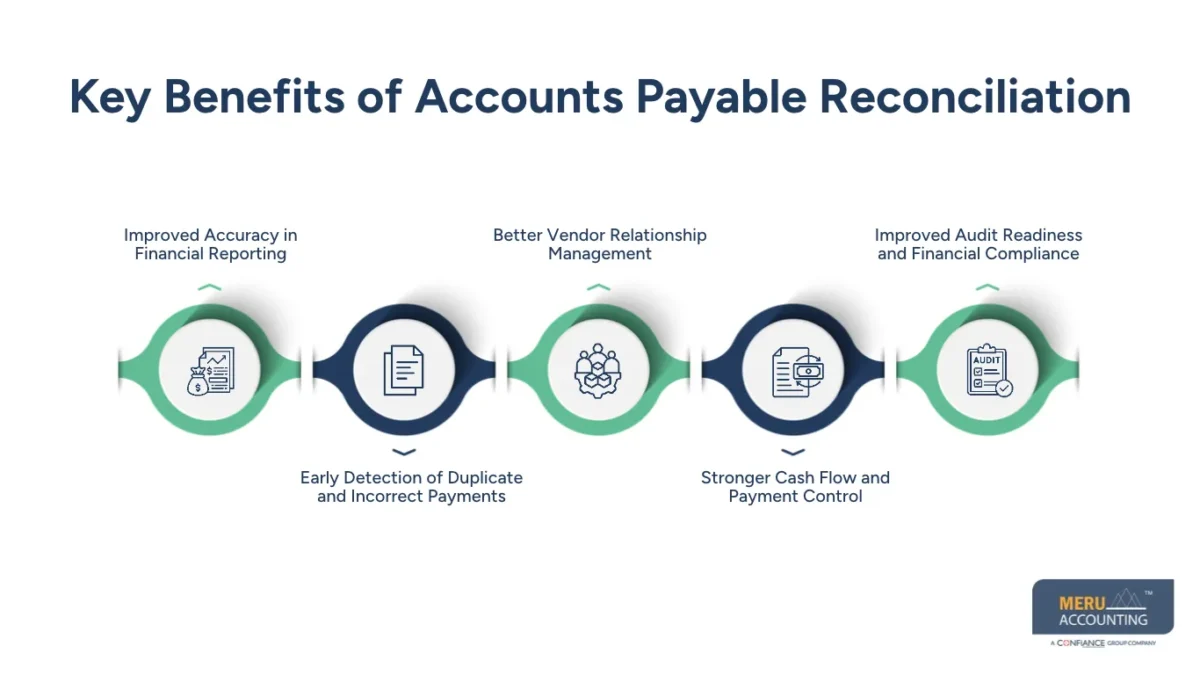
Regular accounts payable reconciliation gives businesses a clearer view of supplier dues and payment activity. It also sets better controls over daily finance work and month-end reporting.
Improved Accuracy in Financial Reporting
Correct vendor balances lead to more accurate balance sheets and expense reports. The finance team can report current liabilities with fewer errors, while managers can make decisions using figures that match the source records.
Early Detection of Duplicate and Incorrect Payments
A review of invoices and payment records can reveal the same bill entered more than once. It can also show wrong amounts, extra charges, or payments sent to the wrong vendor before these issues grow.
Better Vendor Relationship Management
Vendors may raise concerns when their statements show unpaid bills that the company has already settled. Timely checks allow the finance team to share payment proof, clear open queries, and avoid repeated disputes.
Stronger Cash Flow and Payment Control
Monthly accounts payable reconciliation also allows finance teams to review upcoming supplier payments and adjust payment schedules according to available cash. It can plan payment dates, avoid paying the same invoice twice, and make use of valid credit terms.
Improved Audit Readiness and Financial Compliance
A complete record of invoices, payments, approvals, and corrections makes audit checks easier. It also gives reviewers a clear trail of how each vendor balance was checked and approved.
Common Accounts Payable Reconciliation Challenges and How to Resolve Them
Even firms with clear payment rules can face errors when records are late, incomplete, or entered in the wrong account. Finding the source of each difference is more useful than making a quick adjustment.
Missing or Incorrect Vendor Invoices
A vendor may send an invoice late, or the finance team may enter the wrong date, tax, or amount. The team should request the original invoice and compare it with the purchase order and receipt before posting it.
Duplicate Payments and Invoice Entries
Duplicate entries may occur when the same invoice is sent by email and entered again by another team member. Use invoice numbers, vendor IDs, and amount checks to find repeat records before payment approval.
Differences Between Vendor Statements and Internal Records
A vendor may record a bill before the company receives it, or the two sides may use different cut-off dates. Compare transaction dates and request proof for each unmatched item instead of changing the ledger without review.
Unrecorded Payments and Outstanding Credits
A payment may be missing from the vendor account due to a posting delay, while a credit note may not have reached the accounts team. Check bank records and vendor documents, then post the valid missing items.
Manual Data Entry Errors and Delayed Reconciliation
Typing errors, wrong account codes, and late entries can leave supplier balances incorrect. Use standard entry rules, clear review duties, and a fixed check schedule to reduce these issues.
optional anymore
on running the business
Monthly Accounts Payable Reconciliation: Best Practices for Accurate Financial Records
Monthly accounts payable reconciliation gives finance teams a fixed time to review supplier balances and clear open items. A set routine also makes it easier to spot old invoices and payment errors before the next reporting period.
Establishing a Consistent Monthly Reconciliation Schedule
Set a fixed date for collecting statements and checking vendor balances. Assign each vendor account to a team member and set a clear due date for completing the review.
Reviewing Vendor Statements Against Accounts Payable Ledgers
Compare each vendor statement with the internal ledger for the same period. Check opening balances, new invoices, payments, credit notes, and closing balances to find any gaps.
Checking Unpaid Invoices and Outstanding Balances
Review all unpaid bills and confirm their due dates, amounts, and approval status. Separate valid unpaid invoices from bills under dispute so the payment plan reflects the actual amount due.
Investigating Unmatched Transactions
Prepare a list of all items that do not match and note the reason for each difference. Contact vendors when documents are missing and check bank records when payment dates or amounts do not agree.
Documenting Adjustments and Completing Month-End Reviews
Keep copies of statements, invoices, payment proof, and approved journal entries. A reviewer should sign off on the final balance and carry unresolved items into the next month’s review.
Accounts Payable Reconciliation Journal Entries and Accounting Treatment
Journal entries record the effect of vendor bills, payments, credits, and corrections on the company’s accounts. The following examples use a simple case with a $1,000 purchase before tax. Actual entries may differ based on tax rules, inventory methods, and the company’s accounting policy.
Recording Vendor Invoice Entries
When a business receives and approves a vendor invoice for goods worth $1,000, it records the expense or inventory and the amount due to the vendor.
Journal entry:
Account | Debit | Credit |
Purchases / Inventory | $1,000 | — |
Accounts Payable | — | $1,000 |
Recording Payments Made to Vendors
When the business pays the full $1,000 invoice, it reduces the amount due and records the cash outflow from its bank account.
Journal entry:
Account | Debit | Credit |
Accounts Payable | $1,000 | — |
Bank | — | $1,000 |
Adjusting Entries for Invoice and Payment Differences
Suppose a vendor invoice was entered at $1,000, but the approved bill should have been $1,100. The additional $100 must be recorded after checking the supporting invoice.
Journal entry:
Account | Debit | Credit |
Purchases / Expense | $100 | — |
Accounts Payable | — | $100 |
Recording Credit Notes and Purchase Returns
If a vendor issues a $200 credit note for returned goods, the company must reduce its payable balance and reverse the related purchase or inventory cost.
Journal entry:
Account | Debit | Credit |
Accounts Payable | $200 | — |
Purchase Returns / Inventory | — | $200 |
Handling Duplicate Payments and Reversal Entries
If a business pays the same $1,000 invoice twice, the extra payment must be recorded as a vendor receivable or amount recoverable until the vendor refunds it or applies it to a future bill.
Journal entry for the extra payment:
Account | Debit | Credit |
Vendor Receivable | $1,000 | — |
Bank | — | $1,000 |
The finance team should not remove the payment entry without proof. The refund or future adjustment must also be recorded when it takes place.
How Automation Improves the Accounts Payable Reconciliation Process
Automation can reduce the time spent on repeat checks and data entry. It also gives finance teams a clearer view of unmatched invoices, pending payments, and open vendor balances.
Automated Invoice Matching and Data Extraction
AP software can read invoice details such as vendor names, invoice numbers, dates, and amounts. It can then compare these details with purchase orders and receipt records, while sending unmatched bills for review.
Real-Time Transaction Tracking and Reconciliation
Software linked with bank and accounting records can show payment status as transactions are posted. This gives the finance team a current view of paid bills, pending payments, and open balances during monthly accounts payable reconciliation.
Duplicate Payment Detection and Error Alerts
Automation tools can flag invoices with repeated numbers, similar amounts, or matching vendor details. Alerts give the team a chance to review a bill before it moves to payment approval.
Integration With Accounting Software and ERP Systems
A link between AP tools, accounting software, and ERP systems can reduce the need to enter the same data in different places. The team must still check that account codes and vendor details match across systems.
Automated Reconciliation Reports and Audit Trails
Software can create reports that show matched items, open differences, and approved changes. It can also store user actions and approval dates, giving auditors a clear record to review.
Accounts Payable Reconciliation Checklist for Finance Teams
Finance teams can use this checklist before closing the monthly review:
- Collect vendor statements for the full review period.
- Download the latest accounts payable ledger.
- Match invoices with purchase orders and receipt records.
- Check payment dates and bank entries.
- Find duplicate invoices and payment records.
- Review outstanding credit notes and purchase returns.
- List and investigate all unmatched transactions.
- Record approved corrections with source documents.
- Get a second-level review of key balances and adjustments.
- Save the final reports and carry forward open items.
Meru Accounting's Accounts Payable Reconciliation Services
Managing vendor bills, payment records, and month-end checks can take up a large part of an in-house finance team’s time. Meru Accounting provides accounts payable services for businesses that need a clear process for invoice checks, vendor account reviews, and payment records.
Our team follows a structured process that covers:
- Vendor statement checks against internal AP ledgers.
- Invoice matching and review of purchase records.
- Identification of duplicate bills and payment differences.
- Review of unpaid invoices and outstanding credit notes.
- Posting and review of approved adjustments.
- Month-end reports and records for audit checks.
Meru Accounting follows defined review steps and uses accounting software to maintain clear records. Each business can set the scope of work based on its vendor count, transaction volume, and reporting needs.
Our Expert Perspective
One issue that often gets overlooked in accounts payable reconciliation is the gap between payment records and vendor statements. A payment may have left the company’s bank account, but the vendor may not have updated the account yet. Similarly, a credit note may be issued but remain missing from the internal ledger. These small gaps can create confusion during monthly accounts payable reconciliation and month-end closing.
From an accounting perspective, matching the final balance is not enough. Finance teams should also understand why a difference occurred and whether the same issue could happen again. We believe that a useful reconciliation process must focus on the reason behind each mismatch, not just correcting the figures. This approach gives businesses better control over vendor payments and more reliable financial records.
Key Takeaways
- Accounts payable reconciliation checks vendor statements against internal invoices, payments, and credit records.
- Regular reviews reduce duplicate payments and errors in supplier balances.
- Monthly accounts payable reconciliation gives finance teams a set routine for month-end checks.
- Journal entries must reflect the actual invoice, payment, credit, or correction.
- Automation can speed up invoice matching and flag errors for review.
- A clear audit trail is needed for each adjustment and approval.
- Human review remains important even when reconciliation software is in use.
FAQs
Accounts payable reconciliation involves collecting vendor statements, matching invoices with payment records, finding differences, recording corrections, and reviewing final balances.
Vendor statements, purchase orders, supplier invoices, goods receipt notes, payment records, credit notes, and accounts payable ledgers are the main documents required.
Vendor reconciliation compares a specific supplier’s account with the company’s records, while accounts payable reconciliation reviews outstanding balances across supplier accounts.
Reconciliation adjustments are recorded by debiting or crediting accounts payable and the related expense, inventory, bank, or vendor receivable account.
QuickBooks, Xero, NetSuite, and SAP are commonly used for invoice matching, payment tracking, vendor balance checks, and accounts payable reporting.
optional anymore
on running the business