The penalty for filing taxes late is a common concern among US taxpayers who miss an IRS deadline. However, taxpayers expecting a refund are treated differently from those who owe additional tax. The IRS generally calculates the failure-to-file penalty on unpaid tax after eligible payments and credits, not on total income or the expected refund.
For example, if your tax liability is $4,000 and your employer has already withheld $4,800, you may qualify for an $800 refund. In this situation, the standard failure-to-file penalty is generally zero. Still, filing late can delay your refund or cause you to miss the legal deadline for claiming it.
Understanding the penalty for filing taxes late is important because filing and payment are separate tax duties. This article explains IRS rules, penalty calculations, refund delays and available relief.
What You Will Learn From This Blog
- When the IRS charges a penalty for filing taxes late.
- Why taxpayers expecting a refund generally avoid the standard failure-to-file penalty.
- How to calculate IRS late filing penalties using unpaid tax and monthly rates.
- How late filing affects refunds, interest and IRS notices.
- Which penalty relief options are available to eligible taxpayers.
Understanding the Penalty for Filing Taxes Late
The penalty for filing taxes late is generally a charge for failing to submit a required federal tax return by its due date or approved extended deadline. For most individual returns, the standard rate is 5% of unpaid tax for each month or part of a month, up to 25%.
What Makes a Tax Return Late?
A return is late when it reaches the IRS after the applicable filing deadline. An approved extension changes the filing date, but the original payment deadline remains unchanged. The penalty for filing taxes late depends on the return type and the amount of tax unpaid.
How Does the IRS Determine Unpaid Tax?
The IRS subtracts withholding, estimated payments and allowed refundable credits from the tax required to be shown on the return. The remaining amount is generally used to calculate the failure-to-file charge and determine how to calculate IRS late filing penalties. This is why an accurate payment record matters.
Does Every Late Return Result in a Penalty?
No. If eligible payments and credits cover the full tax liability, the standard failure-to-file penalty is generally zero. However, separate penalties may apply to payroll, information and certain business returns.
Filing Deadline Versus Payment Deadline
The filing deadline is the date by which a taxpayer must submit the return. The payment deadline is the date by which the tax owed must be paid. A filing extension does not extend the payment deadline.
Why Should You File When Expecting a Refund?
A taxpayer must submit a return to claim an eligible refund. The general refund claim period is three years from filing or two years from payment, whichever is later. The penalty for filing taxes late may be zero, but delaying a refund claim can still result in lost money.
Do You Pay a Penalty for Filing Taxes Late If You Expect a Tax Refund?
Generally, no. The IRS does not charge the standard failure-to-file penalty when eligible payments and refundable credits cover the full tax liability. Therefore, taxpayers expecting a genuine refund usually do not face the standard penalty for filing taxes late.
When Your Tax Payments Exceed Your Liability
Suppose your final tax liability is $4,500, while your employer has withheld $5,200 throughout the year. Your return shows a $700 refund and no unpaid tax. The standard failure-to-file penalty is generally zero, even if you submit the return after the deadline.
When Your Final Return Shows Unpaid Tax
Suppose your tax liability is $5,700, but your payments total only $5,200. You now have $500 in unpaid tax. If you file after the deadline, the IRS may charge failure-to-file and failure-to-pay penalties, along with interest.
Can the IRS Reduce Your Refund?
Yes. The IRS may use a refund to pay certain outstanding obligations, including federal tax debts, qualifying state tax debts and past-due child support. This may reduce the amount deposited into your bank account, but it is not a failure-to-file penalty.
Can a Late Return Delay Your Refund?
Yes. The IRS must receive and process your return before issuing the refund. Missing information, identity checks and errors can increase processing time. You can check your refund through the official Where’s My Refund? service.
Does Expecting a Refund Remove Every Filing Obligation?
No. Some taxpayers must file even when they expect a refund. Business reporting duties and other tax forms may have separate deadlines and penalties. Always check the requirements for the specific return.
optional anymore
on running the business
IRS Late Filing Penalties: When Do They Apply?
The IRS has separate charges for late filing, late payment and unpaid tax interest. The penalty for filing taxes late is different from the charge for failing to pay the tax by the original deadline.
Failure-to-File Penalty
The standard failure-to-file penalty is 5% of unpaid tax for each month or part of a month, up to 25%. It generally does not apply when the unpaid tax balance is zero. Special minimum rules may apply to certain returns filed more than 60 days late.
Failure-to-Pay Penalty
The standard failure-to-pay rate is 0.5% of unpaid tax for each month or part of a month, up to 25%, which is an important factor in understanding how to calculate IRS late filing penalties. Eligible individuals with an approved installment agreement who filed on time may qualify for a reduced rate of 0.25% per month.
Interest on Unpaid Tax
The IRS charges interest on unpaid tax from the original payment deadline until the balance is paid. For individuals, the rate is generally the federal short-term rate plus three percentage points. Interest compounds daily and changes with quarterly IRS rate updates.
Difference Between Both Penalties
Failure to file means missing the return deadline, while failure to pay means not paying the tax by its due date. When both apply during the same month, the combined standard rate is generally 5%, not 5.5%, which is an important distinction in how to calculate IRS late filing penalties.
When Different Penalty Rules Apply
The penalty for filing taxes late under these rates generally applies to common individual income tax returns. Payroll, partnership and information returns may have different rules. Taxpayers should check the instructions for their specific forms before estimating charges.
How to Calculate IRS Late Filing Penalties
To understand how to calculate IRS late filing penalties, first determine the unpaid tax after withholding, estimated payments and eligible credits. Then apply the relevant monthly rate and maximum limit. The penalty for filing taxes late is not calculated on gross income or the expected refund.
IRS Failure-to-File Calculation
The standard formula is:
Unpaid tax × 5% × Number of late months
For example, if your unpaid tax is $6,000 and your return is two months late:
$6,000 × 5% × 2 = $600.
The standard maximum is 25% of unpaid tax.
Monthly Penalty Rates and Limits
A part of a month generally counts as a full month. The failure-to-file penalty reaches its standard 25% maximum after five months. For qualifying income tax returns due in 2026, the minimum penalty after 60 days is the smaller of $525 or 100% of the tax required to be shown.
Failure-to-Pay Calculation
If you owe $8,000 and leave it unpaid for three months, the failure-to-pay portion of the penalty for filing taxes late is calculated as follows:
$8,000 × 0.5% × 3 = $120.
The maximum failure-to-pay penalty is generally 25% of unpaid tax.
Example: When Both Penalties Apply
If $5,000 remains unpaid for one month, the combined standard charge is generally 5%, or $250. This includes $225 for failure to file and $25 for failure to pay.
Example: When You Expect a Refund
Suppose your tax liability is $5,000 and eligible payments total $5,700. Your expected refund is $700, leaving no unpaid tax. The standard penalty for filing taxes late is generally zero when no additional tax remains unpaid. This explains why how to calculate IRS late filing penalties starts with the unpaid balance.
What Happens If You File Your Tax Return After the Deadline?
Filing after the deadline does not automatically mean that every taxpayer will face a penalty. However, the penalty for filing taxes late may apply when tax remains unpaid.
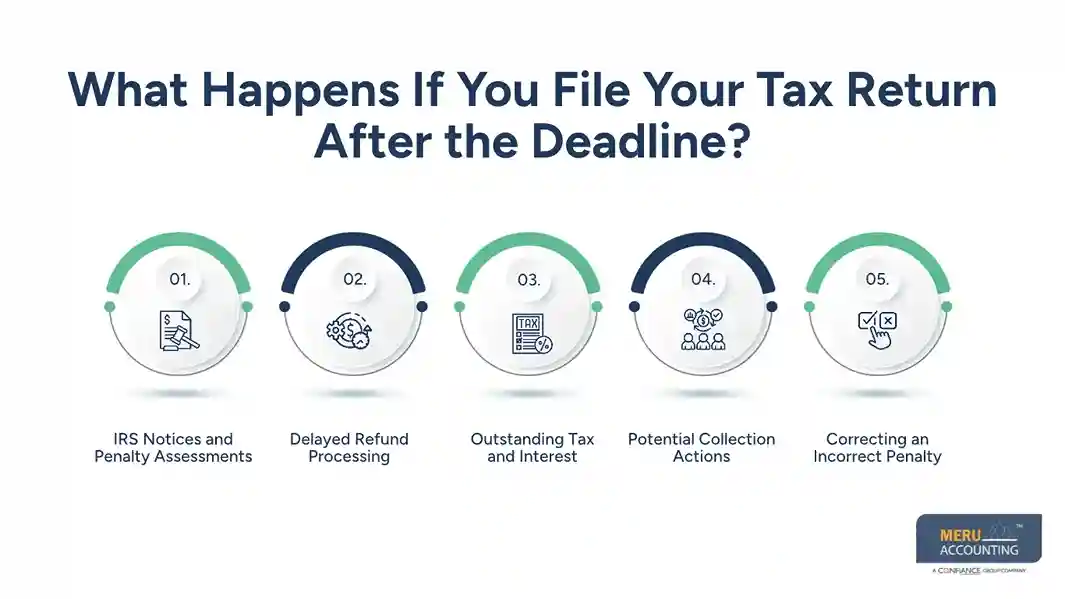
IRS Notices and Penalty Assessments
The IRS may send a notice explaining an unpaid balance, penalty or interest charge. Review the notice against your return and payment records. If the figures are incorrect, contact the IRS using the details provided.
Delayed Refund Processing
The IRS must process your return before issuing a refund. Errors, missing documents and identity checks may increase processing time. Check the official refund status service after submitting your return.
Outstanding Tax and Interest
Unpaid tax can attract late-payment penalties and daily-compounded interest. Filing the return does not clear the balance. Pay what you can and review available payment arrangements.
Potential Collection Actions
If taxpayers ignore IRS notices and leave balances unpaid, the agency may take collection action. Depending on the case, this may include a federal tax lien or levy.
Correcting an Incorrect Penalty
If you believe the penalty for filing taxes late was assessed incorrectly, compare the IRS calculation with your return, payment records and credits. Follow the notice instructions to request a review.
Exceptions and Relief From IRS Late Filing Penalties
The IRS offers relief in certain situations. However, taxpayers must meet the applicable conditions and may need to provide evidence explaining the delay.
First-Time Penalty Abatement
Eligible taxpayers may qualify for First-Time Penalty Abatement to reduce or remove the penalty for filing taxes late. Generally, they must have a clean penalty history for the previous three tax years, have filed required returns and have paid or arranged to pay the tax.
Reasonable Cause
Reasonable cause relief may apply when circumstances beyond a taxpayer’s control prevent timely filing. Serious illness, fire, natural disasters and inability to obtain essential records may qualify, depending on the facts.
Tax Filing Extensions
Individuals can generally request an automatic six-month extension using Form 4868. For most calendar-year individual returns, the usual filing deadline is April 15, with an extended deadline of October 15. The extension does not extend the time to pay.
Disaster-Related Tax Relief
The IRS may postpone filing and payment deadlines for taxpayers affected by certain federally declared disasters. The revised dates depend on the affected location and tax obligation, determining whether taxpayers qualify for relief from the penalty for filing taxes late. Check official IRS announcements before claiming relief.
Requesting Penalty Relief
Taxpayers who receive an incorrect penalty notice should contact the IRS and provide supporting records. Explain the reason for the delay and request the relief that applies to their circumstances.
Why Businesses Choose Meru Accounting for Tax-Related Financial Record Management
Meru Accounting provides accounting, bookkeeping, payroll and financial reporting services to businesses operating in the USA and other markets. Our services focus on maintaining accurate financial records and keeping business transactions properly classified for tax reporting.
Businesses can rely on Meru Accounting for:
- Accounting and bookkeeping: Recording business income, expenses and financial transactions under the correct accounts.
- Account reconciliation: Reviewing bank statements and account balances to identify missing entries and reporting differences.
- Payroll record management: Maintaining wage, salary, withholding and payroll expense records for accurate reporting.
- Expense classification: Categorising business expenses and maintaining clear transaction records for financial review.
- Financial reporting: Preparing income statements, balance sheets and other financial reports to present the business’s financial position.
- Tax record preparation: Organising relevant financial information and payment records for tax preparation and reporting to reduce filing delays and the risk of a penalty for filing taxes late.
With these services, Meru Accounting maintains structured financial records that give businesses a clear view of their transactions, tax obligations and financial information relevant to understanding the penalty for filing taxes late.
Our Expert Perspective
The first step in reviewing a late return and understanding the penalty for filing taxes late is to compare the final tax liability with withholding, estimated payments and refundable credits. This establishes whether any tax remains unpaid.
In our view, taxpayers should not delay filing simply because they expect a refund. Accurate payment records, timely submission and a review of IRS notices are important parts of sound tax record management.
Key Takeaways
- The standard penalty for filing taxes late generally applies when unpaid tax remains after the deadline.
- Taxpayers expecting a genuine refund usually do not owe the standard failure-to-file penalty.
- The usual failure-to-file rate is 5% per month, up to 25%.
- The standard failure-to-pay rate is 0.5% per month.
- Interest on unpaid tax compounds daily.
- An extension provides extra time to file, not extra time to pay.
- Eligible taxpayers may request First-Time Penalty Abatement or reasonable cause relief.
FAQs
No, the IRS generally does not charge a failure-to-file penalty if your tax payments and eligible credits cover your full tax liability.
You can generally claim a refund within three years of filing the original return or two years after paying the tax, whichever period is later.
Yes, you can generally receive your eligible tax refund after filing late, provided you meet the IRS refund claim deadline and other requirements.
No, the IRS generally does not charge interest for late filing when you have no unpaid tax balance.
The standard failure-to-file penalty generally does not apply if you owe no federal income tax, but your refund claim remains subject to the legal time limit.
optional anymore
on running the business