
Financial management has come a long way in the last few years. Most firms no longer rely only on manual bookkeeping, sheets, or basic accounting tools. Now, they want fast reports, better plans, fewer errors, and more control over how they use and track money. This is where accounting and AI come in to help firms use their financial work in a smarter way.
Artificial intelligence helps accounting teams work with large sets of financial data, find key trends, cut down manual work, and help staff make good choices. In place of recording in rows of data for hours, finance teams can spend more time on plans, goals, and long-term growth.
From new firms to large ones, many now use accounting tools with AI-based features to make work more accurate and save time each day. As new tech keeps getting better, firms that use these tools can stay one step ahead of the rest.
In this blog, you will learn how accounting and AI are changing the way firms handle money, the main benefits they can get, and why skilled staff with smart tools lead to much better results.
What You Will Learn From This Blog
- Learn what accounting and AI mean in the way firms work now.
- See why more firms are using AI-based accounting tools.
- Learn how artificial intelligence helps make financial work better.
- Know the top gains for firms of all sizes.
- Find out which fields gain the most from AI-based accounting.
What Is Accounting and AI?
Accounting and AI means using skilled accounting work with smart tools that help do, check, and make financial work better.
Old-style accounting is about keeping track of sales, bills, tax work, and key reports while making sure the firm meets all tax and law rules. Artificial intelligence adds more help by letting smart tools do jobs that once took a lot of time and care from people.
These AI-based tools can help with:
- Automated entries
- Cost sorting
- Bank reconciliation
- Fraud checks
- Financial plans
- Cash flow plans
- Risk checks
- Smart reports
AI does not take the place of an accountant. It takes care of the same tasks that come up each day so staff can check data, fix financial issues, and help lead the firm with sound advice.
Why Firms Are Using Accounting and AI
Firms deal with a huge amount of financial data each month. Doing all this work by hand takes time and makes errors more likely. That is why more firms now use accounting and AI to make financial work much easier, faster, and more accurate.
Some of the top benefits are below:
Better Accuracy: Manual entry can lead to small but costly errors. AI can read bills, bank files, and sales slips on its own, which helps cut down on human mistakes.
Faster Accounting: Jobs that once took hours can now take just a few minutes. This helps teams close the books much faster and build reports with less waiting.
Live View of Finances: Firm owners no longer have to wait for the month-end to know where they stand. AI-based accounting tools give live data so they can see how the firm is doing at any time.
Better Choices: Artificial intelligence looks at financial trends and points out key facts that help firm owners make wise and well-timed choices.
Lower Costs: When AI takes on day-to-day accounting jobs, staff spend less time on repeat work. This helps cut costs and lets the team get more done.
Better Compliance: AI helps find lost files, odd deals, and report gaps long before they turn into big and costly issues.
Key Ways Accounting and AI Improve Financial Management
When firms use accounting and AI as one, they can automate almost all parts of financial management. Here are some of the top ways these tools help.
Automated Bookkeeping
Bookkeeping means keeping track of day-to-day deals. AI can pull data from bills, sales slips, bank files, card payments, and other tools on its own. In place of keying in each deal by hand, the accounting team checks and signs off on the data that AI has saved. This saves time, cuts down on errors, and keeps books in good shape.
Smarter Cost Tracking
Keeping track of costs gets much easier with artificial intelligence.
AI can:
- Read sales slips
- Sort costs
- Find the same claim more than once
- Match costs with firm rules
- Spot odd use of funds
This helps firms keep a close watch on costs and spend less.
Faster Bill Handling
Going through bills by hand can slow down day-to-day work.
AI can:
- Pull bill data
- Check seller data
- Match bills with [purchase orders
- Set pay dates
- Cut down on errors
This helps the payables team work faster and build good ties with sellers.
Better Cash Flow
Cash flow is still one of the top tests for firms that want to grow. By using past financial data, artificial intelligence can help guess how much cash may come in and go out in the days or weeks ahead. This lets firms spot cash gaps early and act well in time. Good cash flow plans help keep the firm in good shape.
Better Financial Plans
Old ways of making financial plans often lean only on past data.
AI looks at much more data, such as:
- Sales trends
- Buyer habits
- Time-of-year sales
- Market trends
- Firm results
This helps build more accurate financial plans and gives firm heads a much better base for the next step.
Fraud Checks
Fraud can lead to a big cash loss for any firm.
Artificial intelligence keeps a close watch on financial deals and can spot signs that may point to fraud.
These may be:
- The same bill was paid two times
- Odd seller use
- Strange spend
When firms find these signs early, they can stop losses and lower risk.
Automated Reports
Making financial reports by hand takes a lot of time.
AI can build:
- Profit and loss reports
- Balance sheets
- Cash flow reports
- Budget reports
- Financial dashboards
This gives owners all the facts they can use to make good and quick choices.
Better Tax Work
Tax work gets much easier when financial files stay neat all year.
AI helps:
- Keep tax files in one place
- Track tax write-offs
- Find lost data
- Cut down on filing errors
The accounting team still checks all tax work, but AI helps make the job much faster and more right.
Stronger Financial Review
One of the best parts of artificial intelligence is how fast it can study huge sets of financial data.
AI can find:
- Sales trends
- Profit shifts
- How fast buyers pay
- Cost jumps
- Risk to the firm
These facts help firms make smart moves, fix weak spots, and keep work on the right path.
Industries That Gain the Most from Accounting and AI
Almost all kinds of firms can gain from accounting and AI, but some fields see even more value because they deal with large amounts of financial data each day.
Health Care
Health care groups deal with bills, claims, payments, and compliance. AI helps make billing more accurate while also helping firms stay in line with the laws.
Retail
Retail firms deal with a high number of sales each day. AI helps with stock costs, sales plans, cost checks, and profit review.
Manufacturing
Makers use AI to help with:
- Cost checks
- Stock control
- Work plans
- Seller pay
These tools help make financial plans much stronger.
Professional Services
Law firms, tax firms, ad firms, and other service firms use AI to help with client bills, job costs, payments, and financial reports.
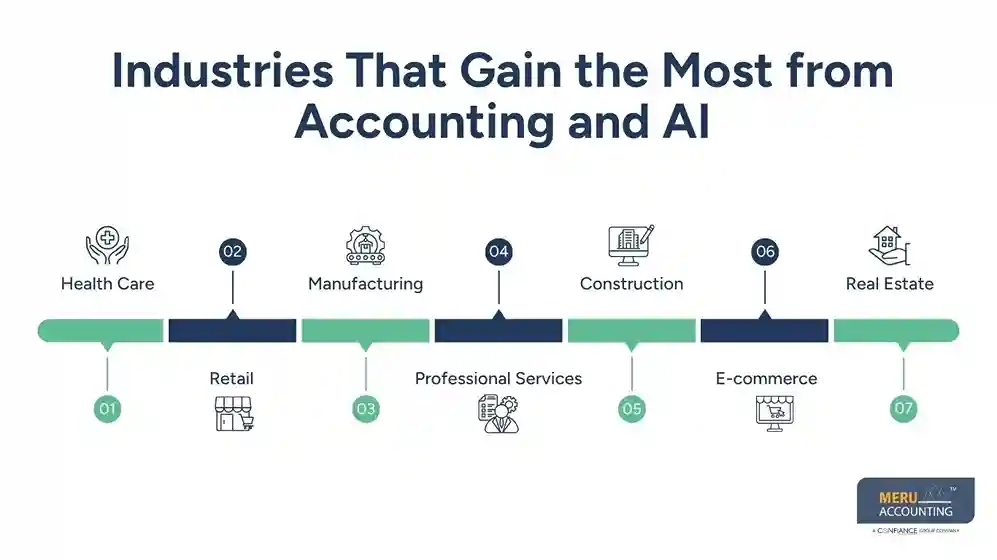
Construction
Construction firms often run many jobs at the same time. AI helps track job costs, watch spend, pay crews, and see how much each job earns.
E-commerce
Web-based firms deal with large sales from many sites. AI helps match payments, track sales, maintain inventory, and help with tax work.
Real Estate
Real estate firms use AI to help with rental records, cost checks, financial reports, and cash flow plans.
How Meru Accounting Helps Businesses Use Accounting and AI
The best results come when smart tools work with skilled people. At Meru Accounting, we help firms use accounting and AI to automate financial management.
Our team brings years of accounting knowledge and pairs it with AI-based tools to make financial work easy while still keeping high work standards and compliance.
Our accounting and AI services include:
- Automated bookkeeping
- AI-based financial reports
- Bank reconciliation
- Bills payable and receivable
- Payroll
- Financial plans
- Cash flow management
- Taxation
- Cloud accounting
- Financial reports for leaders
We know that each firm has its own financial needs. That is why our team works side by side with each client to set up smart accounting tools that fit the day-to-day work and help the firm run better.
If you run a new firm, a small shop, or a fast-growing business, Meru Accounting helps you use new tools while still giving you the one-on-one care, skill, and help your firm needs.
Our Expert Insight
Artificial intelligence is changing how firms handle money, but good financial management still needs skilled people. AI can work with data much faster, spot key trends, and take care of day-to-day tasks. At the same time, accountants use their skills to guide firms, meet tax and law rules, solve complex financial issues, and help make smart plans. When firms bring accounting and AI together, they gain more trust in their data, keep better control of cash, and make sound choices that help them grow for years to come.
Key Takeaways
- Accounting and AI help firms make financial management faster, easier, and smarter.
- Artificial intelligence reduces manual work while making financial data more accurate.
- AI helps with bookkeeping, cash flow plans, reports, fraud checks, tax work, and cost tracking.
- Firms get live financial data that helps them make good and fast choices.
- Healthcare, retail, manufacturing, construction, professional services, real estate, and e-commerce firms all gain from AI-based accounting.
- The best results come from using AI with the skill and care of trained accountants.
FAQs
Accounting and AI combine professional accounting with artificial intelligence to automate financial tasks, improve reporting, analyze financial data, and support better financial decisions.
Artificial intelligence helps automate bookkeeping, invoice processing, bank reconciliation, expense tracking, fraud detection, and financial reporting to improve accuracy and efficiency.
No. AI automates routine accounting tasks, but accountants are still essential for tax planning, compliance, financial strategy, and business advice.
Businesses of all sizes benefit from accounting and AI, especially those in retail, healthcare, manufacturing, construction, e-commerce, professional services, and real estate.
Yes. Accounting and AI help small businesses reduce manual work, improve financial accuracy, manage cash flow, save time, and support long-term growth.