
Scaling an architecture practice is not just about increasing projects or hiring more staff. It also depends on how strong the financial system is from the start. Accounting for architecture firms helps owners clearly see project costs, profit levels, and overall financial stability.
Without proper tracking, growth often leads to cash flow issues, missed expenses, and poor pricing decisions. While design quality and client work are important, financial clarity is equally necessary for steady growth.
Strong accounting for architecture firms ensures every project is tracked from start to finish, so owners know which work is actually profitable. This reduces risk when the firm expands.
In this blog, we will explain how accounting systems affect growth, why traditional methods fail in this field, and how modern practices improve control. We will also look at common mistakes firms make while scaling and how better accounting for architects supports smarter decisions.
What You Will Learn From This Blog
- How financial tracking impacts growth and profit stability in architecture firms
- Why traditional accounting methods often fail in project-based work
- How accounting for architecture firms improves cost control and pricing decisions
- The role of accounting for architects in managing project-based income
- Common mistakes firms make while scaling their operations
- How modern tools improve financial clarity and reduce manual work
- Best practices for managing direct and indirect costs in design firms
- How professional support can improve long-term financial control
Introduction To Accounting For Architecture Firms
Architecture firms work on project cycles rather than fixed production systems. This means the financial structure must follow a project-based approach where each project has its own cost view and outcome tracking. Without this structure, it becomes difficult to understand how money is actually moving within the firm.
Each design project has different needs in terms of time, labor, and resources. This is why structured tracking is important in accounting for architecture firms, as it clearly shows which projects are profitable and which ones are not.
Time also plays a major role in this process, since untracked hours often lead to incorrect profit calculations and unclear performance results. A clear financial setup also requires proper cost segmentation.
Separating labor, software, consultant fees, and overhead expenses gives better visibility into spending patterns across projects. When these systems are set up early, it becomes more stable during growth and allow firm owners to scale without losing control over financial outcomes.
Why Accounting For Architecture Firms Impacts Long-Term Growth, Profitability, And Operational Stability
Clear Project Cost Visibility
Strong accounting for architecture firms gives clear visibility into each project’s cost. This includes labor, design hours, materials, and external services. Without this clarity, firms often underprice projects and lose profit without realizing it.
Better Pricing Decisions
When financial data is accurate, pricing becomes more stable and realistic. Accounting for architects helps owners understand the true cost of design work before setting client fees. This reduces under-quoting and improves profit margins.
Cash Flow Stability
Architecture firms often face delayed payments. Proper financial tracking helps monitor receivables and plan cash flow in advance. This ensures salaries and overhead costs are managed without pressure.
Stronger Growth Planning
With clean financial records, firms can plan expansion with more confidence. It gives insight into which project types generate steady income and which ones create financial stress.
Risk Reduction In Scaling
Poor financial tracking increases risk during growth. Structured systems reduce surprises by highlighting cost leaks early and improving control over project budgets.
Why Traditional Accounting Methods Don’t Work For Architecture Firms
Lack of Project-Level Tracking
Traditional systems often focus only on total income and expenses. This leads to unclear profit analysis because individual project performance is not separated or measured properly.
No Time-Based Cost Allocation
Architectural work depends heavily on time. Without time tracking, accounting for architects cannot show true labor cost per project, leading to inaccurate profit reports.
Delayed Financial Reporting
Manual methods often result in delayed reports. This slows decision-making and weakens control in accounting for architecture firms, especially when multiple projects run together.
Poor Expense Classification
Traditional systems mix different costs together. Proper separation of direct and indirect expenses makes it easier to understand real project performance.
Limited Scalability
As firms grow, manual accounting becomes harder to manage. Structured systems are needed to handle multiple projects without confusion or data gaps.
Project-Based Financial Management in Accounting For Architects
Tracking Income Per Project
Each project should be tracked separately from start to finish. Revenue links directly to specific work for clear financial understanding across all stages.
Monitoring Labor Costs
Labor is a major cost in design work across firms. Time-based costing helps firms understand the real effort behind each job more accurately.
Managing Vendor Payments
External consultants and vendors must be tracked per project. Strong accounting for architecture firms keeps these expenses organized and transparent.
Budget Vs Actual Analysis
Comparing planned and actual costs is key. Structured financial tracking helps identify where projects go over budget and why those deviations occur.
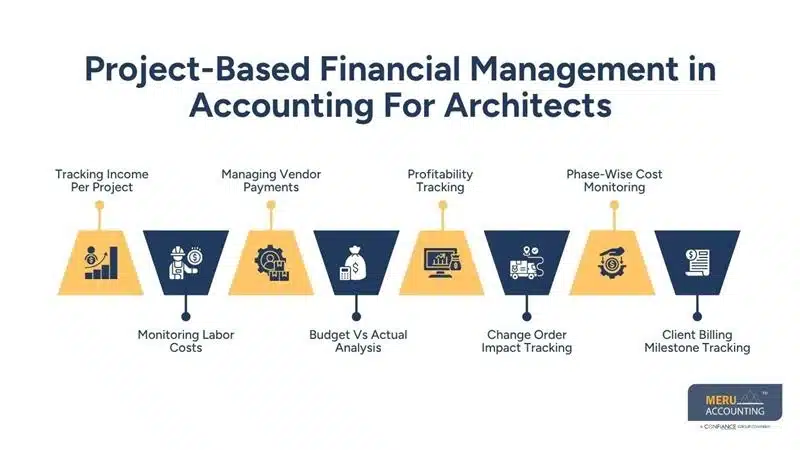
Profitability Tracking
Each project should clearly show the final profit after completion. This clarity helps firms decide which project types should be expanded further.
Change Order Impact Tracking
Design projects often change during execution, affecting total costs. Tracking changes separately helps firms understand cost impact and protect profit margins during adjustments.
Phase-Wise Cost Monitoring
Breaking projects into phases improves cost control across stages. This approach prevents unexpected overruns and keeps financial tracking aligned with project progress timelines.
Client Billing Milestone Tracking
Billing linked to milestones ensures steady cash flow throughout projects. It also aligns income recognition with actual work completion for better financial discipline overall.
How Accurate Tracking Helps Determine True Project Profitability And Improves Decision-Making
Real Cost Identification
Without accurate tracking, hidden costs often remain unnoticed. Detailed records reveal the complete cost structure of each project clearly.
Improved Resource Allocation
Firms can assign staff more effectively across different projects. Tracking time shows where resources are used and whether efforts create value.
Better Client Selection
Profit data allows firms to choose suitable clients and projects. Past results show which work types provide better financial outcomes.
Reduced Financial Leakage
Small untracked costs add up over time. Accounting for architects reduces this leakage by improving expense tracking accuracy.
Long-Term Strategic Planning
Clear financial data supports better planning. Accounting for architecture firms gives direction for future growth decisions.
How Modern Tools And Automation Improve Efficiency In Accounting For Architecture Firms
Automated Expense Tracking
Modern tools reduce manual entries and save valuable working time. Accounting for architecture firms becomes faster and more accurate through automation.
Time Tracking Integration
Digital tools track billable hours and project-related activities. Structured financial systems benefit from real-time labor cost recording.
Real-Time Financial Reports
Firms receive instant reports instead of waiting for updates. Quick data access allows owners to make better financial decisions.
Cloud-Based Access
Teams access project data from different locations without delays. This keeps financial information available whenever the firm requires it.
Error Reduction In Data Entry
Automation reduces mistakes during regular financial record updates. Accurate entries create reliable reports and maintain better information.
Best Practices For Managing Direct and Indirect Costs in Architecture Firms
Separate Cost Categories
Direct and indirect costs must be tracked separately. Clear classification maintains accuracy across all financial records.
Monitor Overhead Expenses
Office rent, software, and admin costs must be controlled. Accounting for architects ensures these do not exceed budget limits.
Track Project Specific Costs
Each project should carry its own cost sheet. Accounting for architecture firms improves transparency in project spending.
Regular Financial Reviews
Monthly reviews help identify issues before they grow. Frequent checks create better control over financial activities.
Use Standard Costing Methods
Standard methods create consistency across financial processes. Structured practices support reliable reporting and better cost management.
Common Accounting Mistakes Architecture Firms Make While Scaling
Mixing Personal And Business Costs
Many firms fail to separate expenses properly during daily operations. Accounting for architecture firms must keep personal and business costs fully separate for accurate financial records.
Ignoring Time Tracking
Without tracking time, accounting for architects cannot show real project costs, leading to incorrect profit data. Missing time records can make labor costs appear lower than actual project expenses.
Weak Invoice Management
Delayed or missed invoices affect cash flow. Strong invoice management ensures timely billing. Poor invoice tracking may create payment delays and impact daily business operations.
Poor Expense Planning
Unexpected costs often appear during scaling. Proper planning helps manage expenses in advance. A clear expense plan allows firms to control spending and avoid unnecessary financial pressure.
No Project Profit Review
Firms often skip project-level analysis. Regular profit checks are important for better control. Reviewing project results helps identify profitable work and improve future planning.
How Meru Accounting Supports Architecture Firms
Meru Accounting provides structured financial support designed for design and construction-based businesses. We focus on improving accounting for architecture firms with clear systems that track every project stage.
Our team works closely with firms to improve accounting for architects by setting up accurate cost tracking, time allocation systems, and reporting formats. This helps owners understand real profit per project.
We also provide support in cash flow planning, payroll management, and expense classification. With our approach to accounting for architecture firms, firms gain better control during scaling and reduce financial confusion.
Our services are built for firms that want clear financial direction while focusing on design quality and client delivery.
Our Expert Perspective
Across our experience working with architecture firms, a common pattern is that while design expertise is strong, financial systems are often not fully structured during early growth stages.
When accounting for architecture firms is set up strategically from the beginning, it enables better control over pricing, hiring, and project selection while improving visibility into overall financial performance.
Firms that adopt structured accounting for architecture practices are consistently better positioned to manage cash flow, reduce financial uncertainty, and achieve more stable, long-term growth.
Key Takeaways
- Strong financial tracking is essential before scaling
- Project-based systems are better than traditional methods
- Accounting for architecture firms improves profit clarity
- Accounting for architects supports better cost control
- Automation reduces errors and saves time
- Clear expense tracking prevents financial leaks
- Proper systems support long-term stability
FAQs
Accounting for architecture firms helps track project costs, income, and profit clearly. Owners can understand financial performance better before scaling their operations.
Accounting for architects focuses on project-based tracking instead of only total income and expenses. The process includes time and cost allocation for each project.
Main challenges include unclear cost tracking, delayed billing, and poor expense control. Strong financial systems solve these issues and improve project management.
Small firms can benefit from structured financial systems and project tracking. Structured financial practices help teams understand project profitability from the early stages.
Proper financial tracking provides clarity for better decision-making during growth. Accounting for architecture firms reduces risk and supports stable business expansion.