
Architecture firms deal with long projects that can last for many months or even years. Unlike firms that sell goods and get paid at once, design firms often work through many project stages before they receive full payment. This can make it hard to track costs, bill clients, and know how much income has truly been earned. Two key parts of firm finance are work-in-progress (WIP) and revenue recognition. Both help firms see where a job stands from a monetary view. When these areas are not managed well, firms may face cash flow issues, weak reports, and poor planning. A skilled architecture accounting service helps firms keep track of project costs, labor time, billing, and earned income.
With clear and up-to-date records, people in the architecture business can make smart choices and keep projects on track. In this blog, we will see how an architecture accounting service can help a firm in managing WIP and revenue recognition.
What You Will Learn From This Blog
In this blog, you will learn:
- What does WIP mean in an architecture firm
- Why WIP tracking matters for profit
- How revenue recognition works in project work
- How an architecture accounting service helps manage both areas
- The value of expert accounting for architects
Understanding Work-in-Progress (WIP) in Architecture Firms
Work-in-progress, or WIP, is the value of work that has been done but has not yet been billed or booked as income. Most architecture jobs move through many stages. These may include site study, design work, plan drafts, permit sets, and project support. As the team goes through these steps, the firm spends money on labor, tools, external help, and other project costs.
Each hour spent on a project adds value. Until that value is billed or booked as income, it stays in WIP.
For architecture firms, WIP tracking often includes:
- Time spent on jobs
- Labor costs
- External consultant fees
- Project costs
- Work done but not billed
- Work billed but not yet earned
A good WIP process gives firm owners a clear view of project health. It helps them know if jobs are moving as planned and if costs stay within budget.
Why Accurate WIP Tracking Matters for Profitability
WIP is much more than a report. It is a tool that helps firms see how projects are doing.
Many firms only look at money that comes in through client bills. While that is useful, it does not show the full story. A project may seem fine on paper while costs are growing too fast behind the scenes.
Good WIP tracking helps firms in many ways. Here are some of them:
Helps Find Cost Issues Early
When firms review WIP often, they can spot cost growth before it becomes a large issue. This gives teams time to make changes and protect profit.
Shows Real Project Profit
WIP helps firms compare project costs with earned income. This makes it easier to see which jobs bring strong returns and which may need more attention.
Improves Cash Flow Plans
Work that has been done but not billed can affect future cash flow. WIP reports help firms know when to bill clients and when cash may come in.
Supports Better Decisions
With clear WIP data, firm leaders can make smart choices about staffing, project loads, and growth plans.
Strong WIP control is a key part of accounting for architects because it helps firms protect both profit and cash flow.
Revenue Recognition in Architecture Projects Explained
Revenue recognition is the process of deciding when income should be recorded. For architecture firms, this can be more complex than it is for firms that sell products. Most design projects take time to finish. As a result, income is often earned over many months.
Revenue recognition helps match earned income with work that has been done.
A few factors affect this process:
- Job scope
- Project length
- Client terms
- Billing plans
- Project progress
- Change requests
Many firms use a method based on project progress. Under this method, income is booked as work is completed.
For example, if half of a project is done, the firm may book half of the project income even if the client has not yet paid the full amount.
This gives a better view of firm performance.
Good revenue recognition helps firms:
- Create clear reports
- Track true income
- Plan for growth
- Improve cash flow forecasts
- Support sound business choices
When income is booked at the wrong time, reports can become misleading. This may lead to poor planning and weak financial control.
How an Architecture Accounting Service Improves WIP Management
Managing WIP by hand can take a lot of time. It can also lead to errors, especially when a firm has many active jobs. A skilled architecture accounting service helps firms build a strong process for project tracking and reporting.
Tracks Project Costs
Each project has costs tied to labor, software, travel, permits, and external support. A good accounting team tracks these costs and links them to the right job.
This helps firms know the true cost of each project.
Tracks Labor Time
Labor is often the highest cost in an architecture firm.
An architecture accounting service helps record staff hours and place those costs in the right project. This creates more exact job reports and helps firms see where time is spent.
Creates Useful WIP Reports
Clear WIP reports help firm leaders see:
- Work done
- Income earned
- Bills sent
- Costs incurred
- Job profit
These reports make it easier to manage projects and improve results.
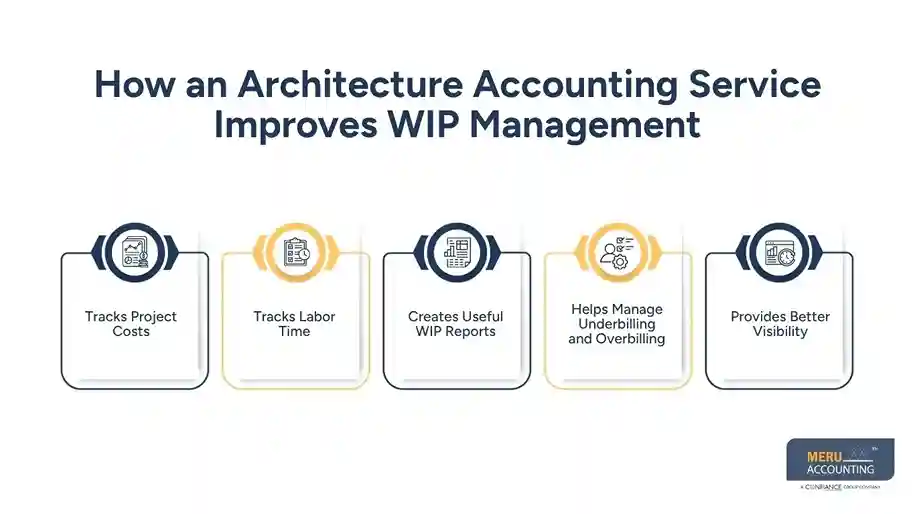
Helps Manage Underbilling and Overbilling
Underbilling happens when work has been done but not billed. Overbilling happens when bills sent are more than the work earned.
Both can affect reports and cash flow. A strong accounting process helps firms find and fix these issues early.
Provides Better Visibility
A good architecture accounting service gives firms timely reports and useful data. Leaders can see project status at any time and make choices based on facts rather than guesswork.
Key Benefits of Professional Accounting for Architects
Architecture firms face many project-based finance issues. This is why expert accounting for architects can add great value.
- More Accurate Records: Clear records help firms avoid mistakes and keep reports reliable.
- Better Project Control: Project leaders can use financial data to watch costs and improve project results.
- Stronger Cash Flow: Good accounting helps firms manage bills, payments, and client invoices in a more organized way.
- Better Income Tracking: Expert support helps firms record income at the right time and keep reports accurate.
- Easier Growth: As firms take on more work, finances become more complex. Strong accounting systems help firms grow with less stress.
- Less Admin Work: When accounting tasks are handled by experts, internal teams can spend more time on design work and client service.
- Better Planning: Accurate reports help owners make smart choices about hiring, growth, budgets, and future goals.
These benefits show why many firms invest in professional accounting for architects as part of their long-term growth plans.
Meru Accounting's Architecture Accounting Service
At Meru Accounting, we know that architecture firms have unique project needs. Project costs, labor tracking, billing, and income reporting all require close attention.
Our architecture accounting service is built to help firms gain better control over project finances and improve reporting accuracy.
Our services include:
- Bookkeeping
- WIP tracking
- Revenue recognition support
- Project cost tracking
- Payroll services
- Accounts payable management
- Accounts receivable management
- Cash flow reporting
- Budget monitoring
- Financial reports
We work with architecture firms to build workflows that fit their daily operations.
Our team helps clients track project costs, review WIP, manage billing, and maintain accurate records. We focus on making financial data easy to understand and useful for decision-making.
With Meru Accounting, firms gain access to professionals who understand accounting for architects and know how to support project-based businesses.
Our Expert Insight
Many architecture firms put most of their focus on design work and client needs. While these areas are important, financial control should not be overlooked.
One issue we often see is a gap between project progress and financial reports. Work may be completed, but income may not be tracked correctly. In other cases, firms delay billing or struggle to see which projects make money.
The firms that perform best review WIP often and keep a close watch on project costs. They use financial data as a tool for growth rather than just a reporting requirement.
A trusted architecture accounting service helps turn project data into useful business insights. This helps firms improve profit, strengthen cash flow, and make better choices for the future.
Key Takeaways
- WIP is work that has been done but not yet billed or booked as income.
- WIP tracking helps firms understand project performance.
- Revenue recognition records income when it is earned.
- An architecture accounting service helps firms track costs and project progress.
- Expert accounting for architects improves reporting and cash flow.
- Strong WIP and revenue recognition processes support better business decisions.
FAQs
WIP is the value of work completed on a project that has not yet been billed or recorded as income.
It helps firms record income when it is earned, which creates more accurate financial reports.
An architecture accounting service tracks costs, labor, billing, and project progress to provide clear WIP reports.
Common issues include cost tracking, project billing, cash flow management, WIP control, and revenue recognition.
Meru Accounting provides bookkeeping, WIP management, revenue recognition support, project tracking, and other accounting services built for architecture firms.