
The need for accounting for consulting business has increased as service-based firms now handle complex billing, time-based work, and detailed project costs.
Many consulting firms work with multiple clients at the same time, manage remote teams, and follow fast payment cycles, which makes financial tracking more detailed than before. Without a clear system, profit leakage can go unnoticed, and financial planning often becomes weak and less reliable.
In the modern business environment, accounting for consulting business goes beyond recording income and expenses. It focuses on understanding project value, client margins, and cash flow timing in a structured way.
Firms that lack this clarity often face delayed payments, incorrect pricing, and slower growth decisions. While modern tools like AI accounting software are changing how records are managed, strong financial practices remain the foundation for accurate reporting, better control, and stable financial decision-making.
What You Will Learn From This Blog
- Why accounting for consulting business is important for service firms
- How consulting firms manage income, cost, and billing cycles
- Role of AI accounting software in modern financial tasks
- How financial structure impacts growth and profit
- Key tools and features used in consulting finance systems
- How Meru Accounting supports consulting firms with clear systems
Importance of Specialized Financial Management For Consulting Firms
Client-Based Revenue Tracking
Consulting firms earn from multiple clients at the same time. This is where accounting for consulting business plays a key role by helping track each client’s income separately, so firms can clearly see which client adds value and which does not.
Time And Cost Accuracy
Most consulting work is based on hours. Proper tracking ensures that every billable hour is recorded with accuracy. This avoids income loss and improves cost clarity across projects.
Project Level Control
Each project has different cost needs, like tools, staff time, and travel. This helps leaders group and review project-wise profit in a structured way.
Better Cash Flow Understanding
Delayed payments are common in consulting work. Strong financial systems help track due payments and reduce gaps in cash flow management.
Simple Compliance Handling
Tax rules and service invoices must be clear. With proper financial tracking, firms reduce errors in reporting and stay ready for audits.
How Accounting For Consulting Business Impacts Growth And Profitability
Clear Profit Measurement
Firms can only grow when profit is clearly visible after all project costs are accounted for. Structured accounting helps identify actual profitability at both client and project levels.
Better Pricing Decisions
When project costs and time investments are accurately tracked, firms can set pricing that reflects real effort and value. This improves margin control and reduces underpricing risks.
Strong Budget Control
Budgets become more reliable when financial tracking is consistent across all consulting projects. This ensures spending aligns with planned limits and avoids unnecessary cost overruns.
Reduced Financial Errors
Structured accounting systems minimize manual inconsistencies in financial records, leading to more reliable reporting and better financial confidence. Monthly closing processes become faster due to fewer discrepancies in financial data.
Growth Planning Support
Accurate financial visibility allows firms to evaluate hiring needs, expansion opportunities, and resource allocation with greater precision. Long-term planning becomes more stable when financial performance trends are clearly documented across multiple projects.
Understanding the Unique Financial Structure of Consulting Businesses
Multi-Client Income Streams
Consulting firms handle income from multiple clients every month. Revenue flows across different service agreements within structured consulting operations.
Hour-Based Billing Models
Billing is often based on tracked working hours per project. Accurate time records ensure correct billing cycles and payment clarity.
Mixed Expense Types
Expenses include software, staff, and travel across multiple projects. Accounting for consulting business, supported by AI accounting software, sorts these costs into clear groups effectively.
Short Payment Cycles
Some clients pay fast, while others delay payments significantly. Payment timing gaps require careful financial monitoring across projects.
Variable Project Costs
Each project has different needs and cost structures overall. Proper tracking matches expenses with each project in detail.
Why Accounting For Consulting Business is Transforming With AI Tools in Service-Based Firms
Automation Of Daily Records
Modern tools reduce manual entry in accounting systems today. AI accounting software now handles invoice entry and simple record updates efficiently.
Faster Data Processing
Financial reports are created faster with AI-based systems. Modern tools help firms react quickly to financial changes.
Error Detection Systems
Mistakes in entries are flagged early using smart tools. This improves accuracy in financial records and reporting quality overall.
Smarter Financial Insights
AI tools study past data and show clear trends. Accounting for consulting business supports better financial decisions based on insights.
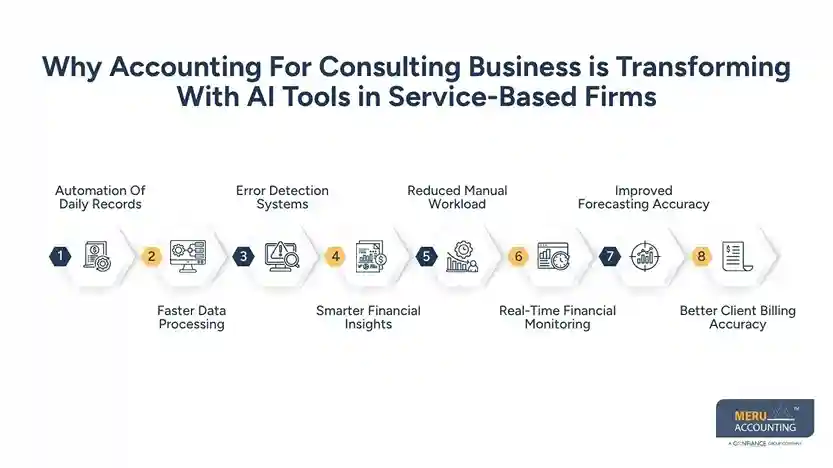
Reduced Manual Workload
Teams spend less time on entry work daily. AI accounting software allows more focus on planning and financial review tasks.
Real-Time Financial Monitoring
AI systems update financial data instantly, giving consulting firms a clear view of cash flow and project status at any moment. Managers gain continuous visibility into financial movements and project health.
Improved Forecasting Accuracy
AI tools analyze historical patterns to predict future income and expenses more accurately, helping firms plan budgets with better confidence. Forecast models become more stable and useful for long-term planning.
Better Client Billing Accuracy
Automated systems reduce billing errors by tracking billable hours and project expenses more precisely, ensuring correct and timely invoices. Billing accuracy strengthens client relationships and payment reliability.
Benefits of AI Accounting Software For Consulting Firms
- Financial data updates quickly with AI accounting software, keeping reports current for accurate business decision-making every time.
- AI tools show inflow and outflow clearly, improving overall financial accuracy across multiple consulting operations consistently.
- Invoices are generated and tracked with ease, reducing delays in billing cycles and improving payment tracking flow.
- Reports become cleaner and more structured with advanced automation tools, reducing manual mistakes in reporting processes significantly.
- Financial data can be viewed anytime, improving accounting for consulting business control for managers across all departments effectively.
Key Features to Look For in Accounting For Consulting Business Tools
Project Wise Tracking
Tools designed for accounting for consulting business must track each project separately for clear financial control. Financial clarity improves profit study across consulting operations today. Project-wise visibility reduces confusion in multi-client environments significantly.
Time Tracking Integration
Work hours must link with billing systems accurately every time. Accurate billing improves operational precision across consulting projects consistently. Better tracking ensures no billable hour gets missed easily.
Invoice Automation
Invoices should be generated automatically without manual effort required. Automation supports smooth billing flow and faster payments overall. Faster invoicing reduces delays in client settlements significantly.
AI-Based Insights
Modern tools use AI accounting software features for better analysis. Insights show trends and patterns in financial data clearly. Forecasting becomes stronger with data-driven decision support systems.
Secure Data Handling
Financial data must remain safe and well stored always. Long-term accounting for consulting business use ensures compliance and control. Strong security reduces the risk of data loss or misuse.
Easy Reporting System
Reports must stay simple and easy for quick understanding. Clear reporting improves review quality across all consulting operations. Better reports support faster and more accurate decisions daily.
How Accounting For Consulting Business Supports Scalability
Strong Financial Foundation
Growth needs clear records for long-term business stability. Stable financial systems create a strong base for expansion planning smoothly.
Hiring Decision Support
When profit becomes clear, firms can always plan hiring effectively. Strong systems guide better workforce decisions across consulting teams consistently.
Expansion Planning
New services need cost planning before execution begins carefully. Accounting for consulting business helps estimate risk before expansion carefully and accurately.
Investor Confidence
Clear reports build trust with potential investors and partners consistently. Investors rely on financial data for funding decisions.
Operational Control
As firms grow, control becomes harder across teams quickly. Structured systems keep operations organized during business scaling phases effectively.
How Meru Accounting Supports Consulting Firms
Meru Accounting provides structured support for firms that need clear financial systems. Our team works with service-based companies to manage daily records, project tracking, and reporting with care.
We focus on strong accounting for consulting business practices that help firms understand real profit and cost flow. Our experts also guide firms in using AI accounting software to reduce manual work and improve report speed.
Key support areas include:
- Clean setup of accounting for consulting business systems
- Project and client-based tracking models
- Integration with modern AI accounting software tools
- Regular financial reporting and review support
- Cost control and cash flow monitoring
Meru Accounting aims to help consulting firms maintain clear financial control so they can focus more on client work and less on record issues.
Our Expert Perspective
Consulting firms require highly structured financial systems due to multi-client operations, time-based billing, and varying project costs that can easily distort profitability if not tracked properly.
The most common financial gaps arise from weak project-level visibility and inconsistent cost allocation rather than revenue generation issues. While AI accounting software enhances speed and accuracy in processing financial data, reliable accounting practices remain essential to ensure correct interpretation, control, and long-term financial stability.
Key Takeaways
- Accounting for consulting business is important for tracking project profit and client income
- AI tools are changing how firms handle daily financial tasks
- Strong financial systems reduce errors and improve planning
- Consulting firms need project-based tracking for better clarity
- Growth decisions depend on clean financial data
- Meru Accounting helps firms build structured financial systems
FAQs
Consulting firms track income, cost, and profit from each client and project clearly for better financial control.
Project tracking, time recording, clear reporting, and easy invoice management are essential to maintain accurate financial records and ensure proper control over client and project finances.
Yes, even small firms need accounting for consulting business systems to avoid loss and confusion.
Wrong billing, missed payments, and unclear profit tracking create serious financial challenges for consulting firms.
No, they only handle routine tasks. Financial review and planning are still needed to ensure accuracy and informed decision-making.